fetching data ... 
Background: Rheumatoid arthritis (RA) is a typical autoimmune disease characterized by synovial inflammation and/or joint destruction. Since the 1980s, methotrexate(MTX) has been the primary and essential medication for RA patients. It is now widely recognized that the immunological tolerance defect caused by insufficient numbers or function of regulatory T cells (Treg) is an important factor contributing to the onset of RA. This has opened up new treatment possibilities. Numerous basic and clinical studies worldwide have demonstrated that low-dose interleukin-2 (Ld IL-2) can promote the proliferation of Treg cells in the peripheral blood of RA patients, thereby restoring immune tolerance. Then, could MTX and Ld IL-2 be used in combination to further alleviate the immune inflammation in RA patients? Unfortunately, we have not observed any relevant studies worldwide.
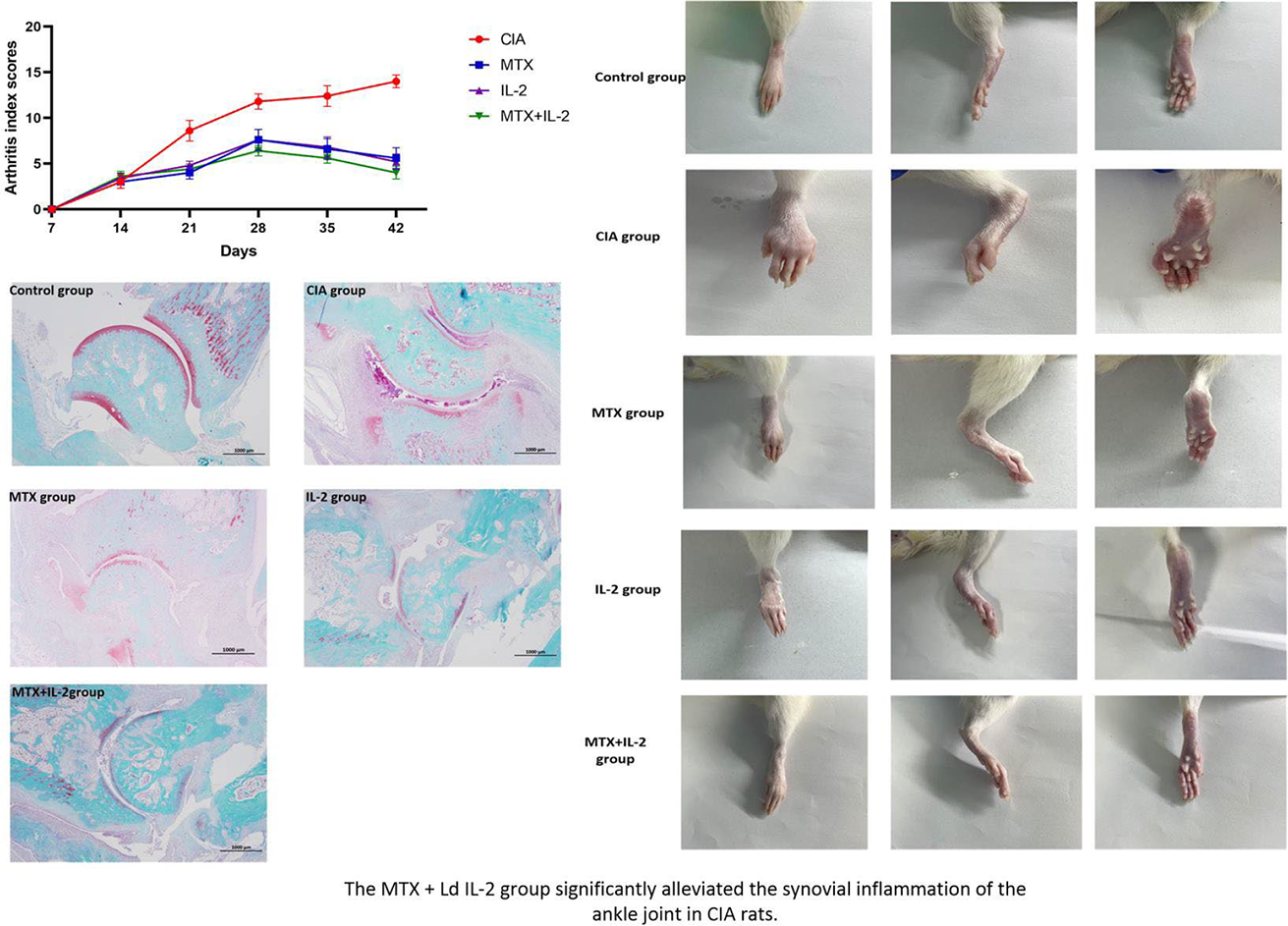
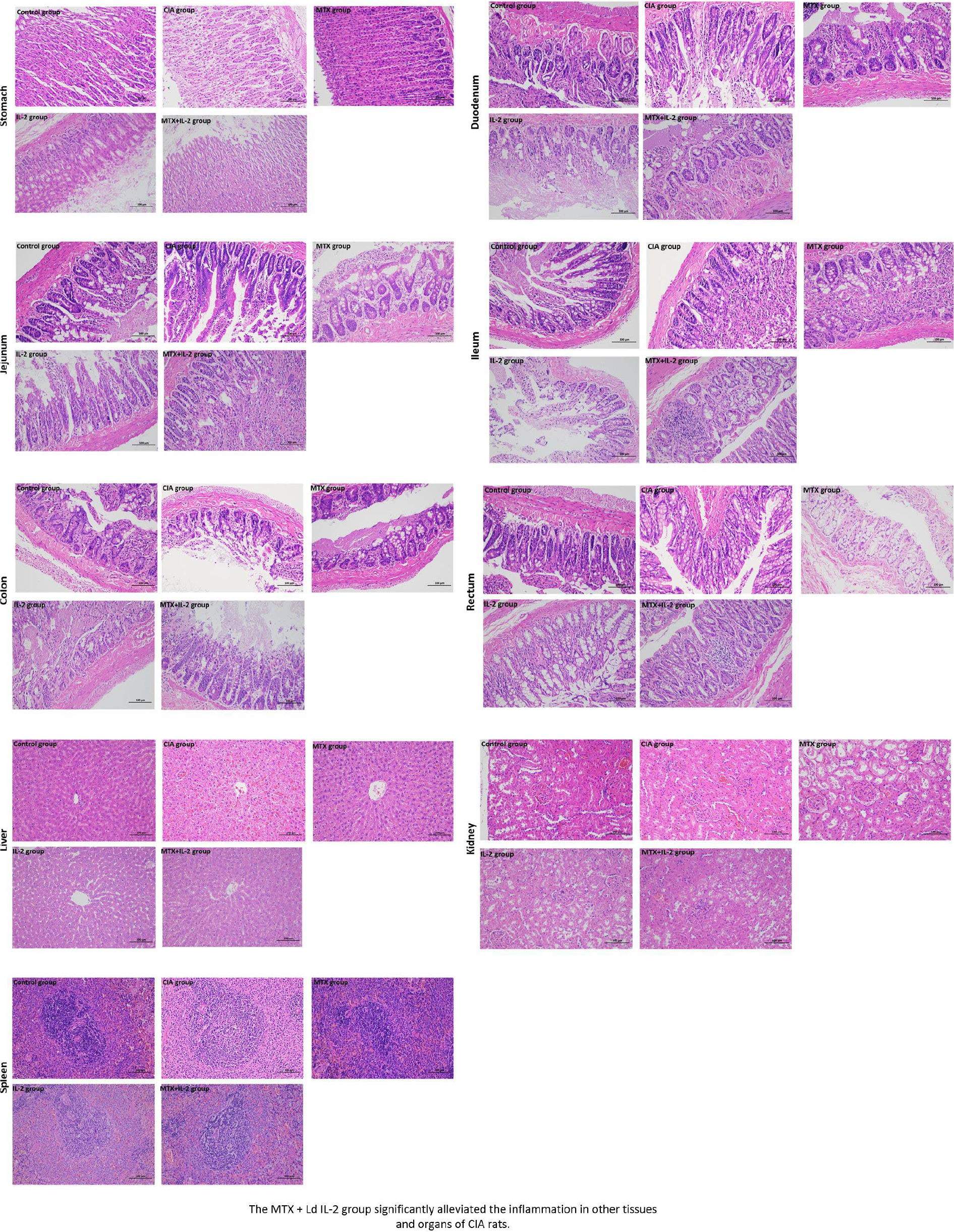
Objectives: The aim is to investigate the effect of MTX combined with Ld IL-2 on the alleviation of inflammation in the synovium and internal organs of collagen-induced arthritis (CIA) model rats (an ideal animal model for RA), particularly compared with the use of MTX alone.
Methods: The experimental animals we used were Sprague-Dawley (SD) rats, totaling 25, which were randomly divided into 5 groups, with 5 rats in each group. The CIA model was constructed by administering the first immunization to the rats on the 7th day and the second immunization on the 14th day. The groups were: control group, CIA group, MTX group, Ld IL-2 group, and MTX + Ld IL-2 group. The indicators we observed included the general condition of the rats and the joint inflammation, as well as the HE staining of rat tissues (stomach, duodenum, jejunum, ileum, colon, rectum, liver, kidney and spleen).
Results: Compared with the groups using MTX alone and Ld IL-2 alone, the combination of MTX and Ld IL-2 was more effective in alleviating the inflammation of the joints and various organs in CIA rats.
Conclusions: Compared with using MTX and Ld IL-2 alone, the combination of the two may be more effective in alleviating the immune inflammation in RA patients. This might provide some insights for certain difficult-to-treat RA patients in clinical practice.
REFERENCES: [1] Bécède M, Alasti F, Gessl I, Haupt L, Kerschbaumer A, Landesmann U, Loiskandl M, Supp GM, Smolen JSAletaha D Risk profiling for a refractory course of rheumatoid arthritis. Semin Arthritis Rheum.49(2019) 211-7.
[2] Leon L, Madrid-Garcia A, Lopez-Viejo P, González-Álvaro I, Novella-Navarro M, Freites Nuñez D, Rosales Z, Fernandez-Gutierrez BAbasolo L Difficult-to-treat rheumatoid arthritis (D2T RA): clinical issues at early stages of disease. RMD Open.9(2023).
[3] Nagy G, Roodenrijs NMT, Welsing PM, Kedves M, Hamar A, van der Goes MC, Kent A, Bakkers M, Blaas E, Senolt L, Szekanecz Z, Choy E, Dougados M, Jacobs JW, Geenen R, Bijlsma HW, Zink A, Aletaha D, Schoneveld L, van Riel P, Gutermann L, Prior Y, Nikiphorou E, Ferraccioli G, Schett G, Hyrich KL, Mueller-Ladner U, Buch MH, McInnes IB, van der Heijde Dvan Laar JM EULAR definition of difficult-to-treat rheumatoid arthritis. Ann Rheum Dis.80(2021) 31-5.
[4] Yamada S, Nagafuchi YFujio K Pathophysiology and stratification of treatment-resistant rheumatoid arthritis. Immunol Med.47(2024) 12-23.
[5] Arjomandnejad M, Kopec ALKeeler AM CAR-T Regulatory (CAR-Treg) Cells: Engineering and Applications. Biomedicines.10(2022).
Acknowledgments: NIL.
Disclosure of Interests: None declared.