fetching data ... 
Background: Sjögren disease (SjD) is associated with increased atherosclerosis risk. Immune-mediated mechanisms and altered lipid metabolism may contribute to risk excess, although mechanisms are ill-defined. Antibodies targeting HDL particles and their components have emerged as modulators of lipid dysfunction and inflammation in several rheumatic and musculoskeletal diseases, but their relevance in SjD remains unexplored.
Objectives: to characterize humoral responses against HDL in SjD and to assess their associations with lipoprotein and lipid traits, inflammatory milieu, functional proteomic pathways, and clinical relevance.
Methods: serum levels of IgG antibodies against HDL (anti-HDL) and Apolipoprotein A1 (anti-ApoA1) were measured in 44 pSS patients (ACR-EULAR classification criteria) and 80 healthy controls (HC). SLE patients (n=80) were included as a validation cohort. Atherosclerosis occurrence and vascular stiffness were measured by Doppler-ultrasound. Metabolomic analyses, including lipoprotein content, particle number and size (Liposcale test), and major lipid classes, were performed by H-NMR. Serum levels of mediators of inflammation (IL-1b, IFNa2, IFNg, TNF, IL-6, IL-8, IL-10, IL-12, IL-17A, IL-18, IL-23 and IL-33) and apolipoproteins (AI, AII, B100, C2, CIII, D, E, E4, H, J and M) were measured by multiplexed immunoassays. A cardiometabolic-related protein panel was evaluated using high-throughput targeted proteomics. KEGG (STRING) and TRRUST libraries were used for bioinformatic analyses.
Results: SjD patients presented with increased levels of very-low density lipoproteins (VLDL) (cholesterol content: p=0.011, particle number: p<0.001), intermediate low-density lipoproteins (LDL) (p=0.034) and reduced HDL particle size (p=0.023) compared to HC. Elevated levels of triglycerides (p=0.010), phospholipids (p=0.001), phosphatidylcholine (p<0.001) and lisophosphatidylcholine (p=0.033) were also observed in SjD. Similarly, increased IFNg, IFNa2, IL-8, IL-10, IL-12 and IL-33 (all p<0.010) were found in SjD.
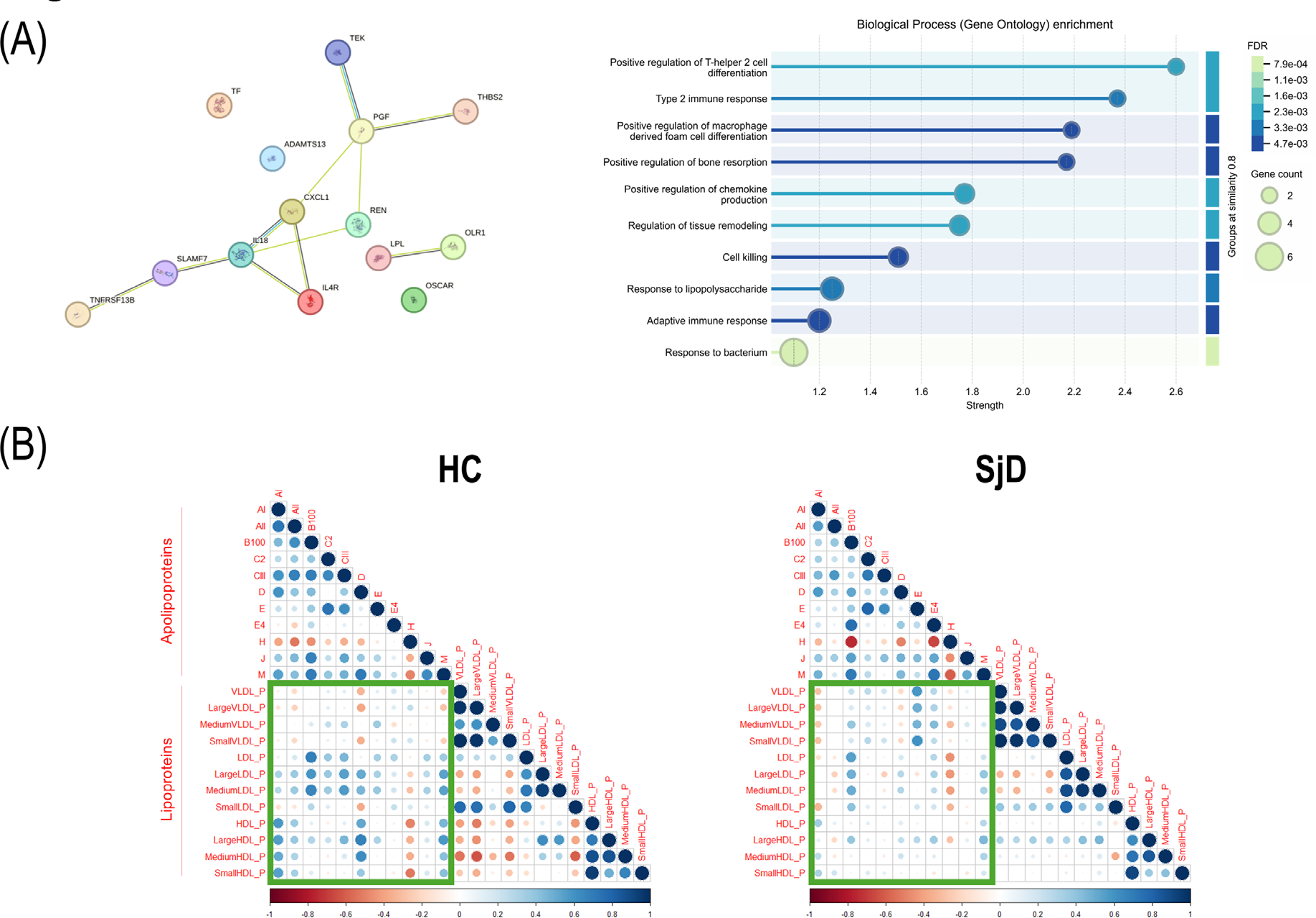
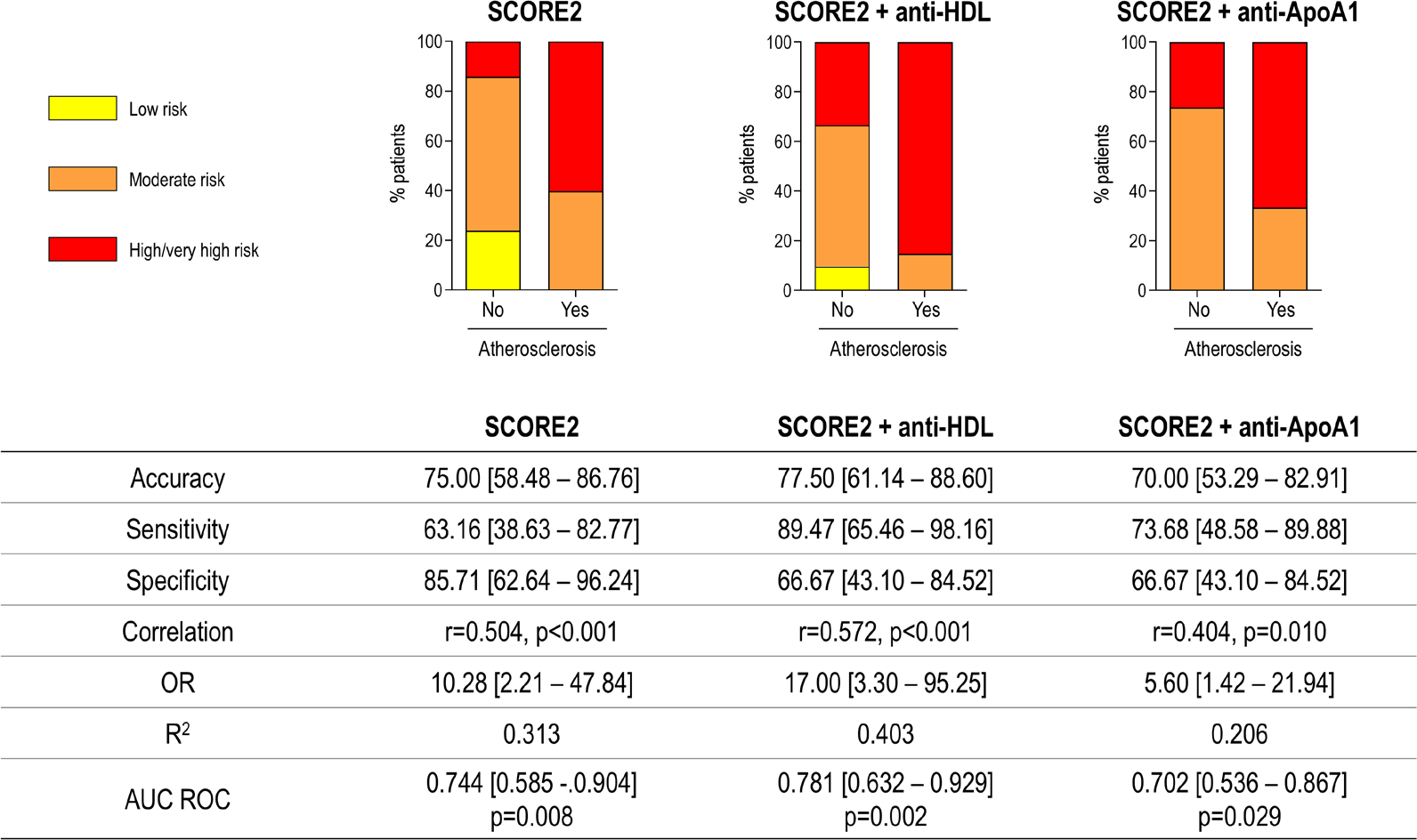
IgG anti-HDL and anti-ApoA1 antibodies were increased in SjD compared to controls (both p<0.010), comparable to SLE and independently of traditional risk factors (smoking, hypertension, diabetes and dyslipemia, all p<0.050). No correlation was found between both antibodies in SjD (r=-0.027, p=0.862). IgG anti-HDL were consistently associated with unfavourable lipoprotein profiles, including decreased cholesterol content on HDL (r=-0.465, p<0.001), decreased particle number (r=-0.439, p=0.003), increased mean particle size (r=0.332, p=0.033), altered size distribution (small HDL: r=-0.537, p<0.001) and increased VLDL particles (r=0.332, p=0.028). Similarly, IgG anti-HDL were correlated with several lipids (triglycerides: r=0.519, p=0.007; free cholesterol: r=0.416, p=0.013; phosphatidylcholine: r=-0.389, p=0.041; linoleic acid: r=0.379, p=0.049, total omega-3: r=-0.380, p=0.018; and total omega-9: r=0.394, p=0.031). Equivalent results were found with proinflammatory cytokines (IFNa, IL-6, IL-10, IL-12, and IL-33, all p<0.050). Anti-ApoA1 antibodies fail to exhibit these associations, whereas being correlated with disease activity outcomes (ESSDAI: r=0.652, p<0.001; clinESSDAI: r=0.657, p<0.001). Proteomic analyses revealed a total of 14 protein hits related to immune responses (IL-18, CXCL1, TNFRSF13B) and vascular homeostasis (Tie2, THBS2, ADAMTS13, LPL) to be correlated with IgG anti-HDL levels, whereas only 2 protein hits were retrieved for anti-ApoA1. Proteins related to anti-HDL showed a high degree of interaction (protein-protein interaction p-value=4.18·10 -6 ) (Figure 1A), and pathway analysis informed relevant biological processes, mostly related to humoral and immune responses, foam cell differentiation and tissue remodelling and proteomic signatures related to immune responses and remodelling (Figure 1A); Correlation analyses between apolipoproteins and lipoprotein profiles suggest potential changes in composition of the latter in SjD (Figure 1B). Associations of anti-HDL with lipidomic and proteomic features were dependent on atherosclerosis status in SjD, although no differences in levels were found. These findings were independent on lipoprotein profiles, disease features or traditional CV risk burden (all p>0.050). Anti-HDL antibodies, but not anti-ApoA1, improved risk stratification over SCORE2 mostly at the expense of increasing sensitivity, whereas only a marginal effect was found for those of anti-ApoA1 (Figure 2).
Conclusions: humoral responses against HDL particles hallmark SjD, with different trajectories observed for functional and clinical correlates, probably linked to altered lipoprotein composition. Anti-HDL were consistently associated with unfavourable lipid, lipoprotein, inflammatory and proteomic circuits, also demonstrating clinical added value. Antibodies against HDL particles could be a missing link between autoimmunity, lipid metabolism and atherosclerosis. This is the first description of the role of anti-HDL antibodies in SjD, thus strenghening the relevance of this topic in the setting of RMDs.
REFERENCES: NIL.
Acknowledgments: NIL.
Disclosure of Interests: None declared.