fetching data ... 
Background: Accurate diagnosis remains challenging due to disease heterogeneity of Sjögren’s disease (SjD) and lack of specific molecular biomarkers, particularly at early stages.
Objectives: To develop a novel predictive model for SjD by identifying characteristic immune cell signatures from single-cell RNA sequencing (scRNA-seq) data that could serve as reliable biomarkers for early and accurate disease detection.
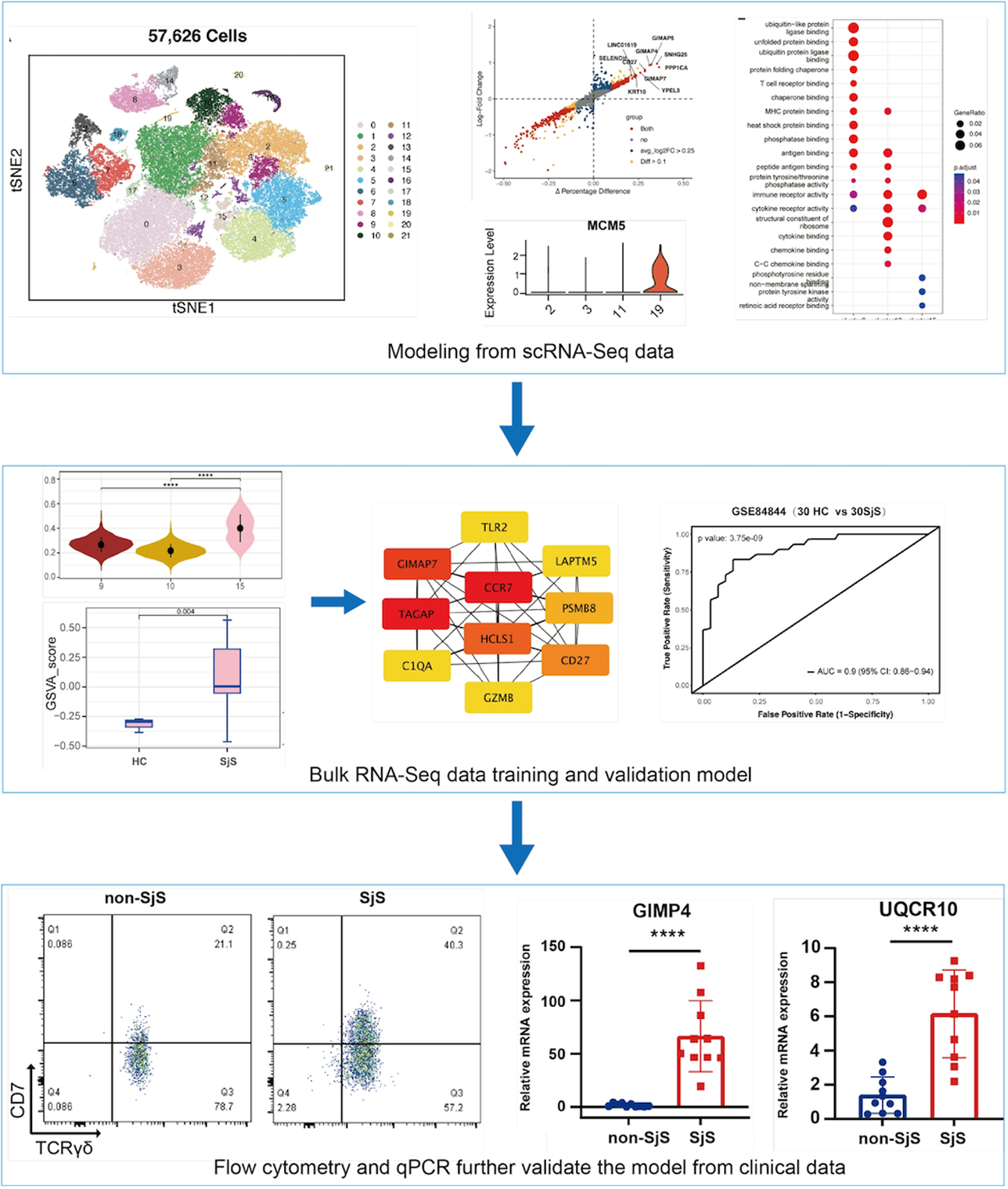
Methods: We analyzed a publicly available scRNA-seq dataset from SjD patients (GSE157278) to identify key immune cell subpopulations associated with disease onset. These critical immune cell subsets were subsequently used to establish the biological foundation of the SjD.Sig diagnostic model, which integrates distinctive gene expression signatures. The model was trained using six independent bulk RNA-seq datasets (GSE208260, GSE159574, GSE127952, GSE97614, GSE40611, and GSE7451) and further validated in newly collected SjD patient samples through flow cytometry and real-time quantitative PCR (qPCR).
Results: scRNA-seq analysis of peripheral blood mononuclear cells (PBMCs) from 5 SjD patients and 5 healthy controls identified 22 distinct cell clusters, with 57,626 single cells analyzed. Four key immune cell subpopulations showed significant alterations in SjD patients compared to controls: naïve CD8 + T cells and Helios + Foxp3 − CD4 + Tregs were significantly decreased, while TRDC γδ T cells and CTLA-4 + CD8 + inhibitory T cells were significantly increased (p<0.05). Characteristic gene signatures were identified for each altered cell subset: naïve CD8 + T cells showed overexpression of SNHG25, GIMAP5, GIMAP4, PPP1CA, and CD27; CTLA-4 + CD8 + inhibitory T cells exhibited high expression of HLA-DRB5, ABHD17A, UBE2J2, LYZ, and TAF10; TRDC γδ T cells demonstrated characteristic overexpression of HLA-DRB5, PPP1CA, MYOM2, S100A11, GIMAP7, YPEL3, and GIMAP4; and Helios + Foxp3 − CD4 + Tregs showed overexpression of LINC01619, PPBP, IL2RG, and SNHG25. Pathway enrichment analysis revealed distinct functional profiles for each cell subset. Naïve CD8 + T cells were enriched in ribosomal and translation-related pathways. CTLA-4 + CD8 + inhibitory T cells were enriched in energy metabolism pathways. TRDC γδ T cells were associated with cell proliferation and apoptosis pathways. Helios + Foxp3 − CD4 + Tregs were enriched in cell signaling and gene expression regulation pathways. These four cell subsets formed the biological foundation of the SjD.Sig diagnostic model, which integrates their characteristic gene expression signatures (e.g., PSMB8, CD27, UQCR10). Using LASSO regression and PPI network analysis, we identified 12 hub genes (GIMAP7, PSMB8, CD27, CCR7, TAGAP, UQCR10, HCLS1, LCK, TNFAIP3, ISG15, GIMAP4, and HLA-DRB1) as the core SjD.Sig signature. The model’s predictive performance was validated in six independent bulk RNA-seq datasets and in newly collected clinical samples. Flow cytometry analysis of PBMCs from 20 participants (9 controls, 11 SjD patients) confirmed the altered frequencies of the four cell subsets in SjD patients. Real-time qPCR validation in 20 new samples (10 controls, 10 SjD patients) showed significant upregulation of six key genes (PSMB8, CD27, UQCR10, HCLS1, LCK, and GIMAP4) in SjD patients (p<0.05). In independent validation datasets, SjD.Sig achieved excellent performance: for GSE84844 (n=60), AUC of 0.88 (95% CI, 0.84-0.93), sensitivity of 89% (95% CI, 80-94%), and specificity of 87% (95% CI, 72-95%); for GSE143153 (n=32), AUC of 0.84 (95% CI, 0.77-0.9), sensitivity of 85% (95% CI, 77-92%), and specificity of 82% (95% CI, 65-92%).
Conclusions: Our study advances understanding of SjD pathogenesis by identifying key immune cell signatures associated with disease onset and provides a clinically applicable diagnostic tool. The SjD.Sig model offers a promising approach for early and accurate disease detection, which could improve patient outcomes through timely intervention.
Graphic abstract
REFERENCES: NIL.
Acknowledgments: NIL.
Disclosure of Interests: None declared.