fetching data ... 
Background: The interleukin (IL)-23/IL-17 pathway is central to the pathogenesis of axial spondyloarthritis (axSpA); however, treatments targeting IL-23 have shown inconsistent effectiveness across spondyloarthritis subtypes. Given this gap in knowledge, we hypothesized that the inconsistent clinical efficacy of IL-23 inhibition may reflect heterogeneity within the IL-23/IL-17 axis according to the degree of radiographic progression. Furthermore, the IL-23/IL-17 pathway may be differentially shaped by IL-10-producing Type 1 regulatory T (Tr1) cells at distinct disease stages, potentially contributing to immunological differences between non-radiographic axSpA (nr-axSpA) and radiographic axSpA (r-axSpA).
Objectives: To explore these hypotheses, we investigated the IL-23/IL-17 axis and Tr1 cell dynamics in nr-axSpA and r-axSpA using a co-culture system of dendritic cells (DCs) and CD4 + T cells.
Methods: Clinical data and peripheral blood samples were collected from nr-axSpA (n = 20) and r-axSpA (n = 24), and synovial fluid samples were obtained from three patients in each group. Serum cytokines were measured using enzyme-linked immunosorbent assay (ELISA) and multiplex assays, and immune cell subsets from peripheral blood mononuclear cells (PBMCs) and synovial fluid mononuclear cells (SFMCs) were analyzed by flow cytometry. Spearman correlation analyses were conducted to evaluate associations between immunological parameters and disease activity indices, and multivariable regression analyses were performed to adjust for potential confounders. Functional co-culture studies using PBMC-derived cells assessed cytokine production by flow cytometry.
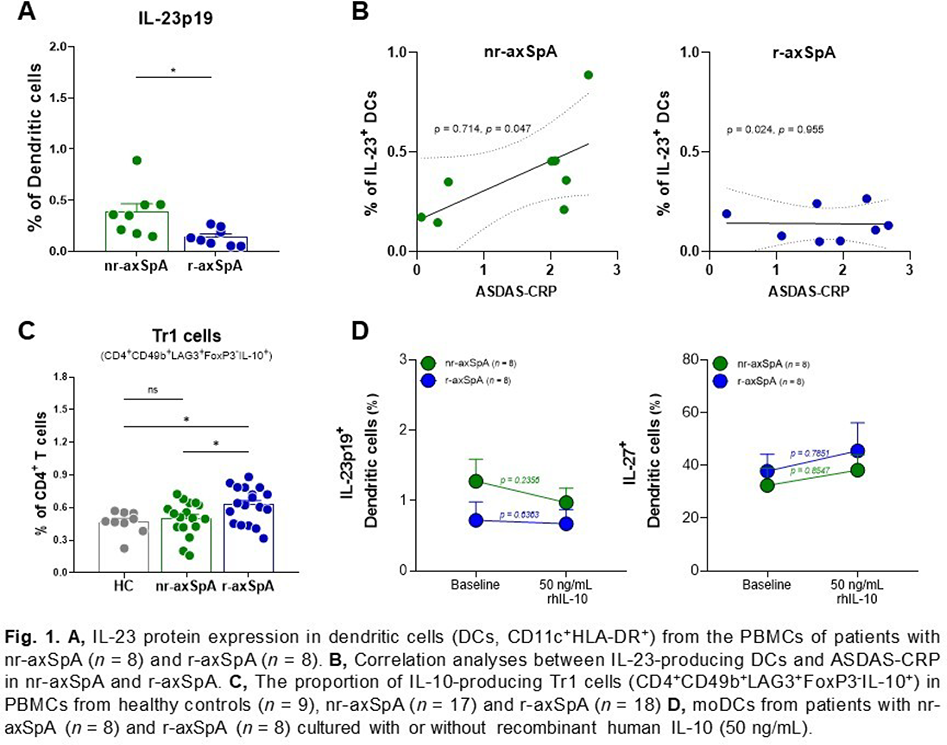
Results: Serum IL-23 levels were higher in nr-axSpA than in r-axSpA ( p = 0.014) and remained significant after adjustment for disease duration and extra-spinal manifestations. IL-23–producing monocytes (CD14 + HLA-DR + ) ( p = 0.028) and DCs (CD11c + HLA-DR + ) ( p = 0.010) were increased in nr-axSpA (Figure 1A) and correlated with disease activity ( ρ = 0.714, p = 0.047) (Figure 1B). Consistent trends were observed in SFMCs. In co-culture systems, monocyte-derived DCs (moDCs) from nr-axSpA more potently induced inflammatory cytokine production in healthy control (HC) CD4 + T cells (all p < 0.05). Circulating Tr1 cells (CD4 + CD49b + LAG-3 + FoxP3 − IL-10 + ) were reduced in nr-axSpA ( p = 0.025) compared with r-axSpA (Figure 1C) and exhibited diminished regulatory effects on cytokine production by HC moDCs in functional co-culture assays. Furthermore, IL-10 treatment was associated with lower IL-23 production by nr-axSpA moDCs ( p = 0.236) (Fig. 1D).
Conclusions: These findings suggest that IL-23-associated immune activity is more prominent in early axSpA and may be linked to stage-dependent differences in Tr1-mediated regulation.
REFERENCES: [1] SIEBERT S, et al. Why did IL-23p19 inhibition fail in AS: a tale of tissues, trials or translation? Ann Rheum Dis. 2019;78(8):1015-8. SCHETT G, et al. Reframing Immune-Mediated Inflammatory Diseases through Signature Cytokine Hubs. New Engl J Med. 2021;385(7):628-39.
Acknowledgments: NIL.
Disclosure of Interests: Jina Yeo I have served as a paid speaker for Boehringer Ingelheim., I have received research grant support from Celltrion., Min-Gang Kim: None declared, Su Young Heo: None declared, Yeonsoo Yang: None declared, Kyung Ann Lee: None declared, Hyo-Jin Choi: None declared, YunJae Jung: None declared, Eun Young Lee: None declared, Han Joo Baek: None declared.