fetching data ... 
Background: Systemic Lupus Erythematosus (SLE) represents a multifactorial autoimmune disorder characterized by genetic polymorphisms and aberrant chromatin remodelling. Within South Asian populations, SLE exhibits elevated incidence of severe end-organ damage, necessitating the development of minimally invasive molecular prognostic biomarkers. While composite disease activity scores provide aggregate assessments, the Easy-BILAG (British Isles Lupus Assessment Group) scoring system enables superior clinical granularity through organ-specific disease activity stratification. MicroRNAs (miRNAs) constitute endogenous, circulating small non-coding RNA molecules (~22 nucleotides) that function as post-transcriptional regulatory elements, fine-tuning the activation thresholds of both innate and adaptive immune cascades. Despite this, the comprehensive plasma miRNA landscape correlated with organ-specific exacerbations in South Asian lupus cohorts remains inadequately defined. Discovery-phase molecular profiling is critical to address existing genomic representation disparities and establish a cell-free, circulating nucleic acid-based platform for dynamic disease activity surveillance.
Objectives: To execute genome-wide Small RNA Sequencing for comprehensive characterization of the circulating miRNA transcriptome in Indian SLE patients, and to delineate novel, population-specific molecular signatures that function as high-specificity diagnostic determinants and predictive markers of disease exacerbation. The investigation specifically sought to establish correlative relationships between these circulating regulatory RNA molecules and organ-stratified disease activity parameters as quantified by the Easy-BILAG assessment framework
Methods: A discovery-phase observational study was executed following Institutional Review Board approval and acquisition of written informed consent. Plasma specimens from 26 SLE patients underwent binary stratification into Flare (n=12) and Remission (n=14) cohorts utilizing Easy-BILAG-based organ-specific activity mapping. Genome-wide small RNA profiling was performed using Illumina next-generation sequencing platforms. To construct functional miRNA-target gene regulatory networks, computational target prediction for differentially expressed miRNAs (DEMs) was performed using four independent algorithmic databases (TargetScan, miRDIP, miRDB, and miRTarBase) with stringent bioinformatic filtering parameters (TargetScan context++ score threshold <-0.4). Predicted miRNA targets were cross-validated against parallel mRNA-seq-derived differentially expressed genes (DEGs) from matched samples using Venny and Interactivenn platforms. Reciprocal expression pattern analysis (upregulated DEGs versus predicted targets of downregulated miRNAs, and inverse relationships) was performed to identify high-confidence regulatory circuits.
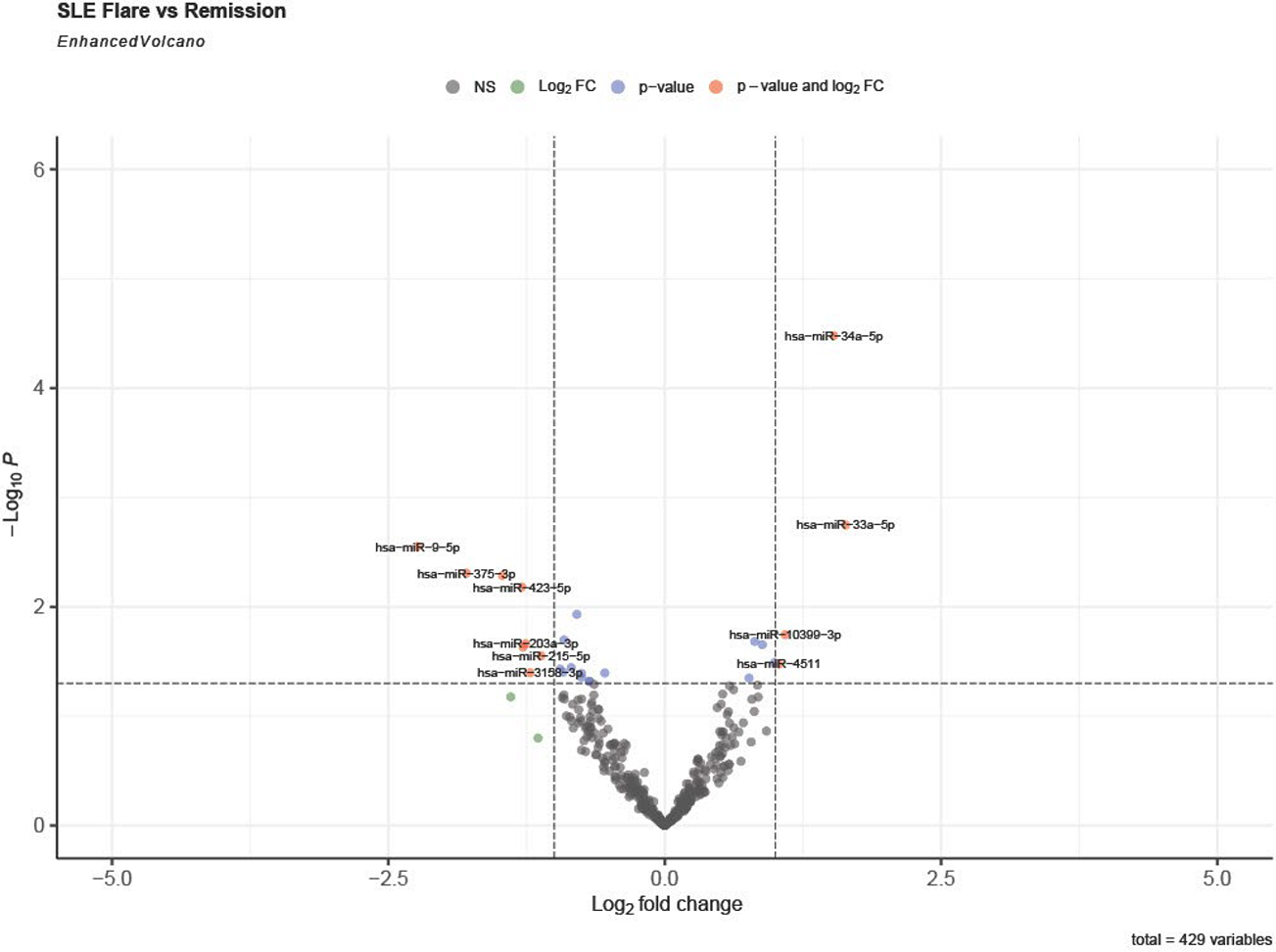
Results: Integrative multi-omic analysis revealed a distinct “Flare Signature” comprising 12 circulating miRNAs strongly associated with renal disease activity.Our study identified hsa-miR-4511 (fold-change: 2.05) and hsa-miR-10399-3p (fold-change: 2.13) as significantly upregulated molecular markers of disease flare without prior documentation in SLE literature. Reciprocal regulatory analysis identified Toll-like Receptor 1 (TLR1) and Interleukin-1 Receptor 1 (IL1R1) as functional downstream targets of miR-4511, suggesting a previously uncharacterized regulatory checkpoint within the innate immune pattern recognition receptor signaling cascade specifically activated during renal exacerbations in South Asian patient populations. Further,hsa-miR-34a-5p demonstrated significant upregulation, with corresponding reciprocal downregulation of its validated target Sirtuin 1 (SIRT1). This regulatory perturbation likely facilitates hyperacetylation-mediated activation of Nuclear Factor kappa B (NF-κB), thereby amplifying pro-inflammatory cytokine production cascades. Downregulated miRNAs hsa-miR-3605-5p and hsa-miR-375-3p exhibited high-confidence reciprocal targeting of Signal Transducer and Activator of Transcription 3 (STAT3) and Janus Kinase 2 (JAK2), respectively. These findings indicate compromised post-transcriptional suppression of the JAK-STAT signaling pathway, a central mediator of glomerular inflammatory responses. Downregulation of hsa-miR-9-5p corresponded with elevated expression of its predicted target PR Domain Zinc Finger Protein 1 (PRDM1/Blimp-1), confirming enhanced molecular programming toward terminally differentiated autoantibody-secreting plasma cell populations during lupus nephritis flares.
Conclusions: Through integration of Easy-BILAG organ-specific stratification with multi-dimensional omics profiling, this investigation identifies novel circulating biomarkers specifically relevant to the high-renal-involvement South Asian SLE population. The discovery of hsa-miR-4511 (with TLR1 regulatory targeting) underscores distinctive molecular pathophysiology characterizing South Asian lupus cohorts. These circulating molecular signatures demonstrate enhanced diagnostic sensitivity compared to conventional clinical scoring instruments, establishing a framework for preemptive therapeutic stratification in patients at elevated risk for lupus nephritis progression.
Differently expressed significant miRNAs: Flare signature
| miRNA | log2 Fold Change | p value | p adj |
|---|---|---|---|
| hsa-miR-33a-5p | 1.636472889 | 0.001784964121 | 0.382874804 |
| hsa-miR-34a-5p | 1.529508979 | 0.00003313684172 | 0.0142157051 |
| hsa-miR-10399-3p | 1.089920394 | 0.01797429622 | 0.7610279255 |
| hsa-miR-4511 | 1.032684785 | 0.03339692116 | 0.7610279255 |
| hsa-miR-9-5p | -2.236425994 | 0.002815239668 | 0.4025792725 |
| hsa-miR-375-3p | -1.795062881 | 0.004923760061 | 0.4443147704 |
| hsa-miR-3605-5p | -1.467963955 | 0.005178493827 | 0.4443147704 |
| hsa-miR-423-5p | -1.29391764 | 0.006588723266 | 0.4710937135 |
| hsa-miR-206 | -1.28244529 | 0.02334418454 | 0.7610279255 |
| hsa-miR-203a-3p | -1.258890591 | 0.02173976239 | 0.7610279255 |
| hsa-miR-3158-3p | -1.218127201 | 0.04006869216 | 0.7610279255 |
| hsa-miR-215-5p | -1.119825711 | 0.028021691 | 0.7610279255 |
Volcano Plot of Plasma miRNAs
REFERENCES: NIL.
Acknowledgments: NIL.
Disclosure of Interests: None declared.