fetching data ... 
Background: Type I interferon (IFN-I) overactivation is a central pathogenic driver in systemic lupus erythematosus (SLE) and lupus nephritis. While therapeutic blockade of IFN-I signaling has shown clinical benefit, precise modulation of this pathway remains challenging. Emerging evidence suggests that cellular metabolism, particularly lipid homeostasis, can influence immune signaling; however, the role of membrane phospholipids in IFN-I pathway regulation remains poorly defined.
Objectives: To investigate the role of phosphatidylethanolamine (PE) metabolism in regulating IFN-I signaling and to evaluate the therapeutic potential of the flavonoid diosmetin in experimental lupus models.
Methods: A high-throughput ISRE-luciferase reporter screen of a metabolically focused small-molecule library was performed to identify IFN-I pathway modulators. Transcriptomic and lipidomic profiling, enzymatic lipid quantification, confocal microscopy, receptor-trafficking assays, gene perturbation, and molecular docking were used to define and validate mechanisms of action of diosmetin. Therapeutic efficacy of diosmetin was evaluated in IFN-α–accelerated NZB/NZW F1 and TMPD-induced lupus mouse models. Ex vivo studies were performed using peripheral blood mononuclear cells (PBMCs) from patients with SLE stratified by IFN signature.
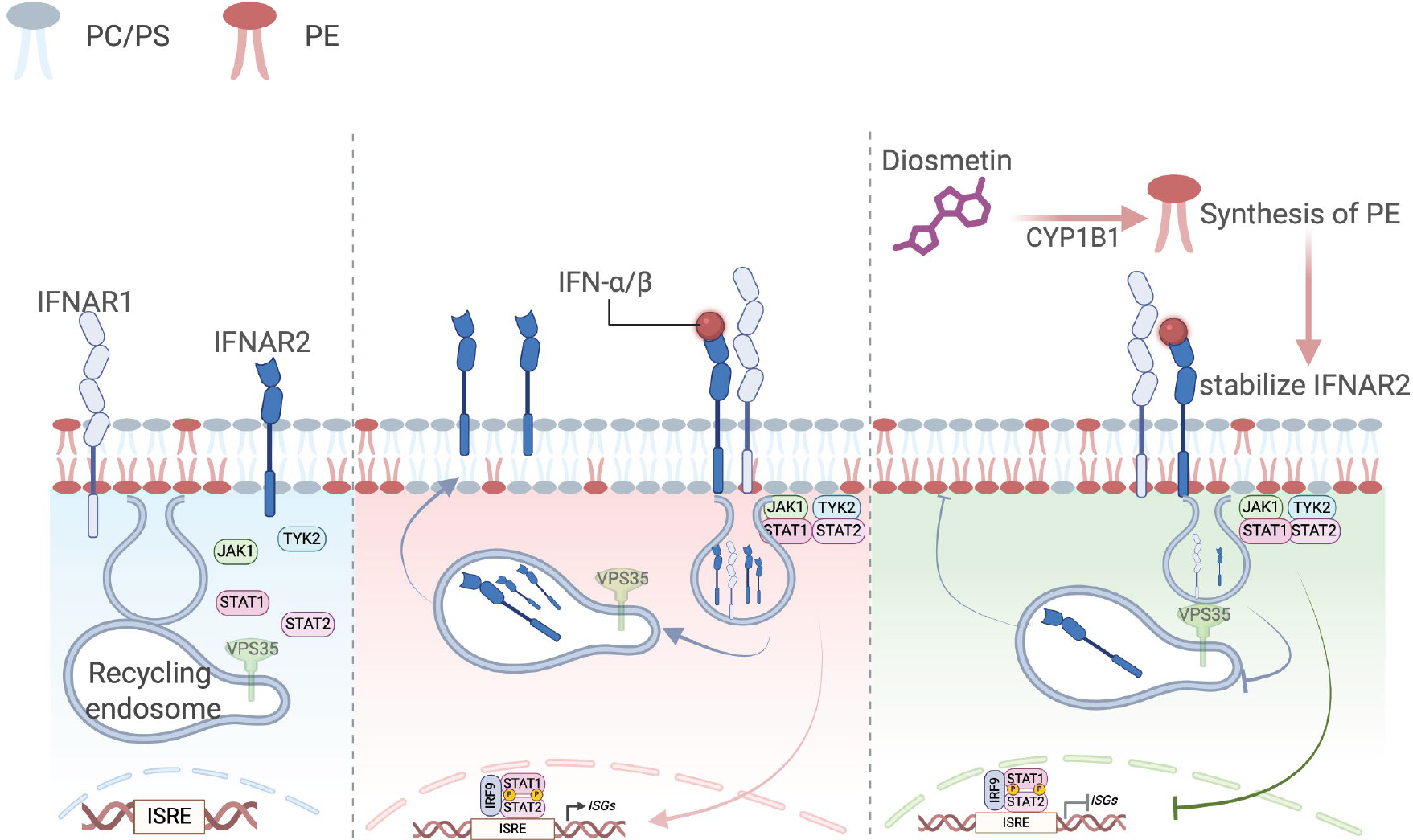
Results: Diosmetin, the aglycone metabolite of the clinically used flavonoid diosmin, was identified as a potent inhibitor of type I interferon signaling with minimal cytotoxicity.IFN-I stimulation induced a selective reduction in cellular PE, which facilitated IFNAR2 endocytosis and amplified downstream JAK-STAT signaling. Diosmetin preserved PE abundance, stabilized IFNAR2 at the plasma membrane, and attenuated ISG expression in several immune cell types. CYP1B1 was identified as a key mediator linking IFN-I signaling to PE metabolism. In lupus-prone mice, diosmetin treatment improved survival, reduced proteinuria, autoantibody production, renal immune complex deposition, and tissue IFN signatures. Ex vivo, diosmetin suppressed ISG expression in PBMCs from SLE patients, with stronger effects observed in individuals with high IFN signatures.
Conclusions: This study identifies membrane phosphatidylethanolamine as a previously unrecognized regulator of type I interferon signaling through control of IFNAR2 trafficking as illustrated in the graphic abstract. Diosmetin modulates this metabolic checkpoint to attenuate pathological interferon responses and ameliorate lupus manifestations in preclinical models. Unlike anti-IFNAR therapies that directly abrogate interferon signaling, diosmetin acts through a metabolic checkpoint to fine-tune IFNAR signaling dynamics, providing a mechanistically differentiated approach to interferon-driven autoimmunity. These findings highlight phospholipid metabolism as a novel regulatory mechanism governing IFN-I signaling and support further investigation of metabolic modulators for IFN-driven autoimmune diseases.
REFERENCES: NIL.
Acknowledgments: NIL.
Disclosure of Interests: None declared.