fetching data ... 
Background: Pregnancy in individuals with systemic lupus erythematosus (SLE) remains high-risk, with increased rates of pre-eclampsia, thrombosis, and fetal loss despite advances in disease management. Current predictors of adverse pregnancy outcomes are limited, highlighting the need for novel biomarkers to improve maternal and fetal health.
Recent studies in non-pregnant SLE populations have identified expansions of specifically double-negative (DN) (CD19+ IgD- CD27-) T-bet+ B cells in SLE, particularly with lupus nephritis and increased disease activity. However, the role of these B cell subsets and associated immunological changes in the B cell compartment during pregnancy remains poorly understood.
Objectives: This cross-sectional study is the first to investigate the frequency of B cell subpopulations in SLE pregnancy and post-partum with a focus on DN T-bet+ B cells in relation to disease and pregnancy outcomes compared to healthy non-pregnant and non-pregnant SLE female controls.
Methods: Healthy pregnant (n = 27) and non-pregnant (n = 20); SLE pregnant (n = 17), non-pregnant (n = 19) and 1-6 months post-partum (n = 9) subjects were recruited from University College London Hospital, with collection of peripheral blood mononuclear cells (PBMCs) in pregnancy and post-partum. Non-pregnant subjects were a mix of never and ever pregnant (recruited more than 6 months post-partum). Subjects in different groups were age (±5 years) matched, apart from SLE post-partum which were individually case-age matched to SLE pregnant samples within 5 years and rates of smoking were similar across groups. Inclusion criteria were: participants aged 18-48, SLE participants had to fulfil the 2019 ACR/EULAR criteria for SLE and exclusion criteria were any previous exposure to B cell depletion therapy. Immunophenotyping of PBMCs was performed using a multi-laser flow cytometry platform to identify B-cell subpopulations and their expression of markers including amine-reactive fixable viability dye, CD19, CD3, CD27, IgD, T-bet, IFN-γR, TLR7, TLR9, Ki67 and CD38. Statistical analysis was performed using ANOVA (analysis of variance) Kruskal Wallis, Mann-Whitney testing based on normality testing of the groups.
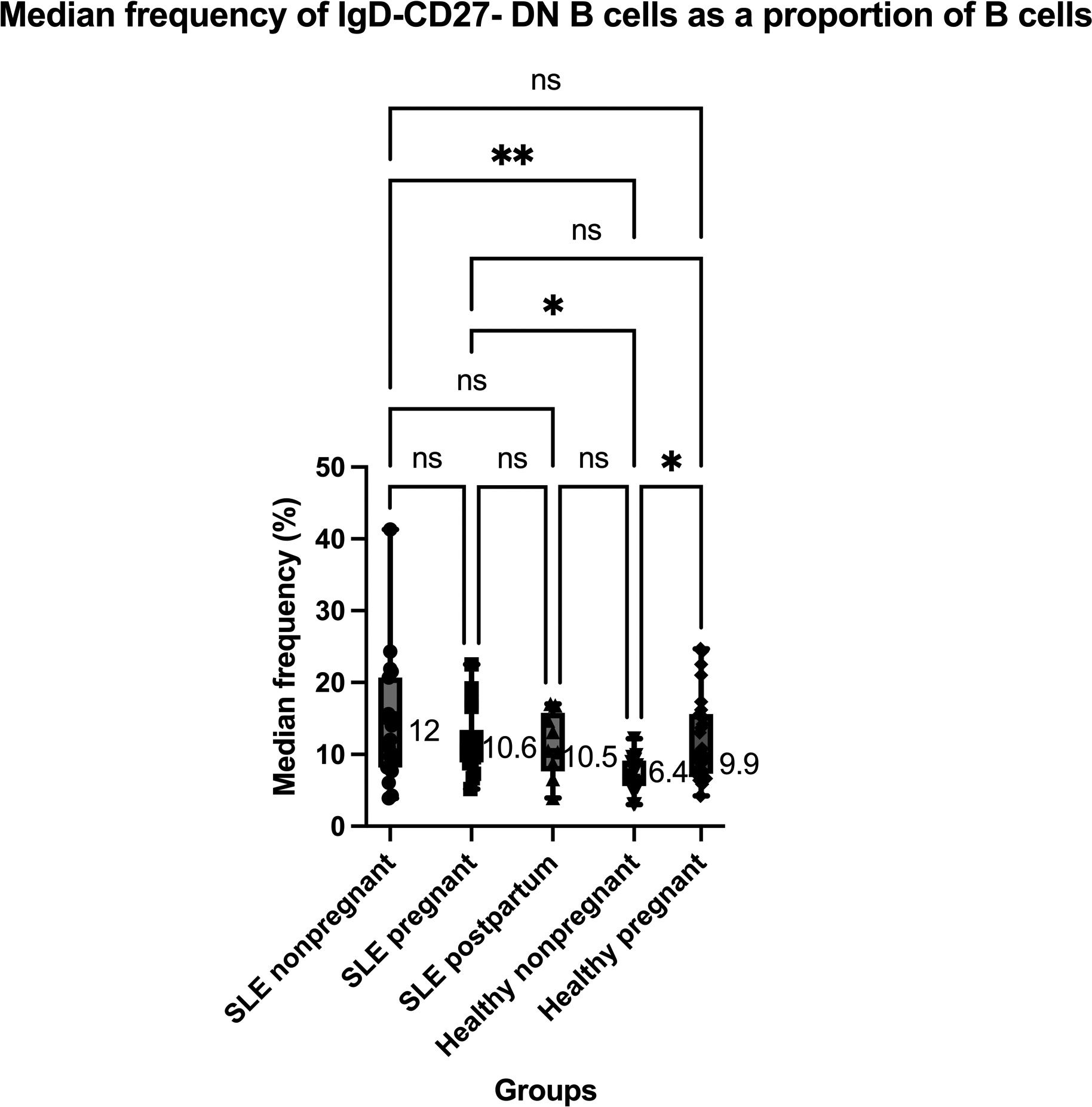
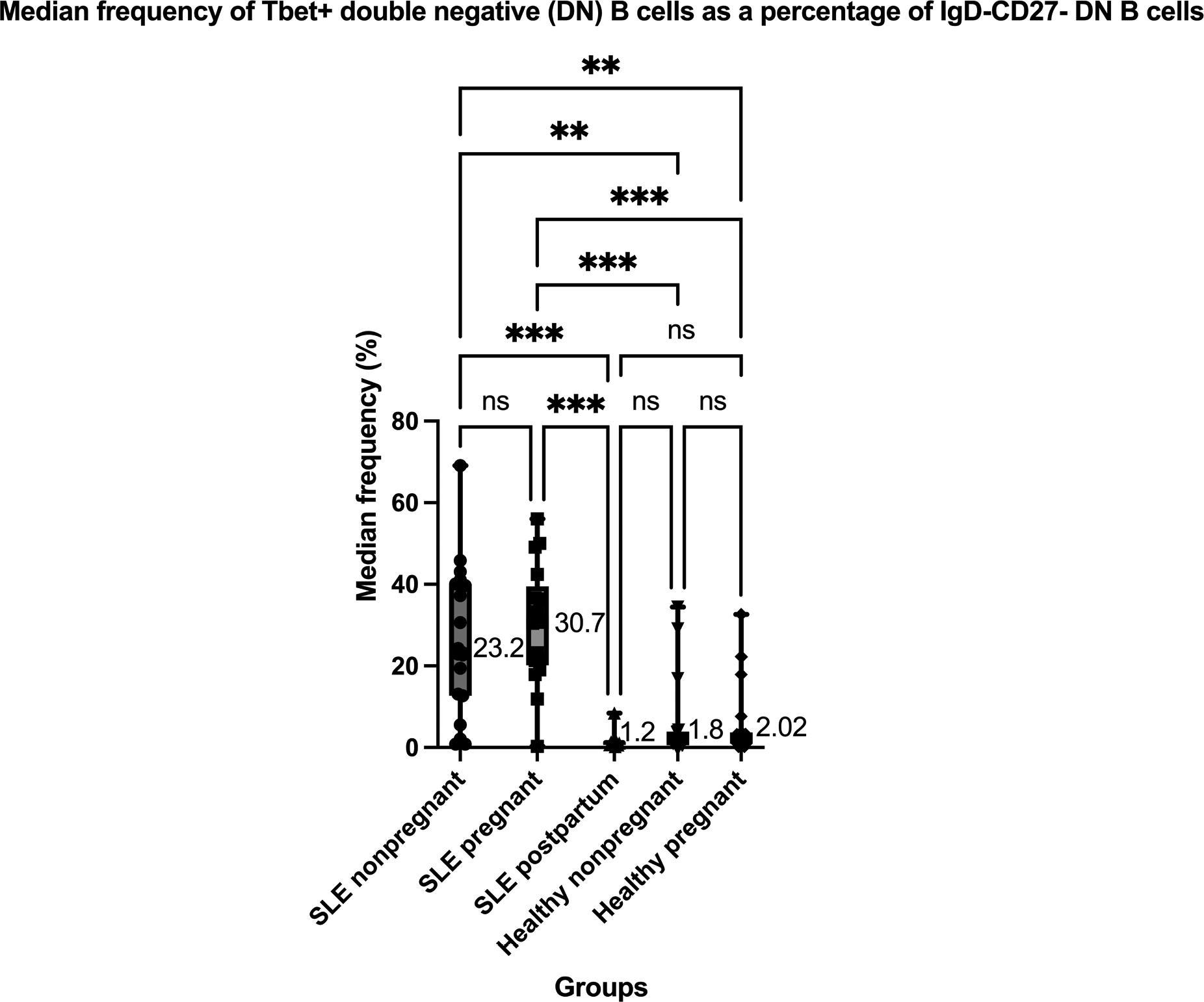
Results: Healthy pregnant and SLE pregnant individuals had higher frequencies of DN B cells compared to non-pregnant healthy controls. Median frequencies of DN (CD19+ IgD- CD27-) B cells (as a percentage of total B cells) were significantly increased in SLE pregnant (10.6%, p=0.0113), SLE non-pregnant (12%, p=0.0022) and healthy pregnancy (9.99%, p=0.0101) when each compared to healthy non-pregnant controls (6.44%) in any trimester (Panel A). However, there were no significant differences in median frequency of DN B cells comparing SLE non-pregnant and pregnant states (12% versus 10.6%, p>0.05) reflecting the higher frequencies of DN B cells in SLE. Due to the rise in DN B cells in healthy pregnancy, there was no difference in DN B cell frequencies in SLE pregnant versus healthy pregnant (10.6% versus 9.99%, p>0.05). Analysis of DN T-bet+ B cells however, showed marked differences between SLE and healthy controls (Panel B). Among DN B cells, the median frequency of DN Tbet+ B cells was significantly expanded in SLE pregnant versus healthy pregnancy (30.70% versus 2.02%, p=0.0003) and SLE non-pregnant versus healthy non-pregnant (23.2% versus 1.8%, p=0.0023) (Panel B). Sub-group analysis of SLE pregnancy to healthy pregnant controls by trimester 2 and 3 demonstrated this expansion of DN Tbet+ cells was statistically significant in both trimesters 2 and 3 (p<0.05). The median frequency of DN Tbet+ B cells in SLE pregnant (30.7%) versus SLE post-partum (1.2%) was markedly different (p=0.0009) with significantly reduced Tbet+ expression post-partum. The SLE post-partum DN Tbet+ median frequencies (1.2%) more closely resembled healthy non-pregnant (1.8%, p>0.05) and healthy pregnancy (2.02%, p>0.05) as a proportion of their DN B cell compartments (Panel B).
Conclusions: DN B cell populations increase in both healthy and SLE pregnancy as a proportion of B cells. However, whilst DN B cells expand in both healthy and SLE pregnancy, T-bet positivity of the DN B cells, characteristic of an atypical memory phenotype, distinguished SLE pregnant and non-pregnant disease samples from healthy pregnant and non-pregnant controls alike. The SLE post-partum DN B cell compartment demonstrates a marked reduction in T-bet positive DN cells closely mirroring healthy pregnant and non-pregnant controls. Therefore, pregnancy may cause an immune reset of peripheral blood B cells in some patients with SLE. Further work is ongoing to associate these findings with disease activity and pregnancy outcomes.
Panel A: Median frequency of IgD- CD27- DN (Double Negative) B cells as a proportion of B cells (%)
Panel B:Median frequency of Tbet+ double negative (IgD- CD27-) (DN) B cells as a percentage of DN B Cells (%)
REFERENCES: NIL.
Acknowledgments: NIL.
Disclosure of Interests: George Woodward: None declared, Bethan Goulden UCB paid speaker fee, Shi-Nan Luong: None declared, Thomas McDonnell: None declared, Maria Leandro: None declared, Venkat Reddy: None declared, Ian Giles UCB paid speaker fee, UCB research grant.