fetching data ... 
Background: Among autoimmune diseases systemic sclerosis (scleroderma; SSc) is the most indecipherable with no clear explanation of the link of its three cardinal features: immunological features, vascular lesions, and fibrosis. Attention has recently been paid to epigenetic abnormalities as a mechanism of the pathogenesis of autoimmune disorders.
Objectives: Based on these recent findings, we aimed to investigate the presence of an aberrant reactivation of transposons (TEs) in SSc. Transposons are mobile genetic elements, originating from repetitive sequences silenced in differentiated cells by histone modifications or DNA methylation. We suggest that loss of DNA methylation, associated with DNA damage reactivates specific families of TEs. These nucleic acids once recognized by cellular DNA/RNA sensors (cGAS-STING) induces IFN1a and NFkB signaling and cell activation.
In the present study we have evaluated the expression of TEs in scleroderma fibroblasts which are the main drivers of fibrosis in scleroderma.
Methods: Two SSc skin scRNAseq data sets (GSE249279 and GSE138669) were analyzed using the CellRangerTE pipeline (
Results: Two-hundred and forty-eight TEs belonging to Class I of transposable elements (retrotransposons) which use an RNA intermediate for transposition were identified. Forty-one of 248 (16.5 %) TEs were of the LINE superfamily (Line 1: 38; Line 2: 3) and 204 TE of SINE superfamily of which 201 belonged to the Alu family. Other Class I TEs identified were LTR (2), ERV (1), MER (4). Five TEs (Tigger2b: 1; Charlie9: 1; FAM:1; Kanga2-a: 1; HSMAR2: 1) belonged to Class II which uses a non-replicative cut-and paste mechanism for transposition. With an arbitrary threshold of 5% fold change, 120 TEs were increased in SSc skin compared to healthy skin. 96 were Alu TEs belonging to the SINE family, 17 of these were LINE TEs, also 4 MER and 2 LTR members were found. Only one of class II TEs, HSMAR2, was deregulated.
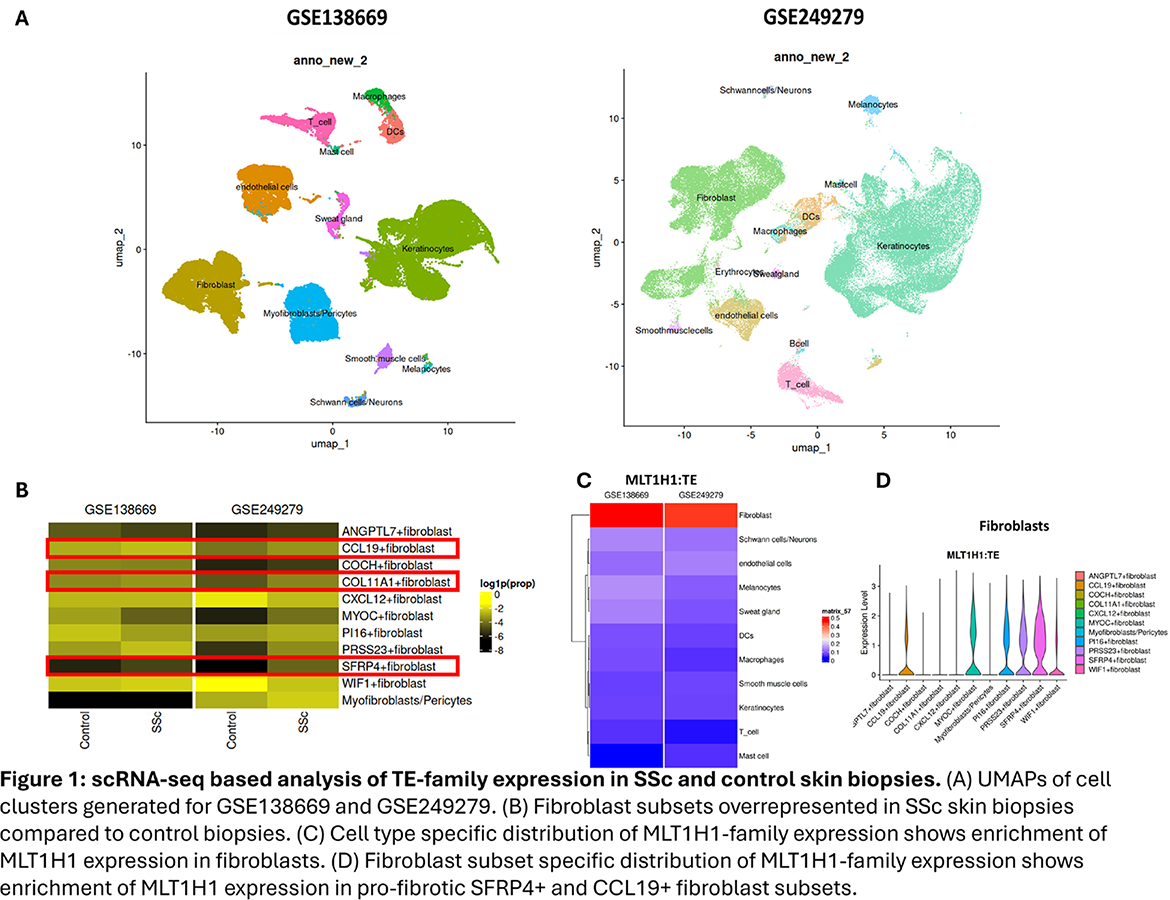
Within the fibroblast cluster, CCL19+, COL11A1+ and SFRP4+ SSc specific fibroblast subsets were found to be overrepresented in the SSc samples compared to healthy controls (Figure 1). The TE-family MLT1H1 was found to be specifically overexpressed in fibroblasts and particularly pro-fibrotic subsets such as SFRP4+, MYOC+ and PRSS23+ fibroblasts. Other TEs were found to be activated preferentially in the profibrotic CCL19+ subset. Most prominently, L1ME3F was overexpressed in this subpopulation. In silico perturbation analysis suggested that a single copy of MLT1H1 (Chr4; 146707686: 146708196) enhanced PI3K (p = 0.005), MAPK (p = 0.018), p53 (p = 0.038) and NFkB (p = 0.05) signaling in fibroblasts, suggesting a transition to profibrotic. A single copy of L1ME3F (Chr8; 56675306: 56675794) was associated with increased Jak-Stat (p < 0.001) and type 2 interferon (p < 0.001) signaling and reduced cytosolic DNA sensing (p < 0.001).
Conclusions: Transposable elements are upregulated in pro-fibrotic and pro-inflammatory subsets of fibroblasts in SSc skin. These TEs apparently affect multiple disease relevant signaling pathways in fibroblasts in SSc. Further investigation of these TEs may lead to a better understanding of the trajectories that drive homeostatic fibroblasts towards pro-fibrotic phenotypes and result in new treatment approaches.
REFERENCES: NIL.
Acknowledgments: NIL.
Disclosure of Interests: Dennis Bleck: None declared, Tim Filla: None declared, Karen Drechsel: None declared, peng li: None declared, Maria Vittoria Napoli: None declared, Pietro Bearzi: None declared, Elena Pachera: None declared, Oliver Distler 4P-Pharma, Abbvie, Acepodia, Aera, AnaMar, Anaveon, Argenx, AstraZeneca, Avalyn, Boehringer Ingelheim, BMS, Calluna, Cantargia, CSL Behring, EMD Serono, Galderma, Galapagos, Gossamer, Hemetron, Innovaderm, Kali, Lilly, Mediar, MSD Merck, Nkarta, Novartis, Oorja Bio, Orion, Pliant, Prometheus, Quell, Scleroderma Research Foundation, Skyhawk, Tandem, Topadur, UCB and Umlaut.bio. Patent issued “mir-29 for the treatment of systemic sclerosis” (US8247389, EP2331143). Co-founder of CITUS AG, 4P-Pharma, Abbvie, Acepodia, Aera, AnaMar, Anaveon, Argenx, AstraZeneca, Avalyn, Boehringer Ingelheim, BMS, Calluna, Cantargia, CSL Behring, EMD Serono, Galderma, Galapagos, Gossamer, Hemetron, Innovaderm, Kali, Lilly, Mediar, MSD Merck, Nkarta, Novartis, Oorja Bio, Orion, Pliant, Prometheus, Quell, Scleroderma Research Foundation, Skyhawk, Tandem, Topadur, UCB and Umlaut.bio. Patent issued “mir-29 for the treatment of systemic sclerosis” (US8247389, EP2331143). Co-founder of CITUS AG, 4P-Pharma, Abbvie, Acepodia, Aera, AnaMar, Anaveon, Argenx, AstraZeneca, Avalyn, Boehringer Ingelheim, BMS, Calluna, Cantargia, CSL Behring, EMD Serono, Galderma, Galapagos, Gossamer, Hemetron, Innovaderm, Kali, Lilly, Mediar, MSD Merck, Nkarta, Novartis, Oorja Bio, Orion, Pliant, Prometheus, Quell, Scleroderma Research Foundation, Skyhawk, Tandem, Topadur, UCB and Umlaut.bio. Patent issued “mir-29 for the treatment of systemic sclerosis” (US8247389, EP2331143). Co-founder of CITUS AG, Antonio Pezone: None declared, Enrico Vittorio Avvedimento: None declared, Nicoletta Del Papa: None declared, Rossella De Angelis: None declared, Jörg Distler: None declared, Armando Gabrielli: None declared.