fetching data ... 
Background: Systemic sclerosis (SSc) is a rheumatic disease affecting the immune system, the microvascular system, and the connective tissue. It is characterized by fibrosis of the skin and internal organs. Interstitial lung disease (ILD) is common in SSc and associated with high mortality [1]. Previous metabolomic studies in blood samples have identified specific dysregulated metabolic fingerprints in patients with SSc compared to healthy controls [2]. Whether those metabolic alterations are associated with disease severity in SSc is still unknown.
Objectives: This study aims to identify biomarkers of metabolic alterations and pathways associated with SSc and its pulmonary manifestation.
Methods: The Western Sweden Systemic Sclerosis Project (WESST) is a longitudinal cohort study that includes patients diagnosed with SSc, followed up at Sahlgrenska University Hospital in Gothenburg and Skaraborgs Hospital in Skövde, along with healthy controls without any rheumatic disease. All patients met the ACR-EULAR 2013 diagnostic criteria for systemic sclerosis (SSc) at the time of inclusion. Plasma samples were collected from 62 patients (44 noILD and 18 ILD) with SSc and 27 healthy controls. Liquid Chromatography-Mass Spectrometry was performed on plasma samples at the Swedish Metabolomics Center. Peak intensities of metabolites were recorded and annotated, and data analysis was performed using Metaboanalyst 6.0. Figures were prepared using Graphpad Prism 10 and SRplot [3].
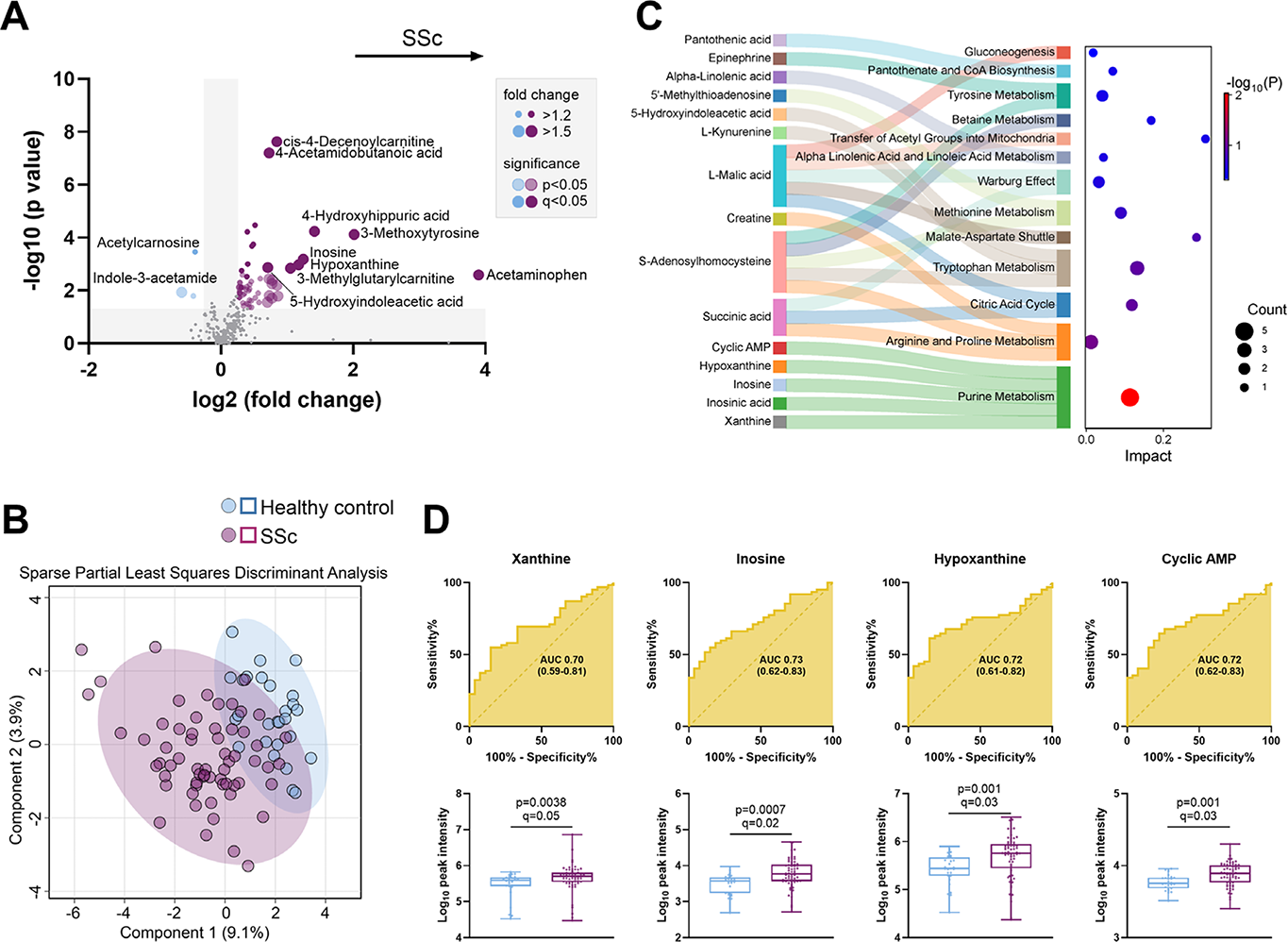
Results: Metabolomics analysis based on 287 annotated metabolites in plasma samples revealed a distinct metabolic fingerprint between patients with SSc and healthy controls. Results from univariate analysis in metabolomics, combining the outcomes from t-test (p < 0.05) and fold-change (1.2) analyses, were shown in a volcano plot (Figure 1A) whereas a scores plot from the sparse Partial Least Squares Discriminant Analysis (sPLS-DA) is shown in Figure 1B. Metabolites with t-test p < 0.05 and fold-change > 1.2 were selected for pathway analysis. The most-affected pathway was purine metabolism; other amino acid metabolism pathways, including arginine and proline, methionine, tryptophan, tyrosine, and betaine, as well as pathways related to energy production, were also affected (Figure 1C). The changes of four metabolites contributing to purine metabolism (xanthine, inosine, hypoxanthine, and Cyclic AMP) are shown in Figure 1D.
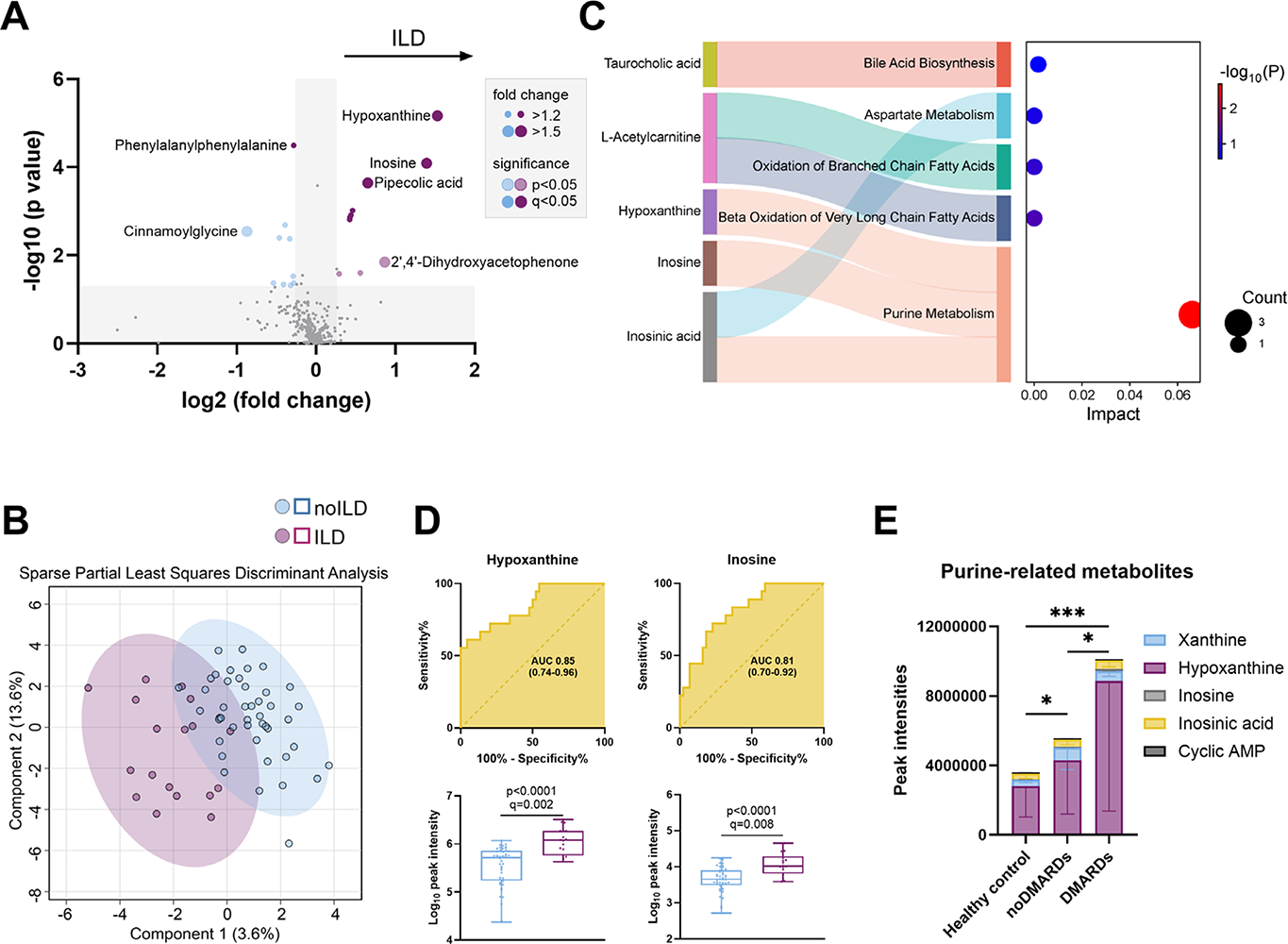
When comparing patients with and without ILD (Figure 2A and B), alterations in purine metabolism as well as metabolism of fatty acids were detected (Figure 2C). Changes in metabolites that are involved in purine metabolism are shown in Figure 2D. As purine metabolism can be influenced by disease-modifying anti-rheumatic drugs (DMARDs), particularly methotrexate and mycophenolate mofetil, we stratified the WESST cohort into three groups: healthy controls, SSc patients not receiving DMARDs (n = 32), and SSc patients treated with DMARDs (n = 30). After stratification, elevated levels of purine metabolites were observed not only in DMARD-treated patients but also in untreated SSc patients (Figure 2E).
Conclusions: This study identifies distinct metabolic plasma signatures in patients with SSc compared to healthy controls, as well as differences in patients with and without ILD. Purine metabolism emerged as the most consistently altered pathway, with elevated purine-related metabolites observed in SSc patients regardless of DMARD treatment. These findings suggest that altered purine metabolism in SSc cannot be fully explained by treatment effects alone, but may instead reflect disease-specific metabolic changes, although further studies are needed to clarify their biological and clinical significance.
Metabolic alterations between patients with systemic sclerosis (n = 62) and healthy controls (n = 27). A. Volcano plot with 287 annotated metabolites. B. Scores plot from the sparse Partial Least Squares Discriminant Analysis. C. Sankey and dot plot showing the top changed pathways and related metabolites. D. Receiver Operating Characteristic curves and box plots for metabolites involved in purine metabolism. Significance was determined by non-parametric unpaired t tests.
Metabolic alterations between patients with (n = 18) and without ILD (n = 44). A. Volcano plot with 287 annotated metabolites. B. Scores plot from the sparse Partial Least Squares Discriminant Analysis. C. Sankey and dot plot showing the top changed pathways and related metabolites. D. Receiver Operating Characteristic curves and box plots for metabolites involved in purine metabolism. E. Purine metabolism metabolites in healthy, SSc patients not receiving DMARDs and SSc patients receiving DMARDs. Significance was determined by non-parametric unpaired t tests in A and D, and 2-way ANOVA in E (*p < 0.05; **p < 0.01; ***p < 0.001).
REFERENCES: [1] Hoffmann-Vold AM, Allanore Y, Alves M, et al. Progressive interstitial lung disease in patients with systemic sclerosis-associated interstitial lung disease in the EUSTAR database. Ann Rheum Dis. 2021;80(2):219-227. doi:10.1136/annrheumdis-2020-217455.
[2] Guo M, Liu D, Jiang Y, et al. Serum metabolomic profiling reveals potential biomarkers in systemic sclerosis. Metabolism. 2023;144:155587. doi:10.1016/j.metabol.2023.155587.
[3] Tang D, Chen M, Huang X, et al. SRplot: A free online platform for data visualization and graphing. PLoS One. 2023;18(11):e0294236. Published 2023 Nov 9. doi:10.1371/journal.pone.0294236.
Acknowledgments: NIL.
Disclosure of Interests: Cecilia Överdahl: None declared, Antonio Orlando: None declared, Roberto Giacomelli: None declared, Rille Pullerits: None declared, Yuan Zhang: None declared, Cristina Maglio honoraria for lectures from Boehringer Ingelheim.