fetching data ... 
Background: Cutaneous fibrosis is the most distinctive clinical feature of systemic sclerosis (SSc), and fibroblasts are the main effector cells through persistent fibroblast-to-myofibroblast transition, largely regulated by transforming growth factor-β1 (TGF-β1) and mechanical stress. SSc displays marked sex differences: although females are more frequently affected, males often develop more severe skin fibrosis with higher modified Rodnan skin scores. Despite recent evidence of sex-biased genetic regulation, the fibroblast states and transcriptional programs underlying sex-biased lesional development in SSc remain poorly understood.
Objectives: To delineate sex-biased fibroblast states and transcriptional programs in SSc skin, and to identify the molecular pathways driving sex-specific fibrotic responses.
Methods: Skin biopsies were obtained from 17 diffuse cutaneous SSc and 8 healthy controls, yielding 34 biopsies: 26 SSc samples from lesional and non-lesional skin (females: 8 lesional, 8 non-lesional; males: 6 lesional, 4 non-lesional) and 8 non-lesional control biopsies (4 female, 4 male). Single-cell RNA sequencing (10x Genomics) profiled 81,232 cells. Data were processed using Seurat with Harmony integration, and cell types were annotated using CellTypist and canonical markers. The fibroblast compartment (14,832 cells) was analyzed in detail. Sex-biased differentially expressed genes (DEGs) associated with lesion development were identified using a pseudobulk approach. Gene set enrichment analysis (GSEA) was performed to identify sex-differential pathways. Differential abundance analysis was used to detect sex-biased fibroblast subpopulations with MiloR. Module scores for extracellular matrix (ECM), collagen, contractile, and myofibroblast programs were calculated to assess functional transcriptional programs across fibroblast subpopulations.
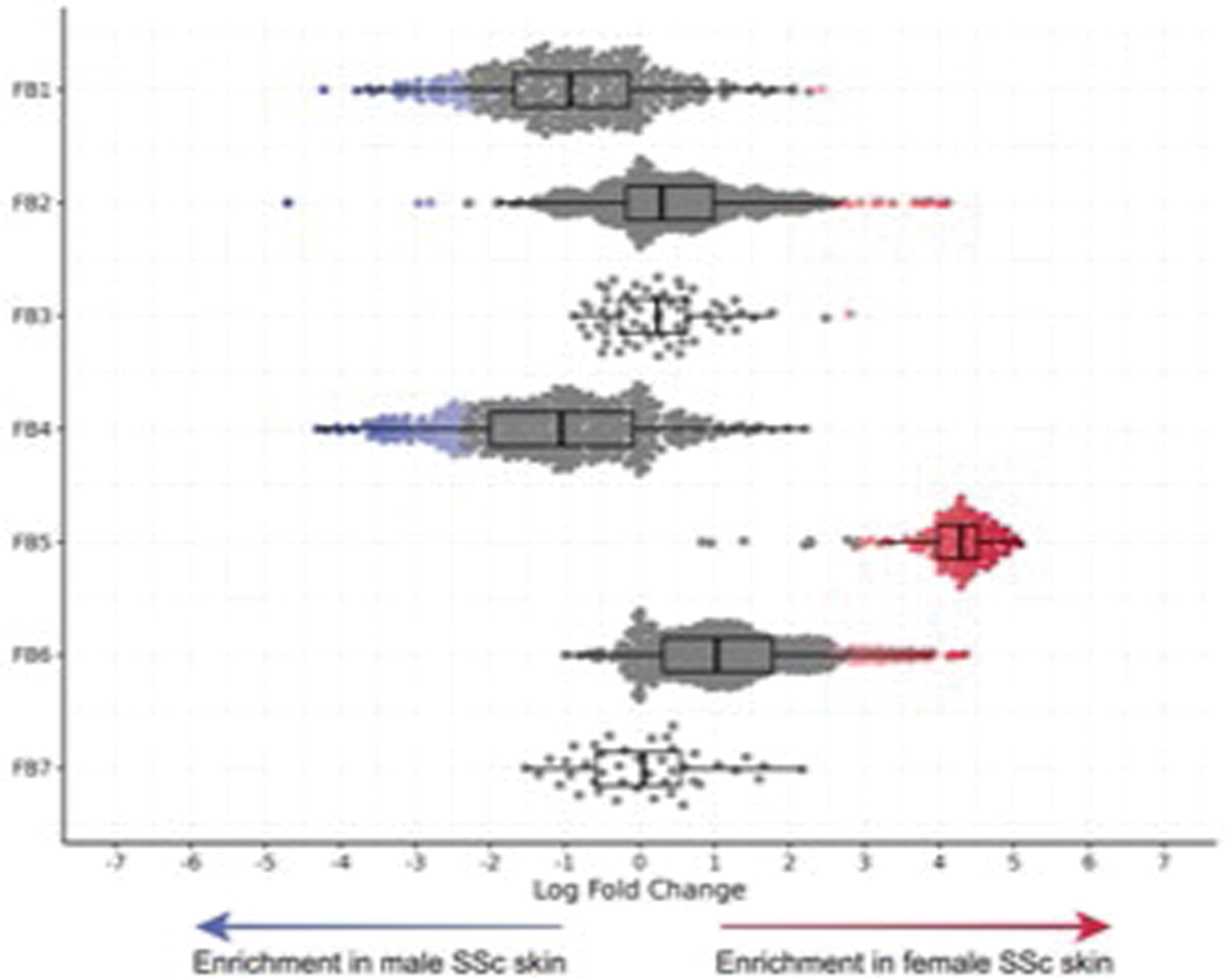
Results: Single-cell profiling resolved 14 major skin cell types. Given their central role in fibrosis, our analyses focused on fibroblasts to uncover sex-specific transcriptional programs underlying lesion development. We identified 878 sex-biased DEGs. Most DEGs (n = 691) exhibited significant transcriptional changes during lesion development in males, whereas 187 genes were significantly altered in females. EPAS1 was the most significant overall DEG in females (logFC = 1.38, FDR < 7.85 × 10 −4 ), while ARL2 was the top male-biased DEG (logFC = –1.40, FDR = 1.97 × 10 −4 ). Gene set enrichment analysis revealed pronounced sex-specific transcriptional programs. Female-biased genes were enriched for inflammatory pathways and ECM–related pathways, indicating a fibroblast state primed for immune engagement and matrix deposition. In contrast, male-biased genes were enriched for contractility-related programs, including smooth muscle contraction and SLIT/ROBO-mediated mechanotransduction. Seven transcriptionally distinct fibroblast populations were identified in SSc skin (FB1–FB7). The FB4 population, defined by COL11A1 and ACTA2 expression, was significantly enriched in male SSc skin. Within FB4, two subtypes were distinguished based on TEAD4 expression ( TEAD4 − and TEAD4 + ). Notably, we identified a female-specific fibroblast population that was significantly enriched in female lesional skin, the FB5 population, characterized by high SFRP2 and COL6A6 expression. Both TEAD4 + FB4 (male-enriched) and FB5 (female-specific) subtypes exhibited elevated contractile and myofibroblast scores, reflecting a sex-biased myofibroblast program. Moreover, the female-specific FB5 population displayed high ECM and collagen module scores and expressed inflammatory myofibroblast markers, suggesting a combined role in matrix deposition and inflammation in female SSc lesions.
Conclusions: SSc skin exhibits sex-biased fibroblast states driving divergent fibrotic mechanisms. Male fibroblasts prioritize contractility and mechanotransduction, whereas female fibroblasts favor ECM and collagen production alongside inflammatory signaling. Strikingly, the identification of TEAD4 + FB4 in males and the female-specific FB5 subtype reveals previously unrecognized cellular mechanisms underlying sex differences in SSc and highlights potential targets for sex-informed therapeutic strategies.
Differential abundance of fibroblast populations (FB1–FB7) between female and male SSc skin. The x-axis shows log fold changes, and the y-axis lists fibroblast populations. Differential abundance neighborhoods with FDR ≤ 10% are highlighted: red for enrichment in female SSc skin, blue for enrichment in male SSc skin. Box plots summarize the distribution of log fold changes, showing the median and interquartile range (lower and upper hinges correspond to the first and third quartiles).
REFERENCES: NIL.
Acknowledgments: NIL.
Disclosure of Interests: None declared.