fetching data ... 
Background: Systemic sclerosis (SSc) is an immune-mediated inflammatory disease with one of the highest mortality rates among rheumatic diseases. Pulmonary involvement, particularly SSc-associated interstitial lung disease (SSc-ILD), is a relevant complication and a major cause of death. SSc-ILD affects approximately 50% of SSc patients and is characterized by marked clinical and biological heterogeneity, making its prediction and clinical management particularly challenging. Genetic susceptibility loci have been described, mainly within the major histocompatibility complex region; however, genome-wide studies focusing on SSc-ILD remain limited, and existing genetic assessments are often constrained by small sample sizes and reduced statistical power.
Objectives: In this work we aim to identify potential pathogenic mechanisms, genetic biomarkers, and therapeutic targets associated with SSc-ILD by conducting a genome-wide association study (GWAS).
Methods: We analyzed genomic data from the largest SSc-ILD cohort to date and newly genotyped data, including 6,156 patients from which 2,539 were SSc-ILD (SSc-ILD + ), and 15,810 controls from 11 international cohorts of European-descent ancestry. Stringent quality control procedures were applied and genome-wide imputation was performed using the TOPMed Imputation Server. Logistic regressions were conducted in each of the 11 cohorts, adjusting for sex and the first five principal components, considering the comparison SSc-ILD + vs controls. Association results were then combined using inverse-variance weighted meta-analysis. Finally, to identify genetic risk variants more specifically associated with SSc-ILD, we prioritized SNPs reaching genome-wide significance (p < 5 x 10 -8 ) in the SSc-ILD+ vs controls comparison that did not show significance in the SSc-ILD − vs controls analysis.
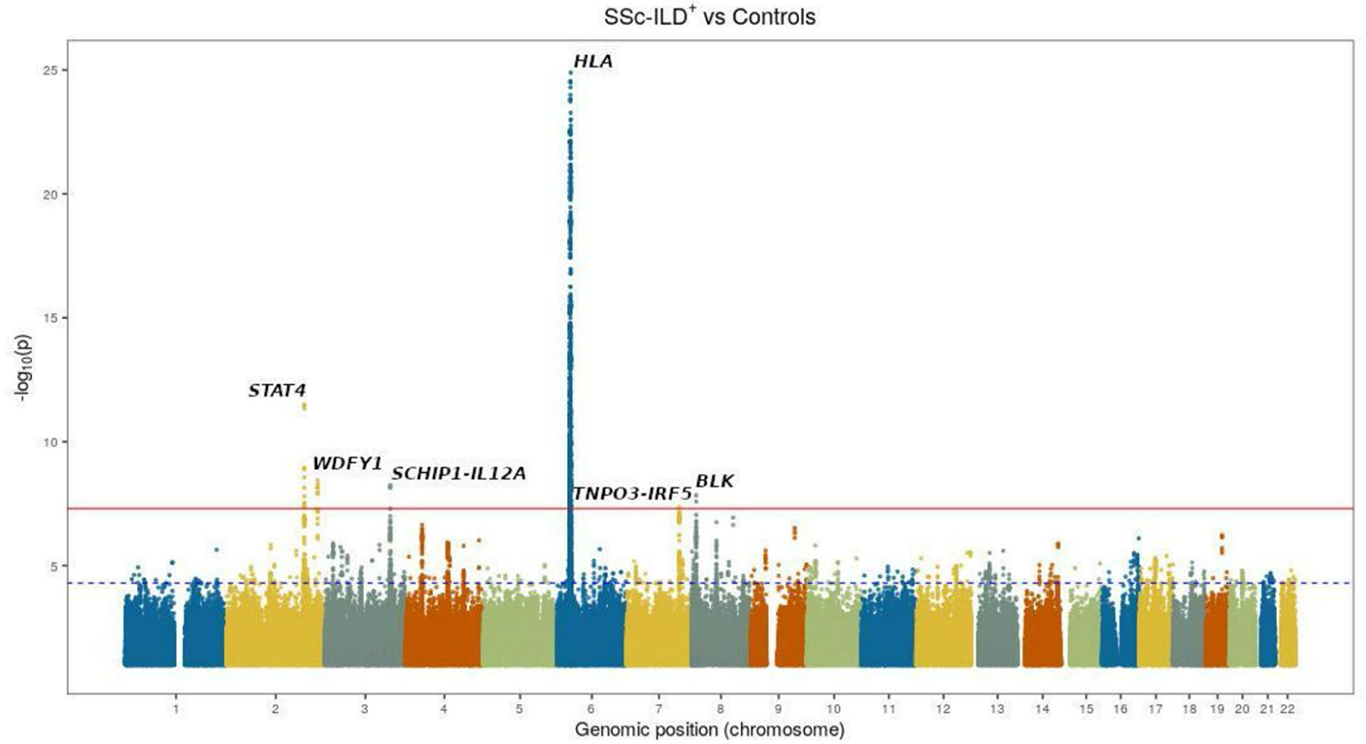
Results: In the meta-analysis of SSc-ILD + vs controls, we identified 26 genome-wide significant variants meeting our predefined SSc-ILD criteria, namely, they were not significant in SSc-ILD − vs controls. Several of these mapped to novel loci implicated in SSc-ILD, including rs6706351 (odds ratio [OR]= 2.81, 95% confidence interval [CI] CI= 1.99 - 3.96, p = 3.55 x 10 -9 ), an intronic variant in WDFY1 . This gene is involved in Toll-like receptor (TLR)-mediated immune signaling, a pathway relevant to the pathogenesis of pulmonary diseases such as idiopathic pulmonary fibrosis and acute respiratory distress syndrome. Additionally, we also identified associations at loci previously linked to SSc, including STAT4 (rs16833260; OR= 0.76, 95% CI= 0.70 - 0.82, p = 3.16 x 10 -12 ) and the IRF5-TNPO3 region (rs34420397; OR= 1.50, 95% CI= 1.29 - 1.73, p = 4.30 x 10 -8 ). Notably, these loci did not reach significance in the more highly powered comparison of SSc-ILD − vs controls, and, interestingly, they presented multiple independent signals associated with SSc within each locus. This association pattern may suggest that a subset of these signals may be preferentially related to pulmonary involvement in SSc.
Conclusions: In this work, we identified multiple genetic variants associated with SSc-ILD by performing the largest GWAS to date. We uncovered novel genes implicating potential pathogenic pathways, such as TLR-mediated immune signaling, as well as previously known SSc susceptibility genes that could be also relevant for SSc-ILD. These findings help uncover the genetic architecture of SSc-ILD, provide insights into potential pathogenic pathways, and suggest candidate genetic biomarkers that may support patient stratification and future therapeutic strategies.
Manhattan plot showing the comparison of SSc-ILD + vs controls. Chromosomes are displayed along the x-axis, and statistical significance is represented on the y-axis as -log10(p). The red line indicates the genome-wide significance threshold (p = 5 x 10 -8 ), while the blue dashed line marks the suggestive threshold (p = 5 x 10 -5 ). Only significant variants meeting the study-defined criteria for SSc-ILD association are represented and each signal is annotated to the nearest gene/locus.
REFERENCES: NIL.
Acknowledgments: NIL.
Disclosure of Interests: Carlos Rosa-Baez: None declared, Carlos Rangel-Peláez: None declared, Inmaculada Rodriguez-Martin: None declared, Gonzalo Borrego-Yaniz: None declared, Martin Kerick: None declared, Alfredo Guillen-Del-Castillo Boehringer Ingelheim, Janssen and MSD Merck, Boehringer Ingelheim, Janssen and MSD Merck, Boehringer Ingelheim, Janssen and MSD Merck, Carmen P. Simeón-Aznar Boehringer Ingelheim, Janssen and MSD Merck, Boehringer Ingelheim, Janssen and MSD Merck, Boehringer Ingelheim, Janssen and MSD Merck, José Luis Callejas: None declared, Alexandre Voskuyl: None declared, Alexander Kreuter: None declared, Oliver Distler 4P-Pharma, AbbVie, Janssen, Lilly, MSD Merck, Nkarta, Oorja Bio, Orion, Pilan, Quell, Redx Pharma, Sumitomo, Tandem, Topadur, Umlaut Bio., 4P-Pharma, AbbVie, Acepodia, Aera, AnaMar, Anaveon, Argenx, AstraZeneca, Boehringer Ingelheim, BMS, Calluna, Cantargia CSL Behring, EMD Serono, Hemetron, Innovaderm, Janssen, Lilly, MSD Merck, Nkarta, Oorja Bio, Orion, Pilan, Quell, Redx Pharma, Sumitomo, Tandem, Topadur, Umlaut Bio, 4P-Pharma, AbbVie, AstraZeneca, Behring Ingelheim, International SSc Group: None declared, Susanna M. Proudman Janssen, Janssen, Boehringer Ingelheim, MSD, Mandana Nikpour Janssen, AstraZeneca, GSK, Boehringer Ingelheim, Bristol-Myers Squibb, Australian Scleroderma Interest Group (ASIG): None declared, Nicolas Hunzelmann: None declared, Gianluca Moroncini: None declared, Armando Gabrielli: None declared, Matthew Dapas: None declared, Jeska K. de Vries-Bouwstra Janssen-Cilag, Boehringer-Ingelheim, Pfizer, Astra-Zeneca, BMS, UCB, Novartis, Abbvie, Lilly, alfsigma, Galapagos, Vifor, Janssen-Cilag, ReumaNederland, NVLE; Consultancy: Janssen-Cilag, Boehringer-Ingelheim, Abbvie, Ariane L. Herrick Boehringer Ingelheim, Janssen, AbbVie, Arena, Boehringer Ingelheim, Janssen, Merck, Novartis, ZuraBio, Yannick Allanore: None declared, Lorenzo Beretta: None declared, Maureen D. Mayes GSK Pharma, AstraZeneca, Novartis, Cabaletta Pharma, Amgen, Prometheus/Merck, Mitsubishi Tanabe, Boehringer Ingelheim, AstraZeneca, aTYR Pharma, Horizon/Amgen, BMS Pharma, Christopher Denton: None declared, Shervin Assassi Boehringer Ingelheim, Abbvie, aTyr, AstraZeneca, Boehringer Ingelheim, Bymmunity, Candid, CSL Behring, Merck, Mitsubishi Tanabe, Takeda and UCB, Abbvie, aTyr, Boehringer Ingelheim and Janssen, Javier Martin: None declared, Marialbert Acosta-Herrera: None declared.