fetching data ... 
Background: Chronic granulomatous inflammation is common to both giant cell arteritis (GCA) and ANCA-associated vasculitis (AAV). However these diseases are clinically distinct with largely non-overlapping biologic therapies, GCA typically responding to T-cell targets and AAV to B-cell targets. We hypothesize that common signals of pathophysiology may overshadow vasculitis-specific signals in isolated transcriptomic projects. We therefore compared transcriptomic studies in GCA vascular tissues with AAV lung and glomerular tissues and proceeded with functional analysis on GCA-specific signals.
Methods: Four transcriptome analyses were completed: (1) Temporal artery (TA) biopsies from biopsy-positive GCA (n=21) versus controls (n=30), RNAseq (unpublished); (2) aortic tissue from GCA (n=19) versus atherosclerotic controls (n=19), RNAseq (GSE224526); (3) lung tissue from eGPA (n=3) vs control (n=4), RNASeq (GSE144302); (4) glomerular tissue form AAV (n=15) and control (n=6), microarray (GSE108109). Differential expression (DE) was assessed with DESeq2 or GEO2R. Network and functional enrichment analysis was performed with STRING. Genes highly connected to other genes are considered ‘hub’ genes. Clusters had a minimum of 3 genes.
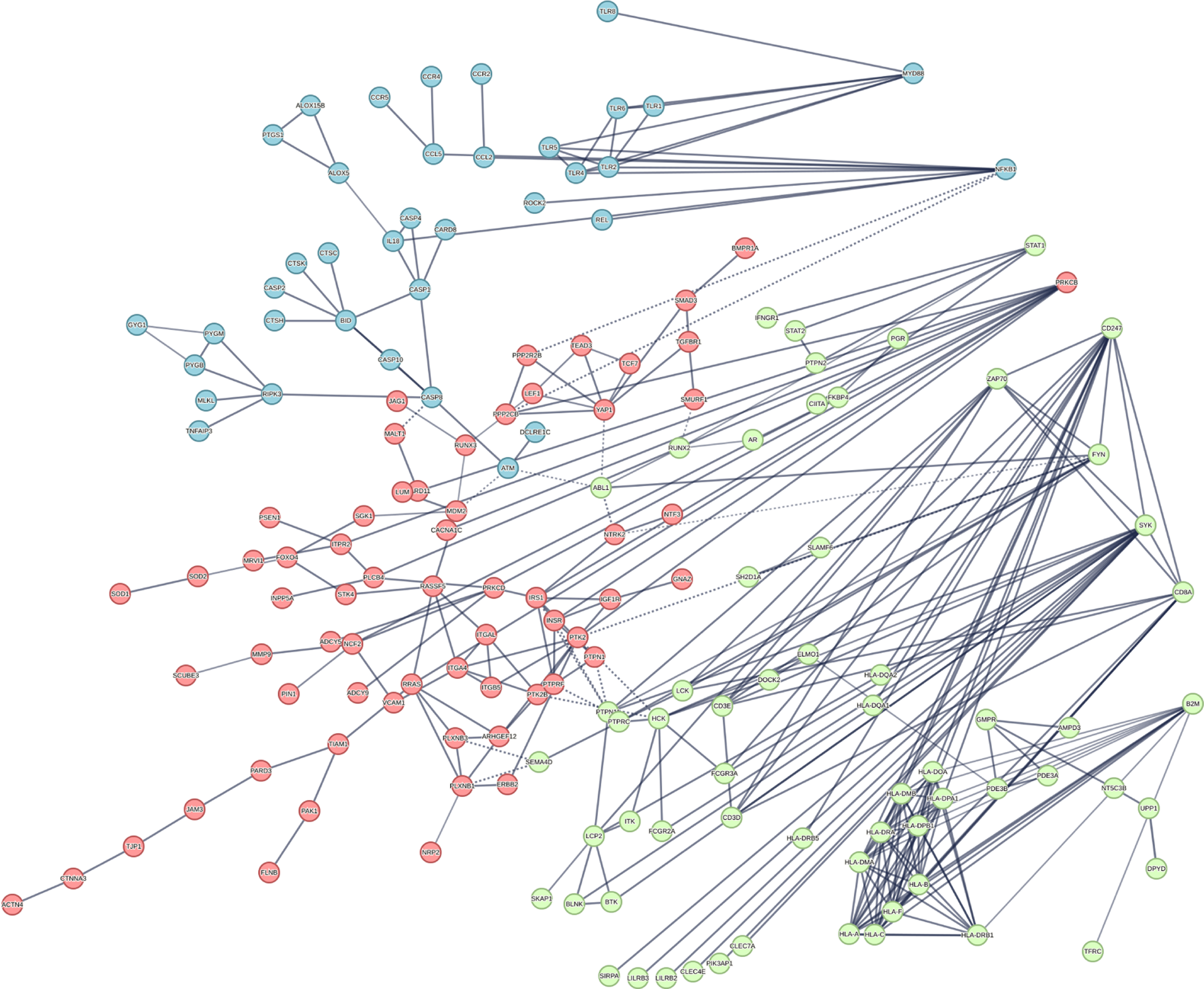
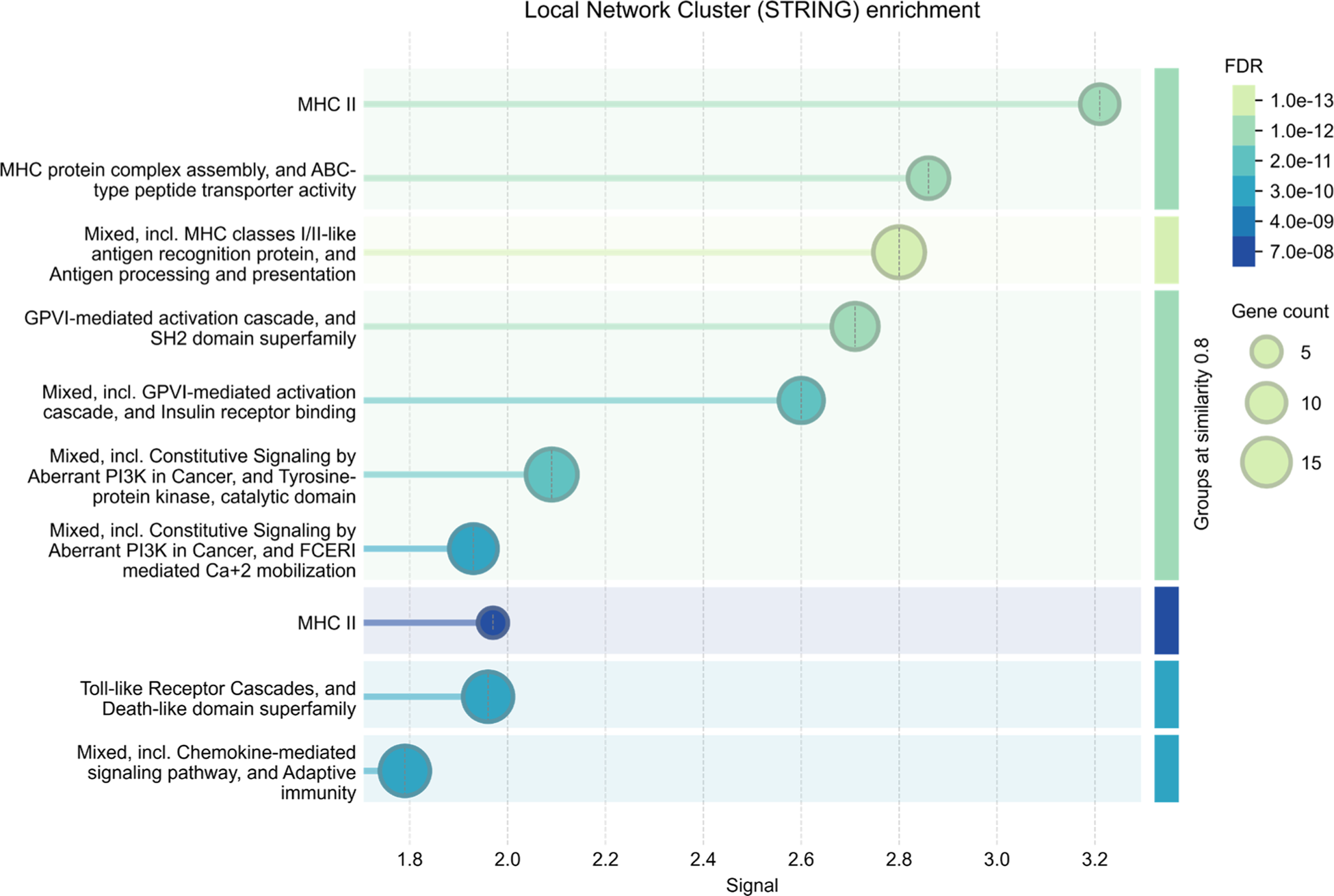
Results: DE genes included 2,135 in GCA-TA, 7,704 in GCA-aorta, 4,097 eGPA-lung, 1,495 AAV-glomerulous. Network analysis on the 1,029 genes that were significant in both TA and aorta from GCA cases but not AAV identified 10 clusters, the largest of which connected 163 genes (Figure 1) with functional enrichment in antigen presentation and toll like receptor signaling (Figure 2). Hub genes with most connections from this cluster include SYK (18) and CD247 (16). SYK (L2FC: 2.5 in TA;1.8 in Aorta) is a biologically compelling tyrosine kinase involved in adaptive immune signaling, cell adhesion, platelet activation and vascular development; it is the selective target of fostamatinib. CD247 (L2FC: 1.59 TA; 2.0 Aorta) is the zeta chain component of the T-cell receptor-CD3 complex involved in coupling antigen recognition to intracellular signaling.
Conclusions: This integrated transcriptome-wide analysis in primary vascular tissues in GCA with AAV to isolate out shared pan-vasculitis pathophysiology identified largely T-cell dominated pathways and hub genes in GCA that are functionally relevant with therapeutic relevance.
Cluster 1 from network analysis of genes common to aorta and TA artery analyses largely belong to antigen presentation (green), toll-like receptor pathways (green), and unannoated group (red). Hub genes are arranged on right side of figure including SYK and CD247.
Functional enrichment analysis of the 163 genes of cluster 1 were further annotated with detailed functions of antigen presentation and innate immune cell signaling.
REFERENCES: NIL.
Acknowledgments: NIL.
Disclosure of Interests: Ingrid Lindquist: None declared, Marcia Friedman Shareholder for Amgen, Employed by Amgen.