fetching data ... 
Background: Artificial intelligence (AI) and machine learning (ML) applications are rapidly expanding across healthcare, including within rheumatology. Early implemented applications have largely focused on administrative and documentation tasks, with emerging second-generation systems to support increasingly complex clinical activities, including diagnosis, risk stratification, and treatment decision-making. Successful implementation of AI technologies in rheumatology will depend not only on technical performance but also on the perceptions, confidence, and preparedness of end users within the rheumatology workforce. Understanding clinicians’ expectations, current use, and concerns regarding AI is therefore essential to inform safe adoption, effective education strategies, and future integration of AI into rheumatology practice.
Objectives: This study aimed to evaluate the current opinions, expectations, and concerns of AI among health care professionals and researchers in rheumatology within the UK.
Methods: A 19-item survey was designed in partnership with rheumatologists, researchers, allied health professionals and nursing staff. The survey was distributed to UK Rheumatology healthcare professionals and researchers through national and regional networks. The questions were divided into three key domains: (i) Participant background data, (ii) Opinions on AI, and (iii) Current applications of AI and ML. Questions were split between multiple choice, ranking of statements, and free text questions. Data were collected over a period of 5 months from 30/06/2025 to 30/11/2025 and were analysed using descriptive statistics.
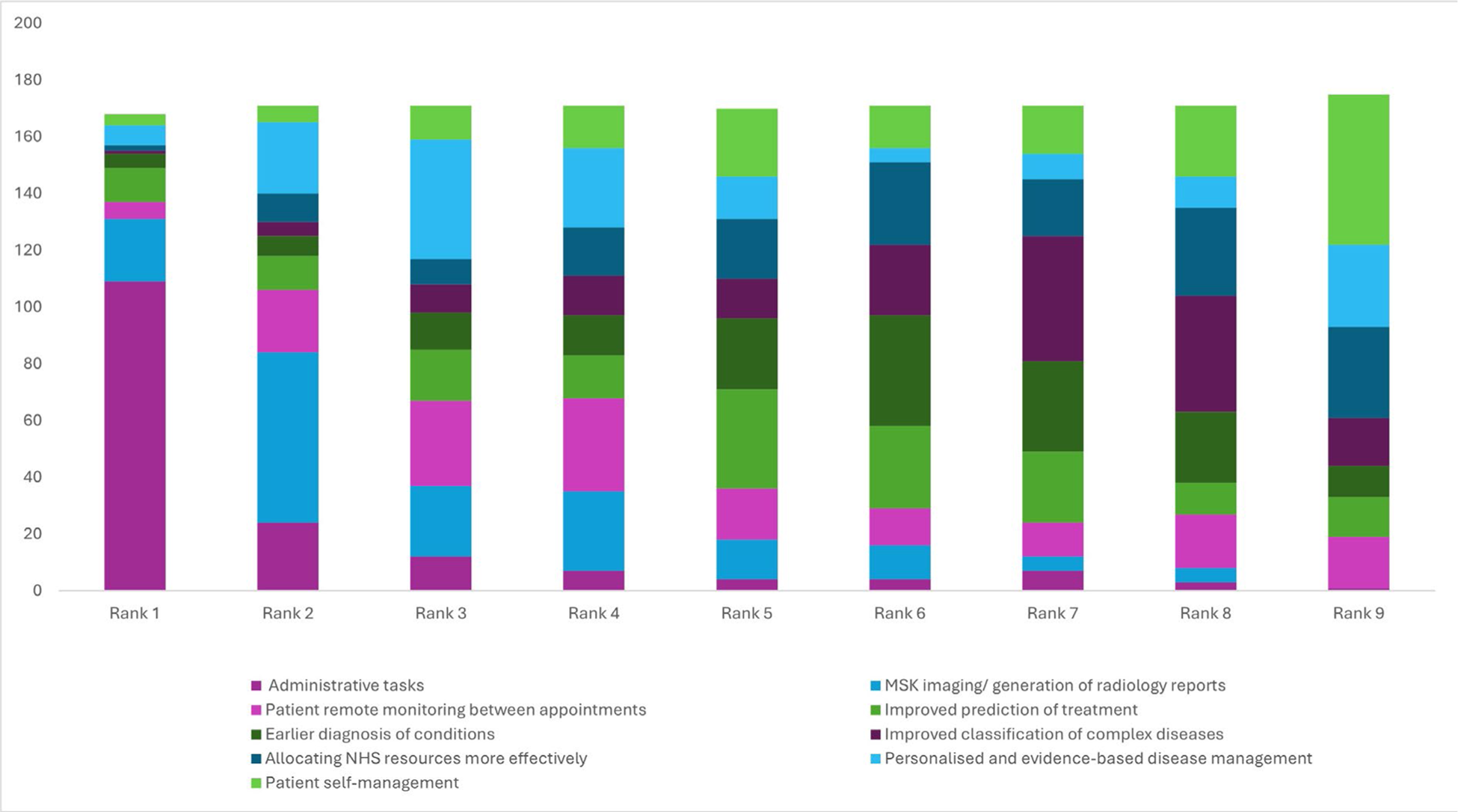
Results: A total of 216 respondents completed the survey. Most participants were female (58%), and two-thirds were aged 36–55 years (67%). Respondents represented a broad range of rheumatology professionals, most commonly consultants (49%) and specialty trainees (15%), specialist nurses (8%), allied health professionals (7%), pharmacists (2%), and non-clinical researchers in rheumatology (10%). Confidence in using digital technologies to access healthcare was generally high, with two-thirds reporting very or extremely high confidence (66%). Self-rated AI knowledge was more modest: most described their knowledge as average (37%) or above average (27%), with relatively few rating their knowledge as excellent (5%). Most respondents anticipated that AI will have a noticeable impact on rheumatology practice within the next five years (70%). Only 16% reported that their workplace had implemented the use of AI tools in clinical practice, and only 19% of workplaces were currently exploring implementation. Administrative tasks were most frequently ranked as the area where AI will have the greatest impact (ranked first,64%), followed by MSK imaging and radiology report generation (ranked second,35%) and patient remote monitoring (ranked third,18%) (Figure 1). Data security and privacy emerged as the most prominent concern (ranked first by 35%), followed by benchmarking clinicians against ML (26%). Workforce displacement was predominantly ranked as the lowest concern (59%). Use of AI tools in some form within clinical settings was common, with only 27% reporting never using AI. AI was most frequently used to look up medical information (36%), improve grammar or clarity of clinical letters (27%), and assist with clinic letter transcription using ambient tools (21%). Respondents expressed greatest interest in further education on the ethical, safe, and secure use of AI (53%) and on the safe and efficient use of large language models in clinical practice (51%). Most respondents believed that AI systems used for predicting treatment outcomes should perform at least at the level of the average clinician (equivalent: 21%; superior: 22%). One in six respondents (16%) expected performance superior to the best-performing clinician.
Conclusions: This national survey demonstrates strong optimism among rheumatology clinicians regarding the near-term impact of AI, particularly for reducing administrative burden. Despite high digital confidence, concerns remain around data governance, transparency, and accountability of AI systems. These findings highlight a critical gap between anticipated impact and readiness for adoption, emphasising the need for careful implementation, targeted education and robust governance frameworks.
Survey Rankings of Predicted AI Impact in Rheumatology
REFERENCES: NIL.
Acknowledgments: NIL.
Disclosure of Interests: None declared.