fetching data ... 
Background: Low-dose methotrexate (MTX) is a fundamental and cost-effective treatment for a wide range of autoimmune diseases. However, it carries a known risk of bone marrow suppression, potentially leading to pancytopenia. Historical case series on MTX-induces pancytopenia have reported mortality rates between 17% and 44% for hospitalized patients [1]. Despite its clinical significance, the true incidence remains poorly defined. Notably, a meta-analysis from 2020 of 30 randomized controlled trials (3,858 patients) reported zero cases of pancytopenia [2]. This discrepancy likely stems from the exclusion of high-risk, comorbid patients in clinical trials, suggesting that trial data underrepresent the risk in real-world clinical practice. Consequently, population-based studies are required to accurately estimate the frequency of MTX-induced pancytopenia. Natural language processing offers a robust approach to identify these cases within unstructured electronic health records.
Objectives: In this study, we used natural language processing to estimate the incidence and clinical consequences of MTX-induced pancytopenia in the Region of Southern Denmark in the period of 2015-2024.
Methods: Study sample. Data were collected from all public hospitals in the Region of Southern Denmark in the period of 01.01.2015-31.12.2024, which includes approximately 1.5 million citizens. We identified all patients who had an ICD-10 code for a condition that can be treated with or developed from MTX. In total, 202 ICD-10 codes were chosen. We searched their full electronic health record for words indicating MTX treatment. These words were identified by a validated language model based on Named Entity Recognition [3]. All patients with at least one word indicating MTX treatment were included. Data collection MTX-induced pancytopenia. We identified patients with pancytopenia in at least one blood sample. Pancytopenia was defined as both anemia (hemoglobin below 7.3 mmol/L for women and 8.3 mmol/L for men), leukopenia (leukocyte count below 3.5x10 9 /L) and thrombocytopenia (platelet count below 165x10 9 /L for women and 145x10 9 /L for men). Their full electronic health record were evaluated manually to identify MTX-induced pancytopenia. A clinical evaluation was performed to exclude cases where another etiology for pancytopenia than MTX was more likely. Validated cases were categorized by treatment indication, route of administration, hospitalization during pancytopenia, and termination of MTX treatment. Treatment duration and dose. We extracted MTX dosing information from free-text patient records using an offline version of an open source large language model. Sentences indicative of MTX treatment were provided to the model in text chunks consisting of the target sentence, one preceding sentence, and two subsequent sentences. The model was prompted to extract the MTX dose mentioned in each chunk. The prompt included multiple instructional examples and was refined iteratively through evaluation runs. Post-processing was performed to infer dose changes over time, calculate treatment duration at each dose level, and derive patient-level summary statistics, including overall treatment duration, cumulative dose, and mean dose. Data analysis. Baseline characteristics were summarized using frequencies and percentages for categorical variables. Continuous variables were reported as means. Cumulative incidence. To conduct a subgroup analysis on a cohort of only new users, a two-year washout period was applied, restricting the study population to patients initiating MTX treatment after January 1, 2017. Follow-up time was calculated from MTX initiation until the first occurrence of either pancytopenia, end of treatment, death, or end of study. The longitudinal risk of MTX-induced pancytopenia was assessed by calculating the cumulative incidence.
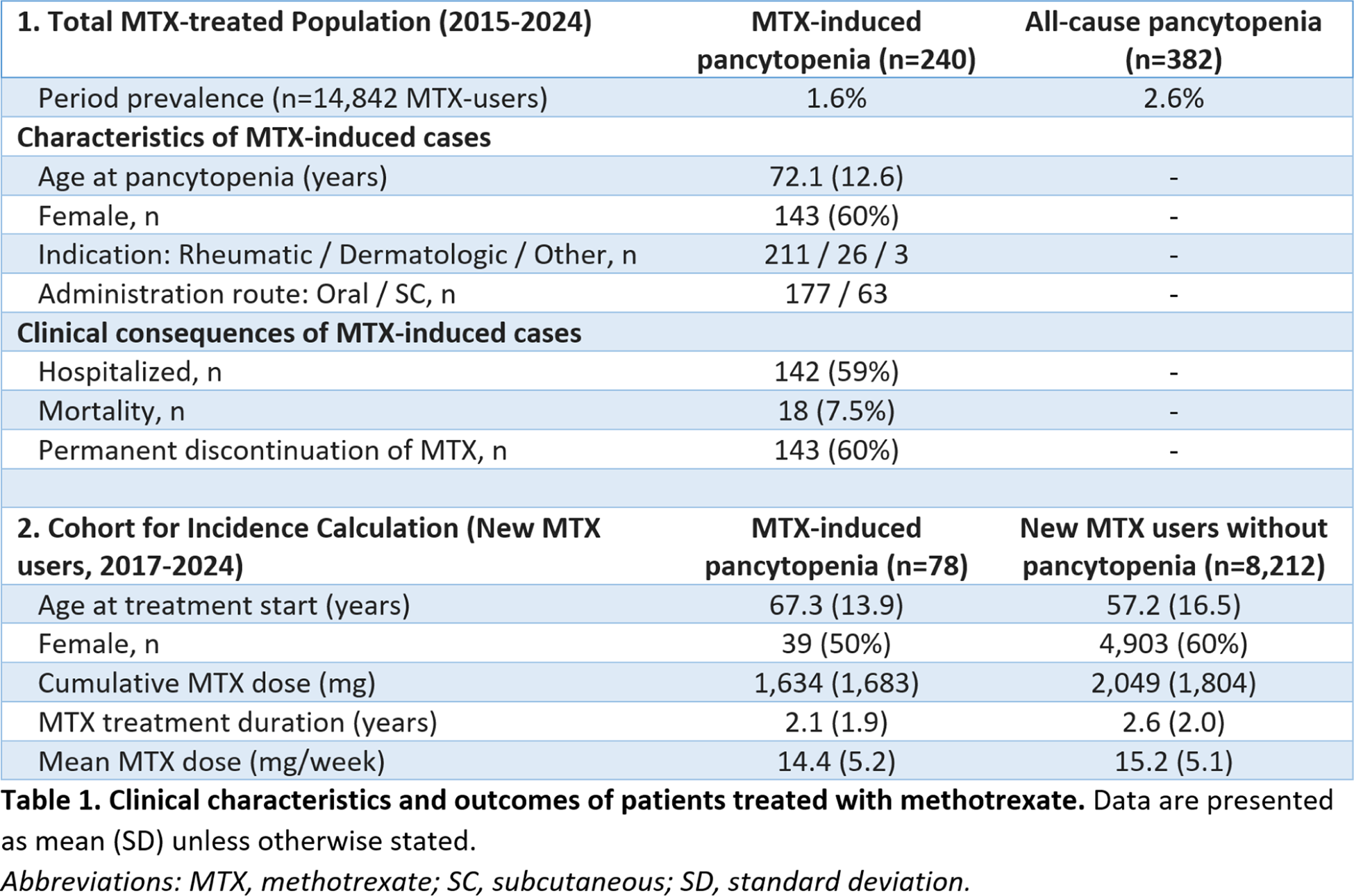
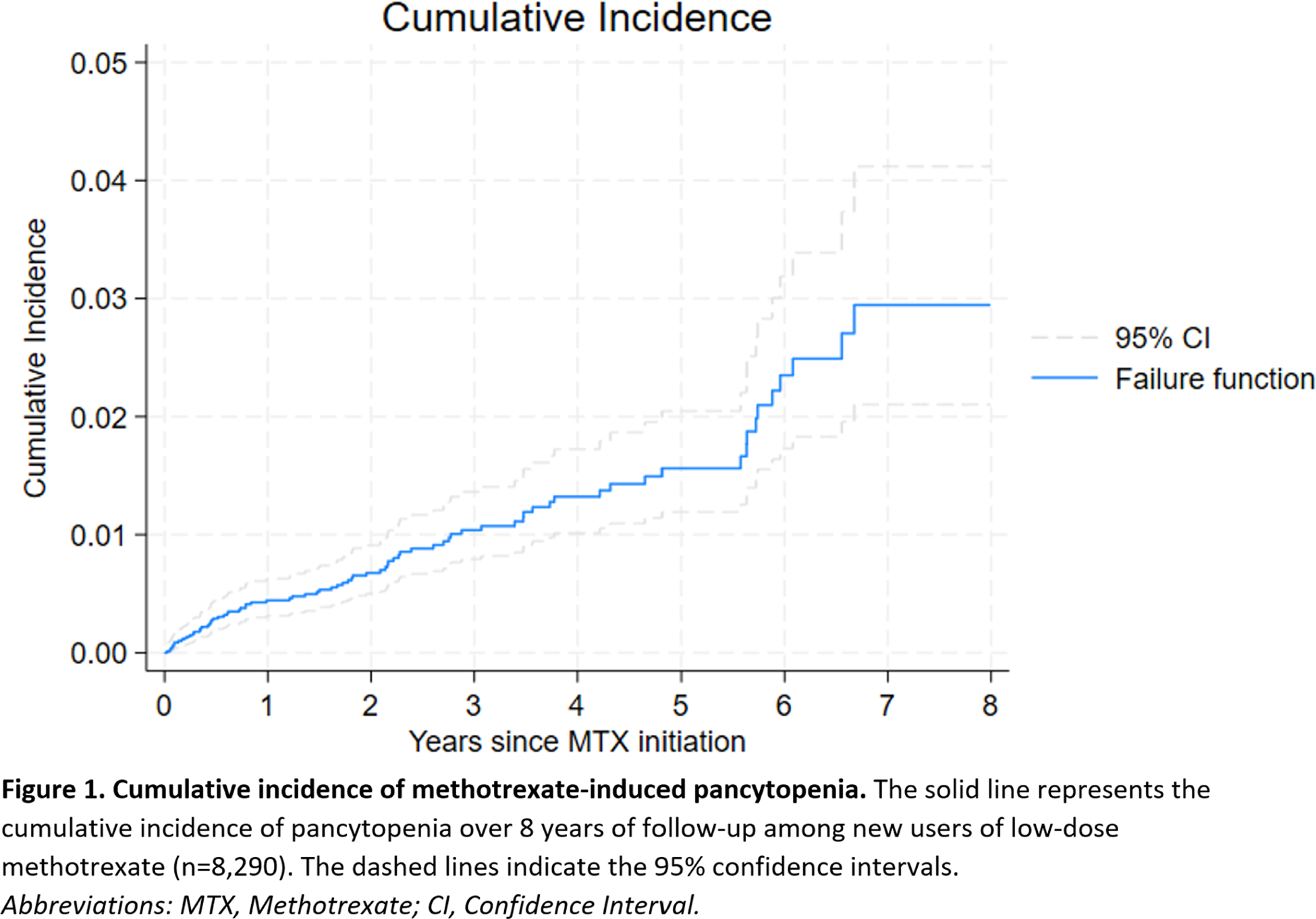
Results: Study sample. A total of 22,272 patients were identified as having both a condition that can be treated or developed by MTX and a word indicating MTX-treatment in their health record in the Region of Southern Denmark in the period of 01.01.2015-31.12.2024. MTX-induced pancytopenia. Of the 22,272 patients in our study sample, 1,546 had at least one blood sample with pancytopenia. By manual review of the 1,546 full electronic health records, we identified 382 patients who developed pancytopenia during MTX treatment. MTX was the cause of pancytopenia in 240 of those cases. In 88% of the 240 cases, treatment were initiated because of a rheumatic condition, mostly rheumatoid arthritis. Almost 60% discontinued MTX treatment and the overall mortality rate of MTX-induced pancytopenia was 7.5% (Table 1.1).Cumulative incidence. Our large language model identified 14,842 patients who received at least one dose of MTX. After the two-year washout period, 8,290 patients were included in the subgroup analysis (Table 1, 2). The cumulative incidence increased steadily and had a tendency to increase further as treatment continued and reached 3% after 7 years (Figure 1).
Conclusions: MTX-induced pancytopenia is a significant clinical challenge with a 7-year cumulative incidence of 3.0%, a need for hospitalization in most cases, and a mortality rate of 7.5%. The steady increase in incidence over time underscores that the risk does not decline with treatment duration, necessitating sustained clinical vigilance even after many years of stable treatment.
REFERENCES: [1] Ajmani S et al. Methotrexate-induced pancytopenia: a case series of 46 patients. Int J Rheum Dis. 2017;20(7):846-51.
[2] Vanni KMM, Lyu H, Solomon DH. Cytopenias among patients with rheumatic diseases using methotrexate: a meta-analysis of randomized controlled clinical trials. Rheumatology (Oxford). 2020;59(4):709-17.
[3] Laursen M et al. Dora explores Clinically Relevant Information in EHRs using NER. In: Proceedings of the 8th International Conference on Natural Language and Speech Processing (ICNLSP-2025); 2025 Jan 15-17; Odense, Denmark. Association for Computational Linguistics; 2025. p. 258–270.
Acknowledgments: NIL.
Disclosure of Interests: Benjamin Schultz Overgaard: None declared, Lina Elkjær Pedersen: None declared, Rasmus Lynggaard: None declared, Pernille Just Vinholt: None declared, Søren Andreas Just is a cofounder of the robotics company ROPCA, producing the automated ultrasound robot ARTHUR.