fetching data ... 
Background: Hyperuricemia (HU) frequently coexists with metabolic-associated steatotic liver disease (MASLD) and low bone mineral density (BMD). Genetic factors, particularly polymorphisms in the glucokinase regulator (GCKR) gene, may contribute to the clustering of these metabolic and skeletal comorbidities, but large-scale population-based evidence remains limited.
Objectives: This study aimed to investigate the associations between common GCKR polymorphisms and hyperuricemia-related comorbidities, including MASLD and low BMD, and to evaluate allele-dose effects across phenotypes.
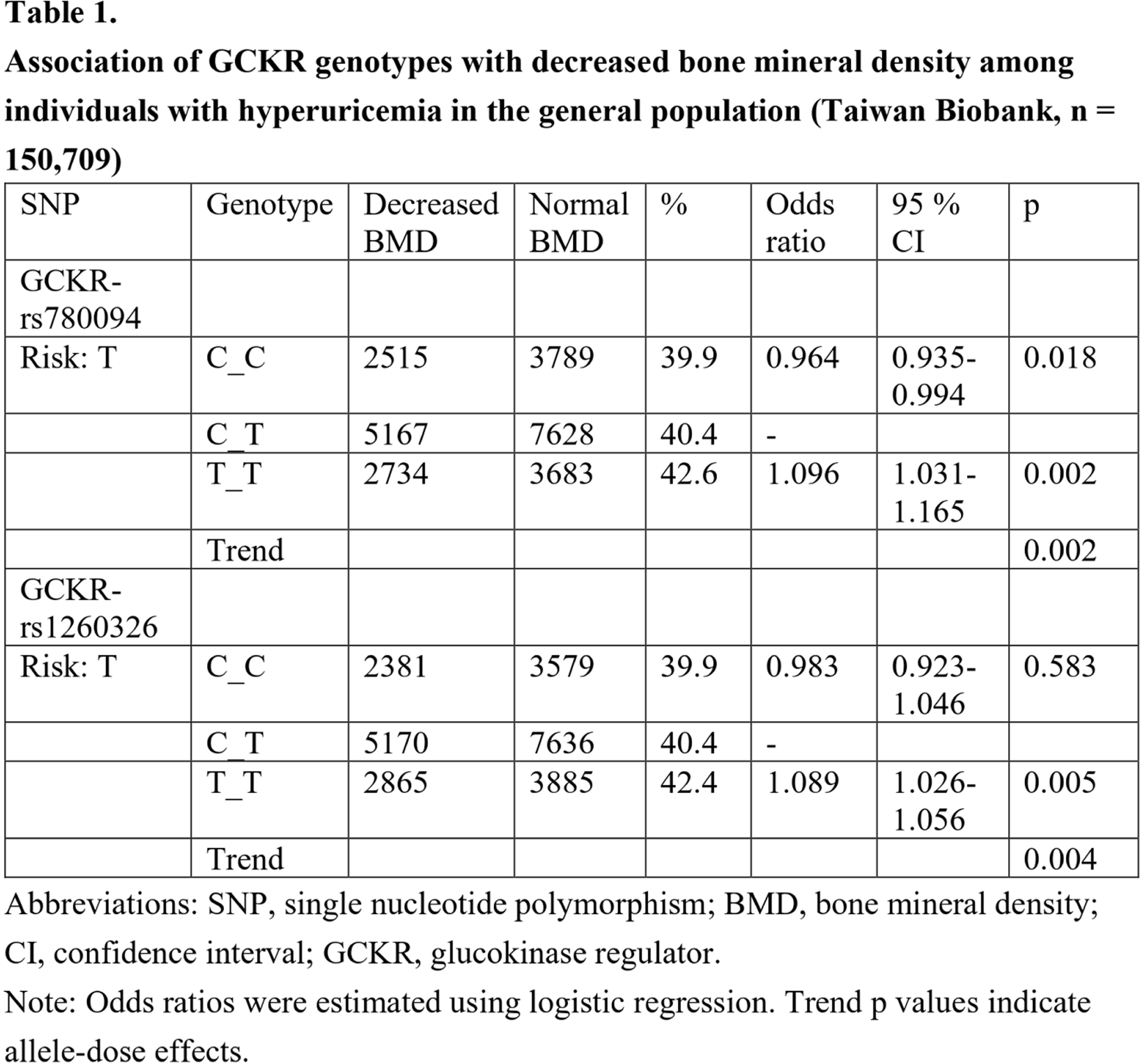
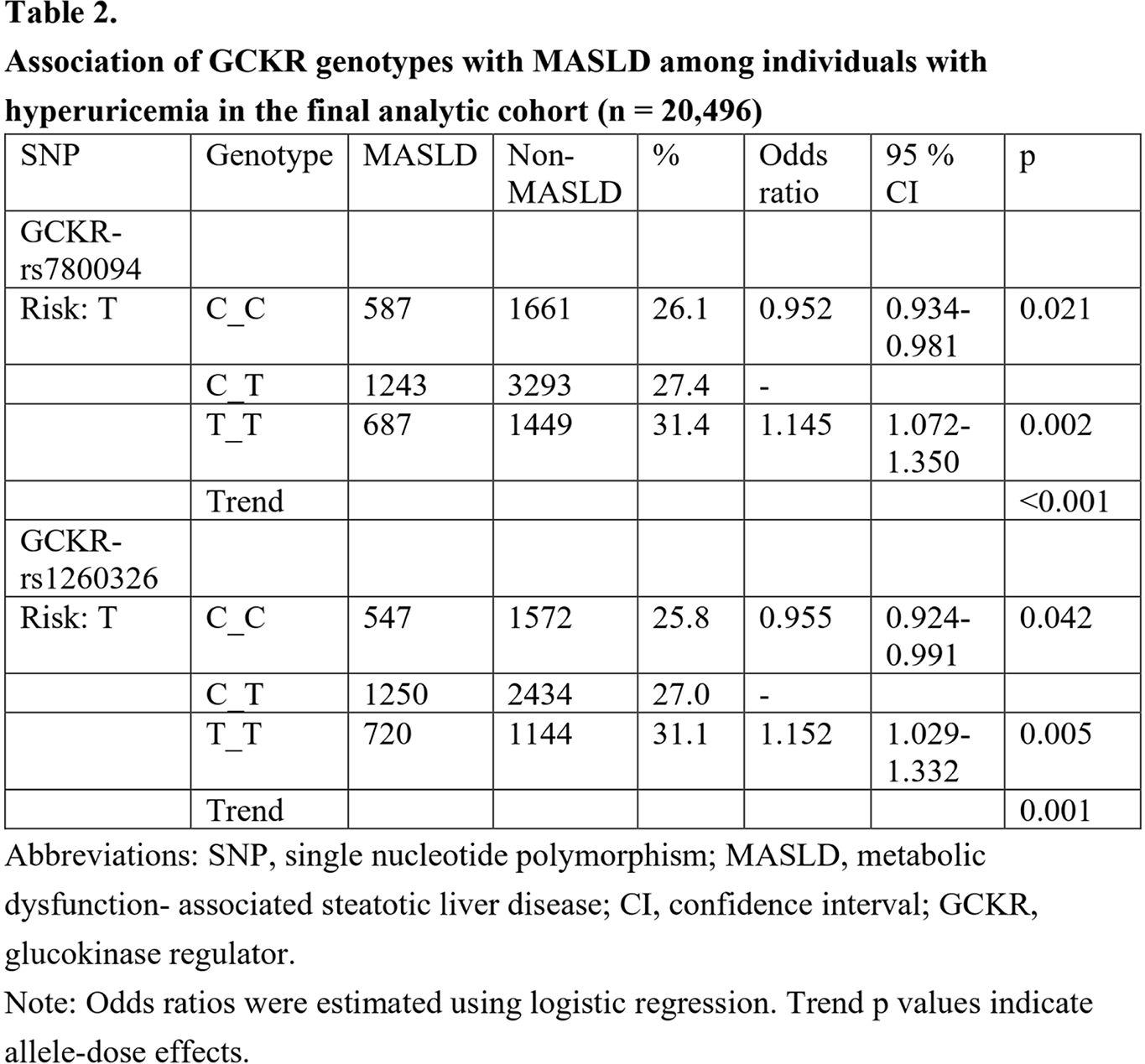
Methods: We conducted a cross-sectional genetic association study using data from the Taiwan Biobank, a nationwide database. A total of 150,709 participants were screened for hyperuricemia. Subgroup analyses were performed in participants with MASLD (n = 20,496). Genotypes of GCKR rs780094 and rs1260326 were analyzed in relation to MASLD and low BMD. Logistic regression models were applied to estimate odds ratios (ORs) and 95% confidence intervals (CIs), and trend analyses were used to evaluate allele-dose effects.
Results: Among individuals with hyperuricemia in the general population (n = 150,709), the T alleles of GCKR rs780094 and rs1260326 were significantly associated with a higher prevalence of low bone mineral density, demonstrating consistent allele-dose effects (p for trend = 0.002 and 0.004, respectively). In the subgroup of hyperuricemic participants with metabolic-associated steatotic liver disease (MASLD, n = 20,496), the prevalence of MASLD increased progressively with the number of GCKR T alleles for both variants (p for trend < 0.001 and 0.001, respectively), indicating a cumulative genetic effect on metabolic comorbidity. Across analyses, carriers of homozygous T genotypes exhibited the highest risk profiles for both skeletal and metabolic outcomes.
Conclusions: Common GCKR polymorphisms, rs780094 and rs1260326, are significantly associated with hyperuricemia-related comorbidities, including MASLD and low bone mineral density, in a large Taiwanese population. The presence of T alleles shows cumulative genetic effects, particularly in individuals with concurrent hyperuricemia and metabolic dysfunction. These findings support the presence of a shared genetic susceptibility underlying the coexistence of metabolic and skeletal comorbidities in hyperuricemia.
REFERENCES: NIL.
Acknowledgments: NIL.
Disclosure of Interests: None declared.