fetching data ... 
Background: Idiopathic inflammatory myopathies (myositis) are characterised by chronic muscle inflammation. Cardiac involvement, including arrhythmias and myocarditis, raises the concern about long-term cardiovascular risk. Exercise has shown to improve muscle function without exacerbating disease activity, yet its cardiac safety profile remains unclear. Previous studies have primarily focused on aerobic interventions, leaving resistance training largely unexplored. Further, limited data exist on cardiac health in stable patients with myositis who have undergone structured exercise regimes.
Objectives: To evaluate the impact of 16 weeks of high-intensity resistance training on cardiac health in patients with stable myositis.
Methods: Post-hoc analysis based on data from a previous RCT (NCT04486261) including adult patients diagnosed with myositis (excluding inclusion body myositis) with stable disease prior to inclusion (Jensen et al., 2024). All participants maintained their usual medication regimen throughout the study to minimize confounding effects. Participants was randomly allocated to resistance training (n=14, age: 44.4 years, disease duration: 5.1 years) or control (n=16, age: 49.1, disease duration: 4.3 years). Compliance with the resistance training protocol was monitored and exceeded 90%, ensuring intervention fidelity. Cardiac health was measured by cardiovascular biomarkers (HbA1C, glucose, lipid profile [total cholesterol, high-density lipoprotein (HDL) cholesterol, low-density lipoprotein (LDL) cholesterol, and triglycerides), 12-lead Electrocardiography (ECG) outcomes (heart rate, p-wave, P-Q interval, QT and QTc [Bassett and Friderica]) and blood pressure. A Linear mixed model was used to evaluate within and between group differences. Results are presented in group means ± standard deviation.
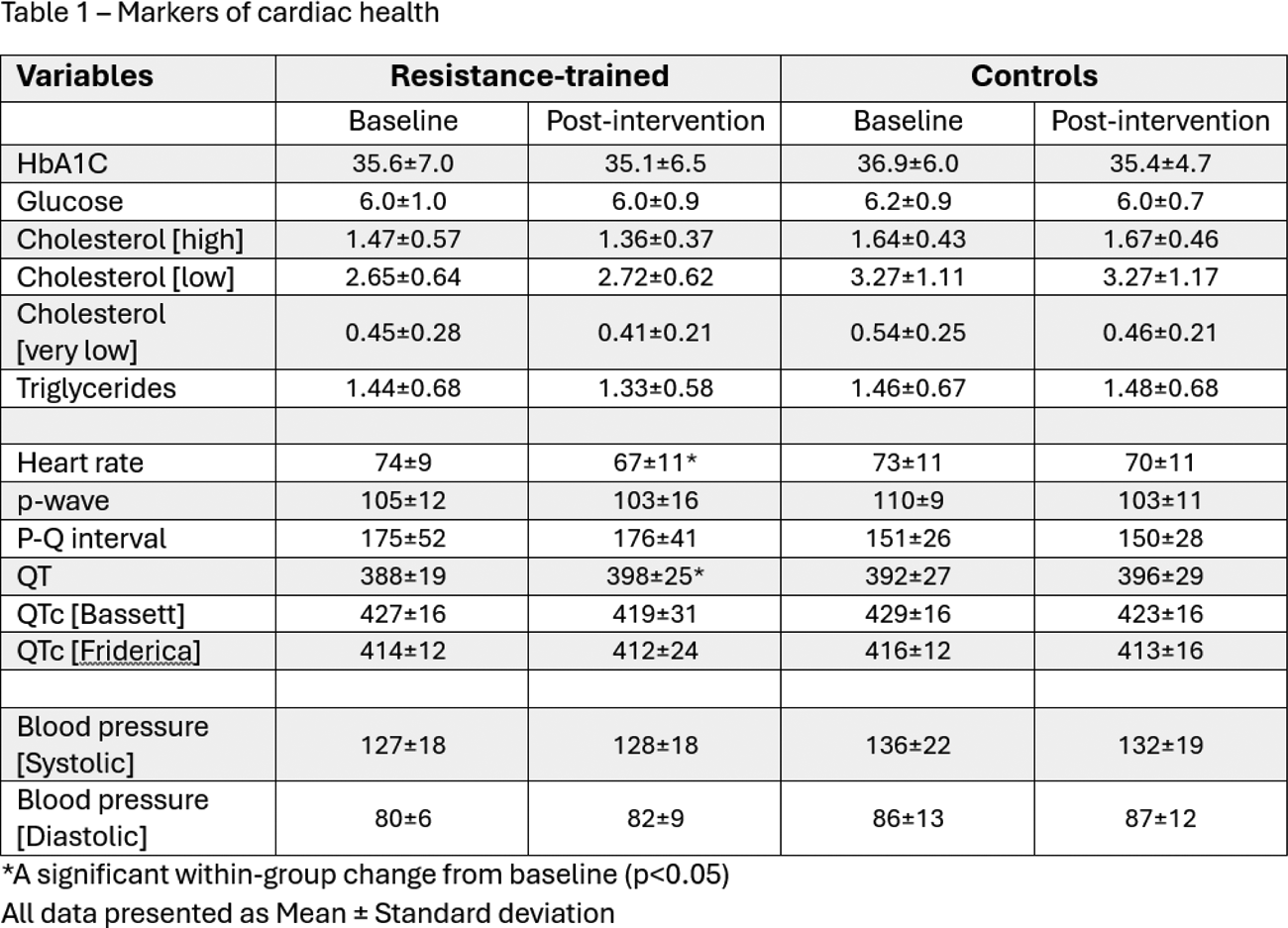
Results: No significant between group differences were observed within the cardiovascular biomarkers following the 16 weeks of high-intensity resistance exercise. Likewise, the components of the 12-lead ECG showed no between group differences after the 16 weeks of intervention. However, within the group of resistance trained individuals, heart rate decreased from 74±9 to 67±11 beats per second (p<0.05), while QT increased from 388±19 to 398±25 milliseconds (p<0.05), while all other cardiovascular biomarkers, ECG parameters, and blood pressure remained unchanged following the 16-week intervention (Table 1). Within the control group, none of the analysed outcomes were observed to change throughout the study period. No adverse cardiac events were reported in either group during the intervention period.
Conclusions: Our findings indicates that patients with stable myositis maintain a normal cardiac health profile. The surrogate marker for aerobic fitness (heart rate) improved in the group of resistance trained individuals, suggesting that 16 weeks high-intensity resistance training can potentially have a positive effect on aerobic capacity in patients with myositis. Despite the expectation of improvement, the cardiovascular risk profile remained unchanged for both the resistance-trained and the controls following the 16 weeks of intervention. Larger longitudinal studies incorporating echocardiography and other cardiac biomarkers are warranted to confirm these findings and guide long-term cardiovascular care in individuals with myositis.
Table 1 .
REFERENCES: [1] Jensen KY, Aagaard P, Suetta C, Nielsen JL, Bech RD, Schrøder HD, Christensen J, Simonsen C, Diederichsen LP. High-intensity resistance training improves quality of life, muscle endurance and strength in patients with myositis: a randomised controlled trial. Rheumatol Int. 2024 Oct;44(10):1909-1921. doi: 10.1007/s00296-024-05698-y. Epub 2024 Aug 27. PMID: 39192022; PMCID: PMC11392978.
Acknowledgments: NIL.
Disclosure of Interests: None declared.