fetching data ... 
Background: Systemic Juvenile Idiopathic Arthritis (sJIA) is a distinct and severe subtype of JIA characterized by chronic inflammation, extra-articular features, and a high risk of long-term morbidity. Predicting clinical trajectories remains a challenge due to the heterogeneous nature of the disease and variable responses to therapy. While conventional statistical methods have identified some risk factors for poor prognosis, they often fail to capture the complex, non-linear interactions between clinical, laboratory, and demographic variables in real-world cohorts.
Objectives: To determine the prognostic performance of several routinely collected clinical parameters at baseline, in predicting active disease status at one-year follow-up, in children with sJIA treated at a pediatric rheumatology centre.
Methods: We retrospectively reviewed the charts of all patients who consulted the pediatric rheumatology clinic at a tertiary care centre in India, during 2008 to 2024. We included all children with sJIA who satisfied EULAR/PReS criteria [1], as determined by a senior pediatric rheumatologist. All children received standard immunosuppressive therapy as per international consensus guidelines [2]. We excluded children with less than one year of follow-up. We abstracted each child’s demographic variables, baseline clinical symptoms and disease severity data. As our primary outcome, we categorized the children into those with active disease and those in remission after one year of follow-up. We developed ML classification models for one-year outcome classification using Random Forest, logistic regression, and KNN algorithms from Python-3.0’s Scikit library. Class imbalance was addressed using SMOTE. Hyperparameter tuning and five-fold cross-validation were done for all ML models, and accuracy scores were compared. From the best-performing ML model, we attempted to determine the variables that contributed the most towards the one-year outcome classification, using the KNN drop-column method.
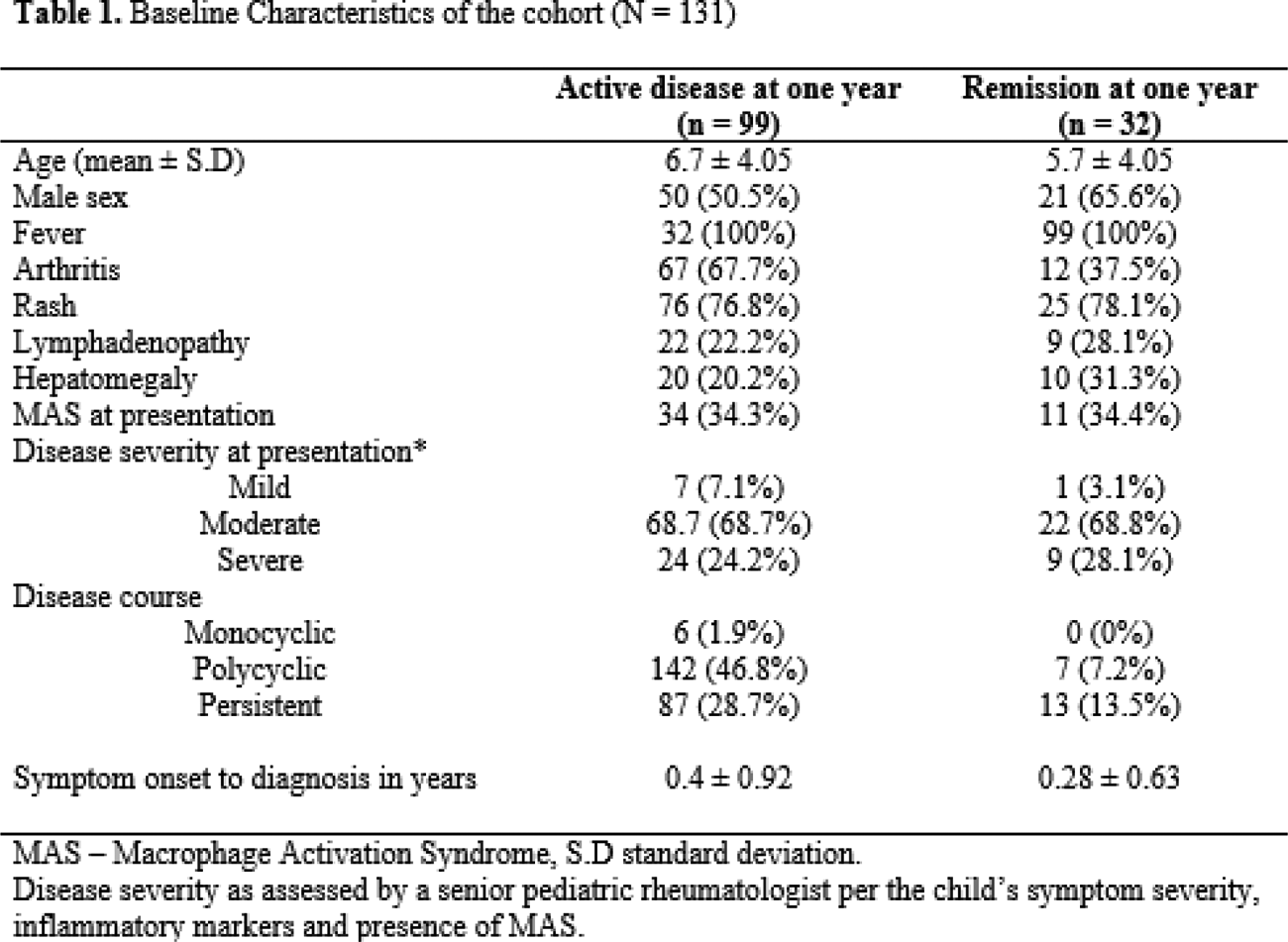
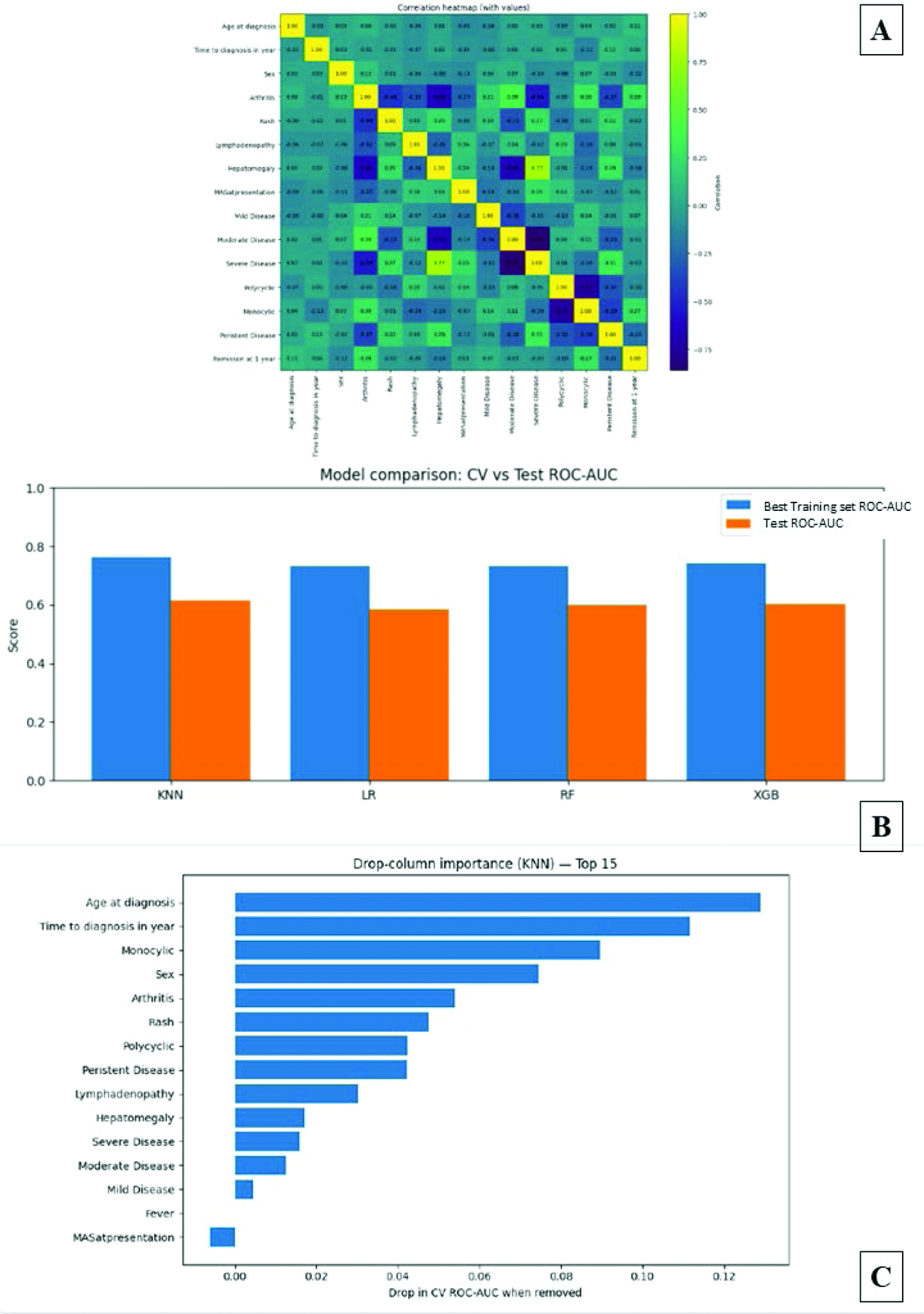
Results: The baseline characteristics of the 131 included children, stratified by their one-year outcomes, are presented in Table 1. The mean age of the cohort was 6.5 ± 4 years, with a male predominance (n = 71, 54.2%). At the one-year follow-up, a large majority of children still had active disease (n = 99, 75.6%), while the remainder had achieved remission; there were no mortalities. Severe disease at presentation was moderately correlated with hepatomegaly (r = 0.77), as depicted in Figure 1A. Compared to other models, the K-Nearest Neighbor (KNN) model demonstrated the best classification performance, with an Area Under the Curve (AUC) of 0.764 on the training set and 0.614 on the validation set (Figure 1B). According to the drop-column method, age at diagnosis (AUC drop of 0.129) and time to diagnosis (AUC drop of 0.112) were the primary contributors to the model’s performance.
Conclusions: Supervised machine learning models revealed that increasing age and prolonged time to diagnosis were predictive of active disease at the one-year follow-up in this real-world cohort. To prevent morbidity and mortality, children with sJIA require prompt diagnosis, accurate risk stratification, and the early initiation of immunosuppression under the care of a pediatric rheumatologist. Future analyses should investigate whether including routine blood investigations and inflammatory markers can further improve the model’s prognostic performance.
REFERENCES: [1] Fautrel B, Mitrovic S, De Matteis A, et al. EULAR/PReS recommendations for the diagnosis and management of Still’s disease, comprising systemic juvenile idiopathic arthritis and adult-onset Still’s disease. Ann Rheum Dis. 2024 Nov 14;83(12):1614-1627. doi: 10.1136/ard-2024-225851.
[2] Beukelman, & CARRA FROST Investigators. First-line options for systemic juvenile idiopathic arthritis treatment: an observational study of Childhood Arthritis and Rheumatology Research Alliance Consensus Treatment Plans. Pediatr Rheumatol Online J. 2022 Dec 8;20(1):113. doi: 10.1186/s12969-022-00768-6.
Acknowledgments: NIL.
Disclosure of Interests: None declared.