fetching data ... 
Background: The dynamic and continuously expanding landscape of medical knowledge presents significant challenges for healthcare professionals. There remains a growing unmet need for unified, up-to-date, and reliable learning resources that can be accessed at the point of care by both trainees and consultants. Traditional resources are often outdated or physically inaccessible during clinical shifts, creating an Accessibility Gap . Conventional internet or AI-based searches frequently yield incorrect, fragmented, or poorly structured information, leading to an Efficiency Gap in information retrieval. Furthermore, the proliferation of clinical guidelines across multiple platforms creates an Integration Gap , making it difficult to consolidate content into a cohesive framework. Cumulatively, these challenges result in a Knowledge-to-Practice Gap , defined as the disconnect between current knowledge and its application in clinical practice [1]. Limited accessibility, inefficient retrieval, and fragmented guideline integration prevent clinicians from making timely, evidence-based decisions, potentially compromising patient care. Evidence suggests that mind mapping facilitates the visual organisation of complex information, enhances memory retention, and supports critical thinking in medical education [2–5]. By enabling rapid access, intuitive navigation, efficient retrieval, and simple updating, mind maps help overcome these gaps in clinical practice.
Objectives: This project aimed to develop a novel, free, web-based educational resource to address these gaps within adult rheumatology practice in the United Kingdom. Specifically, the objectives were to create a highly accessible digital platform for point-of-care use, design an intuitive system to minimise search time, integrate disparate online resources into a single mind-mapping framework, and support evidence-based clinical decision-making through a structured visual approach.
Methods: The Rheumatology Mind Map website (
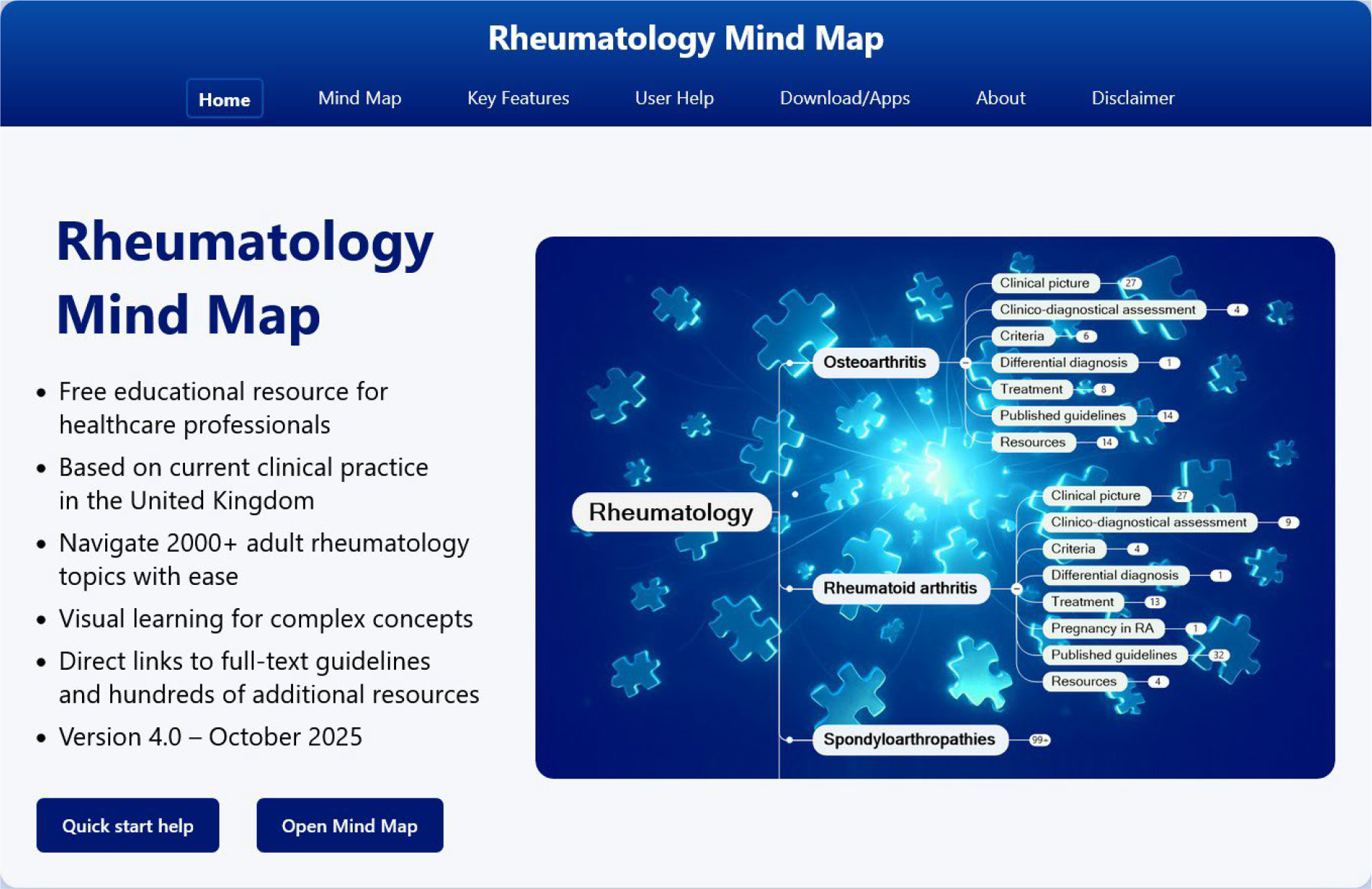
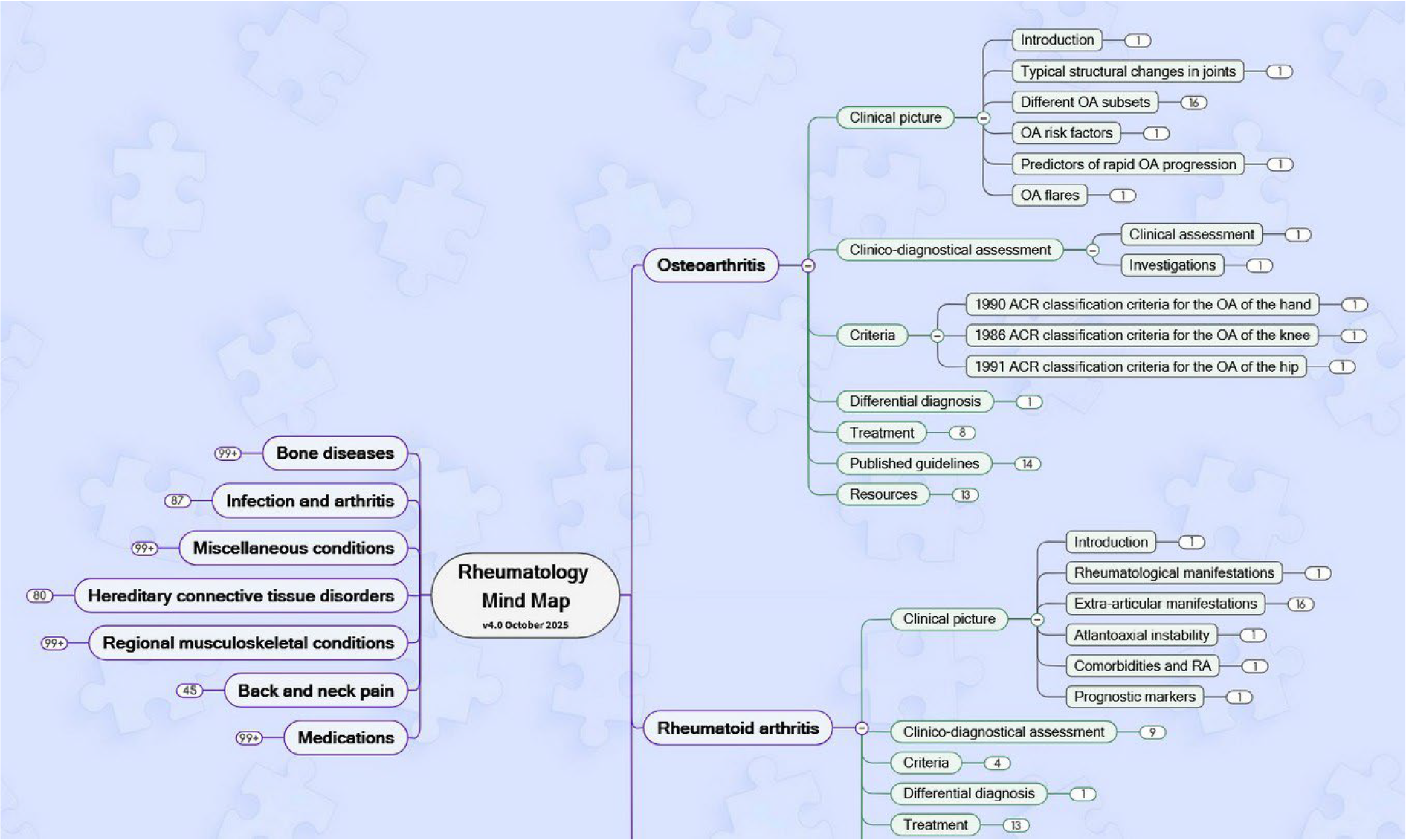
Results: The current platform (Version 4.0, regularly updated) comprises over 2,000 subtopics, offering comprehensive coverage of adult rheumatology practice in the UK. The mind map serves as a free-to-access, centralised hub of clinically relevant information. Content is curated from authoritative UK and international sources and organised in accordance with medical education standards. It includes information on clinical presentation, classification and diagnostic criteria, clinico-diagnostic assessment, investigations, differential diagnoses, management strategies, and pregnancy-related considerations. Direct links are provided to relevant BSR, SIGN, EULAR, NICE, and ACR guidelines, NHS policies, clinical calculators, databases, downloadable templates, patient information resources, and professional societies. Usage analytics over the past one to two years demonstrate consistent engagement, with approximately 20–30 users accessing the platform daily. Regular positive feedback has been received from users, highlighting its clarity, usability, and value in supporting clinical practice.
Conclusions: Mind mapping offers an effective approach to organising and navigating complex medical knowledge. The Rheumatology Mind Map addresses critical information gaps by providing a free, unified, and practice-oriented digital resource tailored to UK rheumatology. It supports both independent learning and evidence-based clinical decision-making through rapid access to structured, up-to-date information.
REFERENCES: [1] Lang ES, Wyer PC, Haynes RB. Knowledge translation: closing the evidence-to-practice gap. Ann Emerg Med. 2007;49(3):355-363.
[2] Aljamal H, Alawneh R, Derbas A, Edaibes M, Ahmed A, Amer L, et al. Efficacy of mind maps and concept maps in enhancing academic performance among undergraduate medical students: a systematic review. Adv Health Sci Educ. 2025;30.
[3] D’Antoni AV. Relationship between the mind map learning strategy and critical thinking in medical students. [Dissertation]. Seton Hall University; 2009. ETDs. No. 1372.
[4] Sajadi AS, Babajani A, Sedigh Maroufi S, Sarraf N. Using the mind map method in medical education, its advantages and challenges: a systematic review. J Educ Health Promot. 2024;13:483.
[5] Shrivastava SRBL, Shrivastava PS. From chaos to clarity: use of mind maps as a tool to ensure better learning among medical students. Indian J Community Med. 2024;49(1):233–236.
Acknowledgments: NIL.
Disclosure of Interests: None declared.