fetching data ... 
Background: Subclinical inflammation is thought to play a central role in the development of multiple long-term conditions (MLTC), often preceding clinical diagnosis by several years. Studying early inflammatory risk at scale is challenging because key inflammatory mediators, such as interleukin-6 (IL-6), are not routinely measured in clinical practice. Instead, population-level and primary care datasets rely on standard laboratory tests such as C-reactive protein (CRP), full blood count indices, and albumin, which individually provide an incomplete and often noisy representation of inflammatory activity. Approaches that can extract latent inflammation-associated information from these routinely collected biomarkers are therefore needed to support early identification of individuals at risk of developing MLTC.
Objectives: To develop a composite measure of subclinical inflammation using routinely collected clinical biomarkers and to evaluate whether this measure can be reliably transferred to predict incident MLTC within two years in large cohorts where comprehensive inflammatory profiling is unavailable.
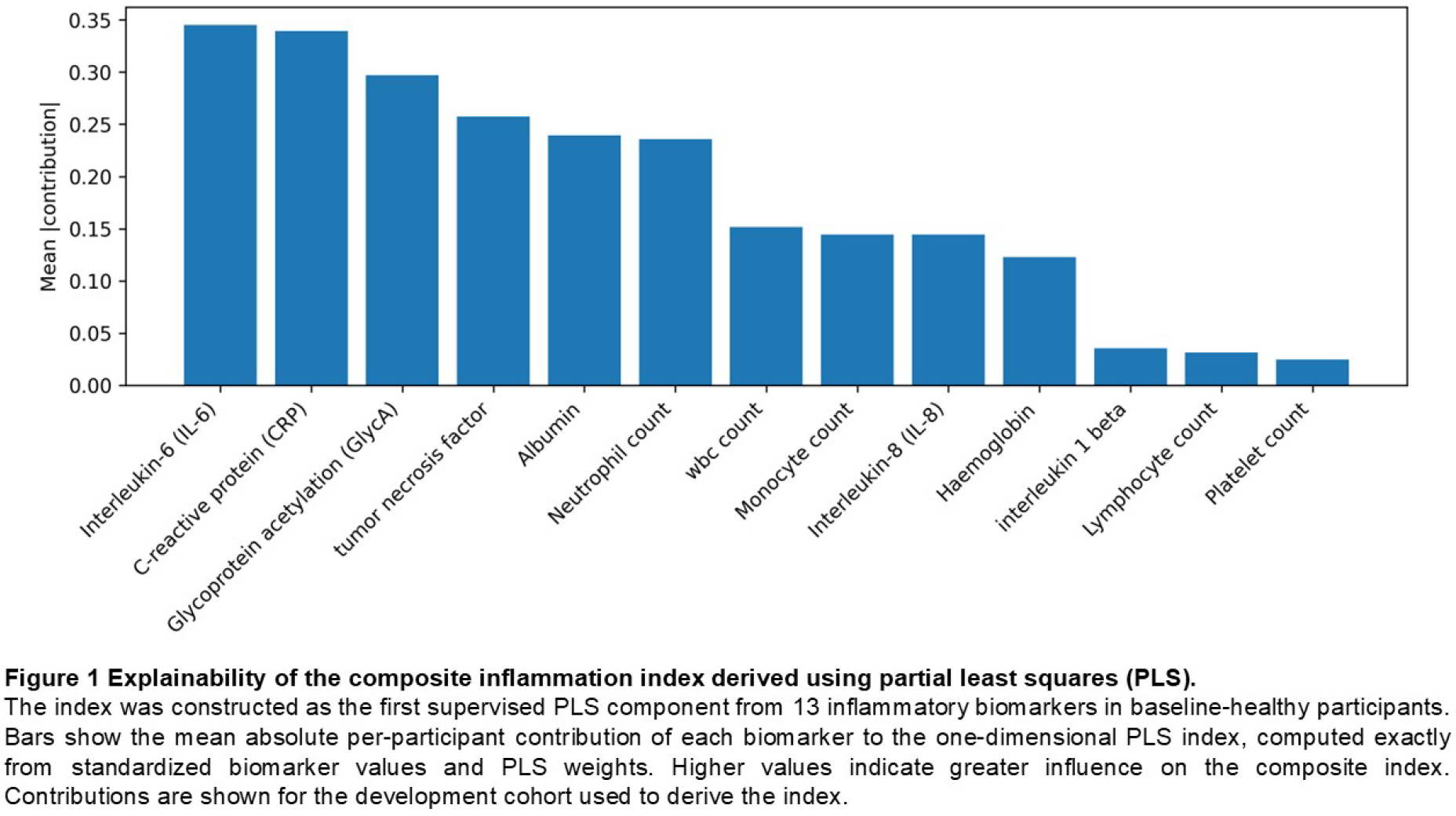
Methods: We analysed baseline-healthy participants from the UK Biobank with linked general practice records. Incident outcomes were defined as one or more, or at least two, new chronic condition diagnoses occurring within two years of recruitment, with analyses focused on cases whose first incident diagnosis occurred between ages 40 and 70. In a development subset with complete measurements for 13 inflammatory biomarkers (N = 3,487), partial least squares (PLS) regression was used to derive a one-dimensional composite inflammation index associated with subsequent disease incidence. The 13 biomarkers comprised eight routinely collected laboratory measures: CRP, white blood cell count, lymphocyte count, neutrophil count, monocyte count, platelet count, haemoglobin, and albumin, together with five additional inflammatory markers not routinely available in clinical practice: glycoprotein acetylation, IL-6, tumour necrosis factor, interleukin-8, and interleukin-1β. To enable application in routine clinical data settings, the composite index was approximated using only the eight routinely collected biomarkers via gradient-boosted regression. Performance was evaluated in a large, non-overlapping validation subset (N = 58,565 for one or more diagnoses; N = 49,078 for two or more diagnoses) and compared with direct eight-biomarker classifiers using the area under the receiver operating characteristic curve (AUROC).
Results: The composite inflammation index showed consistent associations with incident chronic condition diagnoses. When applied to the routine biomarker setting, the transferred index demonstrated improved discrimination compared with direct eight-biomarker models, achieving AUROC 0.573 (p < 0.001) for one or more diagnosis and 0.632 (p < 0.001) for two or more diagnoses within two years. Performance gains were more pronounced for higher disease burden, suggesting that the composite index captures stable inflammation-associated signals relevant to early MLTC development.
Conclusions: Inflammation-associated signals relevant to the development of chronic disease and MLTC, typically characterised using cytokines such as IL-6, can be approximated using routinely collected laboratory measurements, including CRP, full blood count indices, and albumin. A composite inflammation index that is deployable in routine biomarker settings provides a scalable approach for studying inflammation-associated risk and predicting incident multimorbidity in population-based and primary care datasets where direct cytokine measurements are unavailable.
REFERENCES: NIL.
Acknowledgments: NIL.
Disclosure of Interests: None declared.