fetching data ... 
Objectives: Digital health technologies may help address current challenges in rheumatological care, including workforce shortages and rising healthcare costs. A structured understanding of digital maturity is essential to ensure effective, and sustainable implementation. We therefore aimed to develop a comprehensive digital maturity assessment model for rheumatology services on an organisational level and to evaluate the level of digitalisation of rheumatology care worldwide using this model.
Methods: The Digital Rheumatology Radar survey was developed through a structured review of existing digital maturity frameworks and iterative interdisciplinary discussions involving patient representatives, nurses, rheumatologists, and health services researchers. The final questionnaire was implemented as a web-based REDCap survey and distributed to rheumatology healthcare professionals (HCPs) via national representatives and international rheumatology organisations. The Ethics Committee of Philipps-University Marburg confirmed that formal ethical approval was not required for this anonymous survey study (reference: 25-162 ANZ).
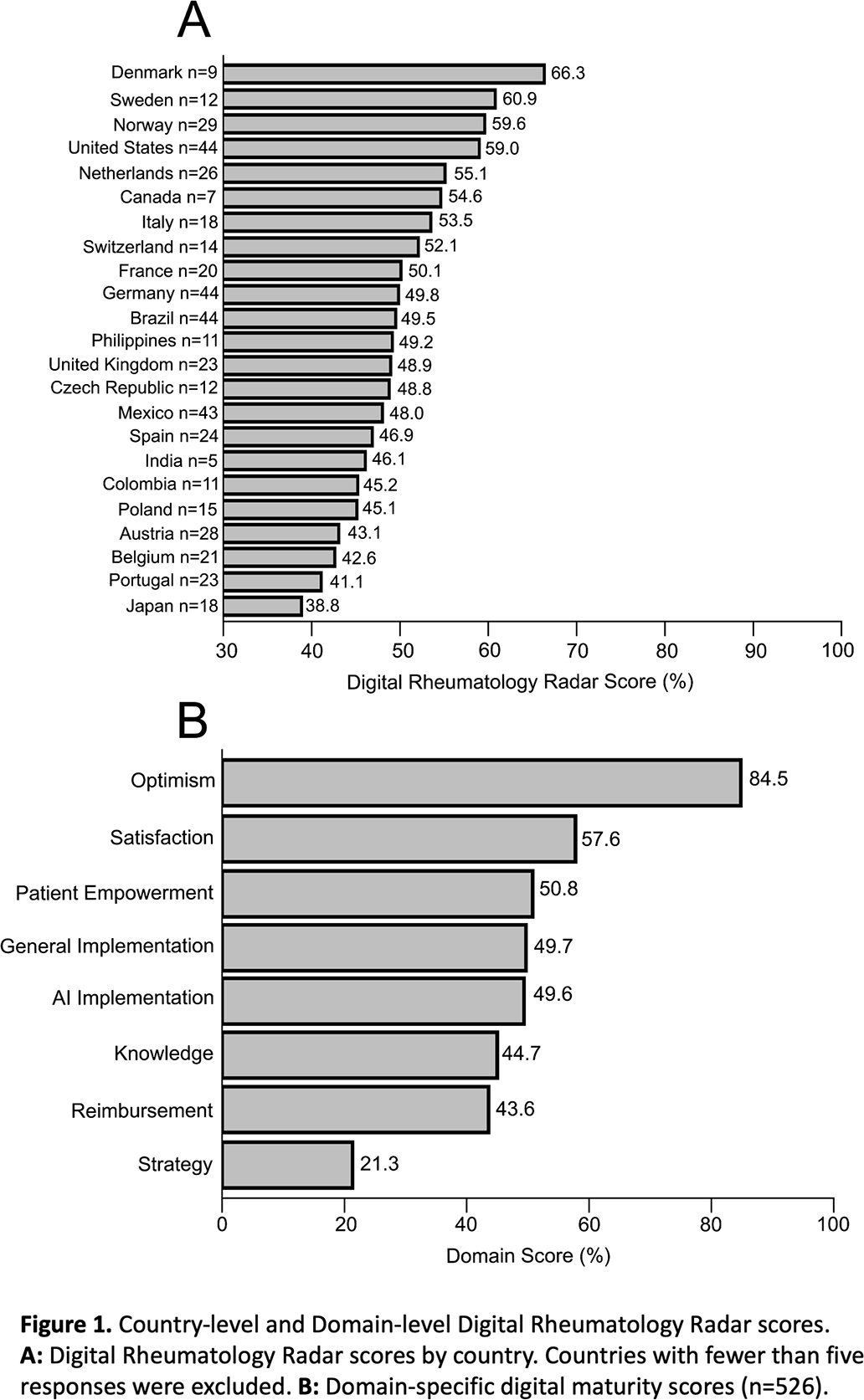
Results: The final model comprised eight digital health dimensions (satisfaction with digital services, optimism, knowledge, organizational strategy, patient empowerment, reimbursement, implementation of services in general, and implementation of artificial intelligence) and included a total of 43 items. Overall, 720 questionnaires were initiated, of which 526 were completed by HCPs, predominantly rheumatologists (86.3%), across 37 countries. Mean age was 43.3 years, 59.1% were female (Table 1). The majority (59.1%) worked at academic or university-affiliated hospitals. The mean (SD) Digital Rheumatology Radar score on a 100-point scale (100=maximum) was 50.2. The three countries with the highest scores were Denmark (66.3), Sweden (60.9) and Norway (59.6) (Figure 1A). Across all respondents, the highest-scoring dimension was Optimism, followed by Satisfaction (Figure 1B). Two thirds (66.3%) of respondents reported using AI tools not approved as medical devices (e.g., ChatGPT, DeepL, OpenEvidence) for work-related purposes on a daily or weekly basis. 90.3% would be interested in additional training in digital health.
Conclusions: To our knowledge, this study constitutes the first and largest systematic international assessment of digital maturity in rheumatology services. Digital maturity varied substantially across countries, with the Scandinavian countries demonstrating the highest levels. The observed gap between optimism and strategic readiness underscores the need for decision-makers to translate current enthusiasm into concrete action. The Digital Rheumatology Radar offers a transparent and scalable questionnaire that enables rheumatology services to identify strengths and gaps, monitor progress over time, and support the strategic implementation of digital health solutions.
Demographic and professional characteristics of the survey respondents (n = 526).
| Survey Respondents | |
|---|---|
| Demographics | |
| Age mean ± SD, min–max | 43.3 ± 11.0, 25-82 |
| Female n (%) | 311 (59.1) |
| Profession n (% ) | |
| Rheumatologist | 371 (70.5) |
| Rheumatologist in training | 84 (16.0) |
| Nurse | 38 (7.2) |
| Nurse specialist | 19 (3.6) |
| Physician assistant | 14 (2.7) |
| Work Place n (% ) | |
| University/Teaching hospital | 311 (59.1) |
| Public general hospital | 93 (17.7) |
| Private hospital/clinic | 77 (14.6) |
| Non-hospital outpatient care center | 41 (7.8) |
| Other healthcare institution | 4 (0.7) |
REFERENCES: NIL.
Acknowledgments: NIL.
Disclosure of Interests: Vanessa Bartsch Johnson & Johnson, Karen Salomon-Escoto Abbvie, Diederik De Cock: None declared, Andre Ribeiro: None declared, Hana Smucrova: None declared, Thomas Davergne: None declared, Anna Fusshoeller: None declared, Vincenzo Venerito: None declared, Shinji Izuka: None declared, Azalea Rojas: None declared, Nina Osteras: None declared, Marcin Milchert: None declared, Margarida Lucas Rocha: None declared, Paul Studenic BMS, CSL Vifor, AbbVie and AstraZeneca, J&J, Diego Benavent: None declared, Astrid van Tubergen Novartis, Abbvie, Novartis, Johnson and Johnson, UCB, Novartis, Antoni Chan: None declared, Felix Muehlensiepen: None declared, Sebastian Kuhn: None declared, Thomas Hügle: None declared, Latika Gupta: None declared, Lise M. Verhoef: None declared, Johannes Knitza Abbvie, AstraZeneca, BMS, Boehringer Ingelheim, Chugai, Fraunhofer, Fachverband Rheumatologische Fachassistenz, GAIA, Galapagos, GSK, Janssen, Lilly, Medac, Novartis, Pfizer, Rheumaakademie, Sanofi, Sobi, UCB, Vila Health, Chugai, AlfaSigma, Deutsche Rheumastiftung.