fetching data ... 
Background: Rheumatoid arthritis (RA) is a chronic autoimmune disease characterized by persistent synovial inflammation, joint destruction, and systemic immune dysregulation. Tumor necrosis factor (TNF) is a key inflammatory mediator in RA pathogenesis and remains a central therapeutic target. Etanercept, a soluble TNFR2–Ig fusion protein, neutralizes soluble TNF and lymphotoxin-α, and differs mechanistically from anti-TNF monoclonal antibodies. Despite its widespread clinical use, a substantial proportion of RA patients fail to achieve sustained clinical response to TNF inhibition. The immunological mechanisms underlying heterogeneous responses to TNFR2-Ig therapy, particularly in longitudinal settings, remain incompletely defined.
Objectives: To characterize the longitudinal immune kinetics induced by etanercept in RA and to evaluate, via high-dimensional systemic profiling, whether clinical efficacy is underpinned by a concerted modular resetting of both innate and adaptive immune landscapes.
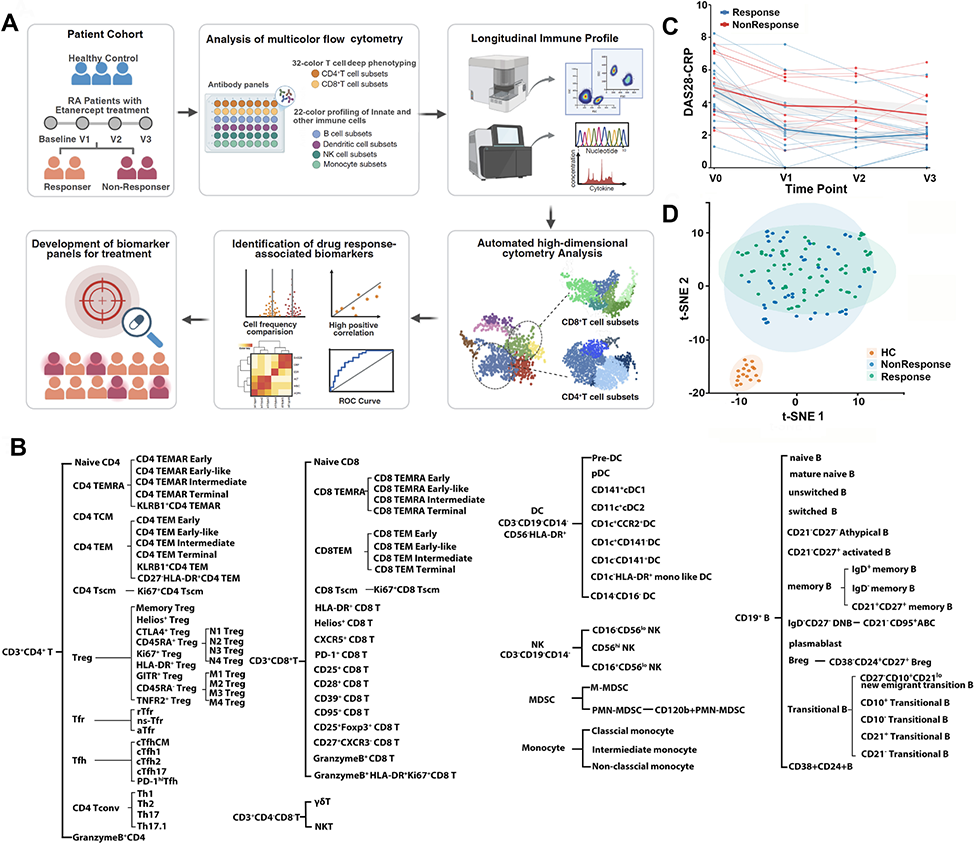
Methods: In this prospective longitudinal cohort, 30 RA patients initiating etanercept were monitored. Clinical response was adjudicated per DAS28-CRP criteria, categorizing patients into responders and non-responders. Deep immunophenotyping of PBMCs was performed at serial intervals via spectral flow cytometry employing a 32-color T-cell and a 22-color B/myeloid panel. We characterized 108 distinct immune subpopulations, including T cells, B cells, NK cells, monocytes, MDSCs, and dendritic cells, using expert-guided hierarchical gating alongside unsupervised t-SNE and FlowSOM clustering. Longitudinal cellular dynamics were modeled using linear mixed-effects models. To resolve cellular evolution, pseudotemporal trajectory inference via Cytotree was utilized to reconstruct differentiation continua and dynamic state transitions. Associations between immune signatures and clinical disease activity were evaluated via correlation analyses.
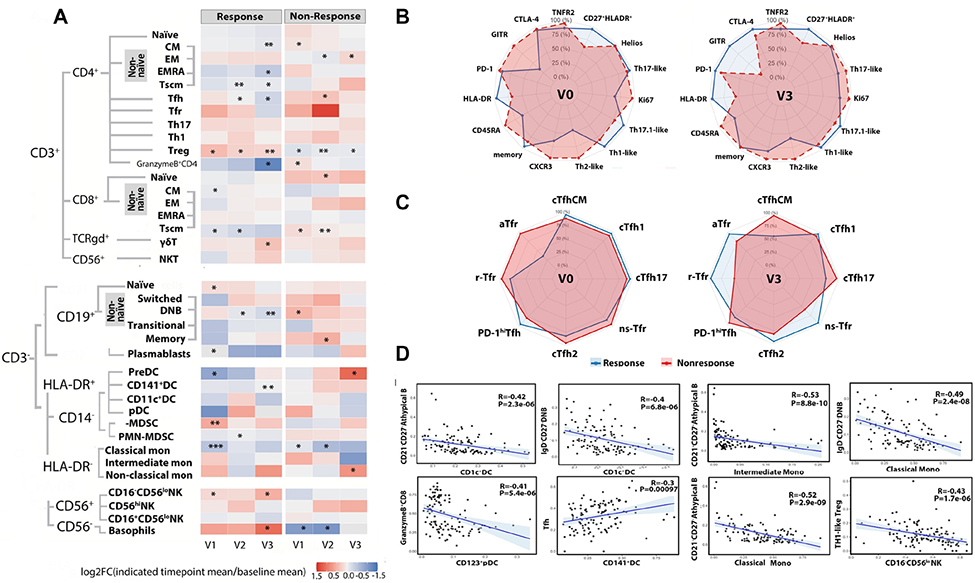
Results: While both cohorts showed initial DAS28-CRP reductions following therapy induction, only responders achieved sustained clinical remission, a divergence not reflected in absolute lymphocyte counts but underpinned by distinct longitudinal immune kinetics. In responders, the resolution of inflammation was characterized by a significant contraction of pro-inflammatory and stem-like memory reservoirs, specifically within the CD4 + TCM, CD4 + TEMRA, and both CD4 + and CD8 + TSCM subsets. Conversely, non-responders exhibited persistent T-cell activation and expansion of effector phenotypes. This contraction in responders was coupled with a qualitative recalibration of the Treg, where integration of activation markers via radar plots revealed a coordinated shift toward a highly suppressive and proliferative Treg signature, including upregulation of GITR, PD-1, HLA-DR, Helios, and Ki-67. To resolve the underlying kinetics, pseudotemporal trajectory inference rooted at naïve Tregs demonstrated that etanercept drives an accelerated differentiation continuum toward mature functional states in responders, while non-responder Tregs remained arrested in early differentiation phases. Furthermore, this systemic rebalancing extended to the follicular niche, where responders demonstrateda restoration of follicular immune homeostasis, characterized by a significant shift in the Tfr/Tfh ratio. This was marked by increased activated Tfr subsets and a reciprocal decline in germinal center–associated helper programs, including cTfhCM, cTfh17, and PD-1 hi Tfh populations.Mirroring these T-cell dynamics, the B-cell compartment in responders underwent a concerted transition from inflammatory and extrafollicular activation states toward a naïve-predominant and regulatory phenotype. Early after treatment initiation, responders displayed an expansion of naïve B cells coincident with a rapid depletion of plasmablasts and a progressive decline in double-negative (DN) B cells. Specifically, inflammatory age-associated B cells (ABCs) and atypical B cells CD21 low CD27 - , both implicated in pathogenic extrafollicular trajectories, were significantly reduced following effective TNF blockade. In contrast, regulatory B cells (Bregs) displayed a reciprocal increasing trend in responders, with correlation analyses confirming that naïve B-cell and Breg frequencies were negatively associated with DAS28 scores, while transitional and unswitched memory B cells correlated positively with deformity joint counts. The myeloid compartment further distinguished clinical outcomes. Specifically, circulating preDCs and CD123 + pDCs declined markedly in responders but persisted or expanded in non-responders, with pDC abundance correlating positively with CRP and joint deformity. While classical monocytes showed a pan-reduction, non-classical monocytes expanded selectively in non-responders, tracking with DAS28 scores. Notably, cross-lineage analyses revealed an inverse correlation between classical monocytes and Bregs, while CD141 + DCs declined longitudinally and correlated robustly with circulating Tfh cells, suggesting their role in orchestrating the follicular axis. Finally, etanercept induced an NK-cell re-equilibration, characterized by the selective expansion ofCD16 - CD56 lo NK cells in responders, which associated negatively with Th1-like Tregs, favoring a homeostatic profile during clinical remission.
Conclusions: Etanercept therapy in RA is associated with distinct longitudinal immune remodeling patterns that differentiate responders from non-responders. Clinical response is characterized by coordinated changes across adaptive and innate immune compartments rather than alterations in individual cell populations. These findings provide a systems-level view of immune dynamics during TNFR2-Ig therapy and support the utility of high-dimensional longitudinal immune profiling for understanding heterogeneous treatment responses in RA.
REFERENCES: NIL.
Acknowledgments: NIL.
Disclosure of Interests: None declared.