fetching data ... 
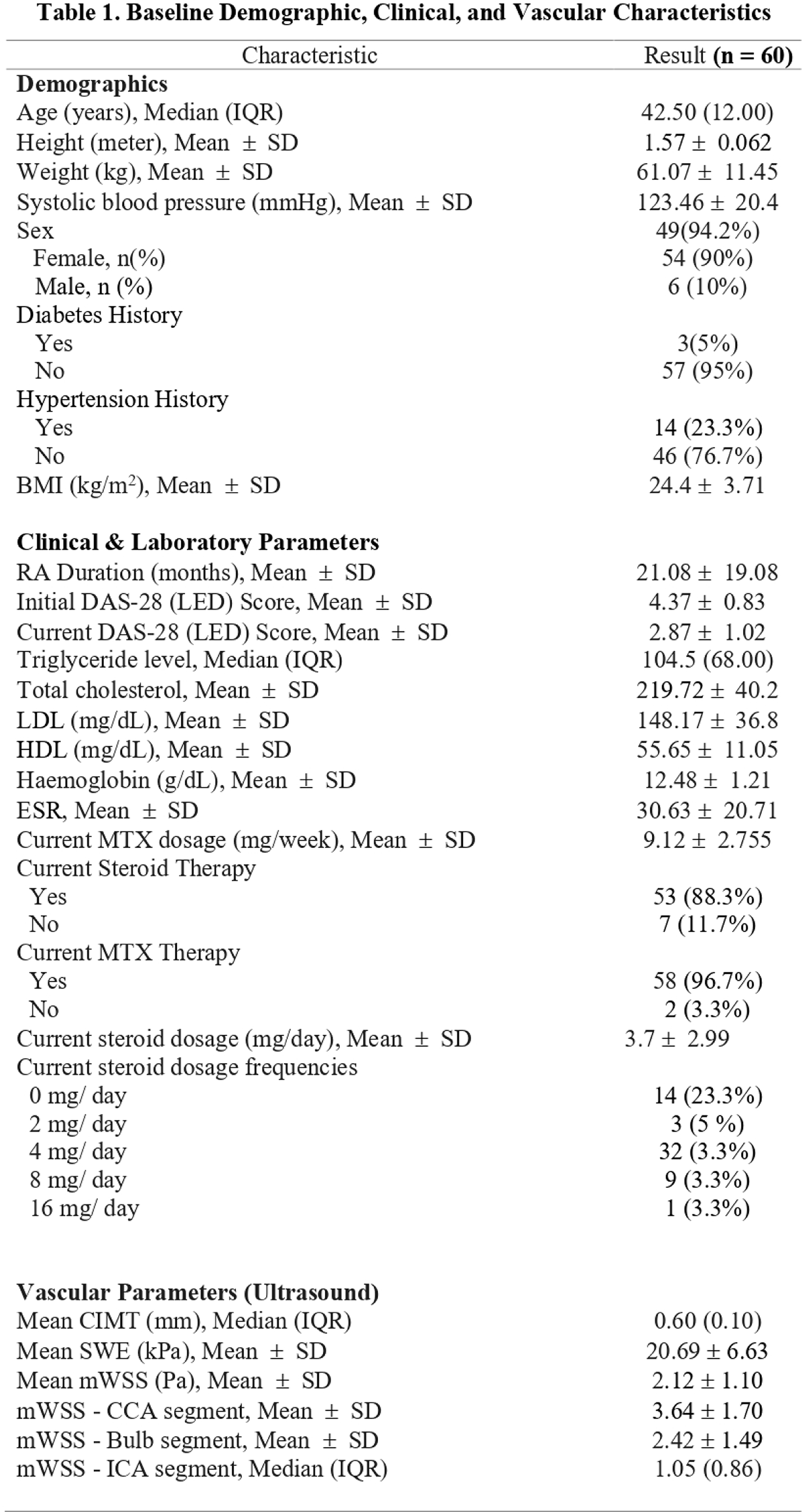
Background: Individuals with rheumatoid arthritis (RA) are at an elevated risk for cardiovascular disease, frequently presenting as accelerated vascular aging. Traditional clinical markers may inadequately reflect the initial phases of this process. While carotid intima-media thickness (CIMT) is a common indicator of structural deterioration, it may not accurately reflect the early mechanical and functional changes in the artery wall. To close this diagnostic gap and improve cardiovascular prevention, we used a multimodal vascular ultrasonography framework that included structural (CIMT), mechanical (Shear Wave Elastography/SWE), and functional (Wall Shear Stress/mWSS) parameters to provide a comprehensive assessment of subclinical arterial alterations in RA patients.
Objectives: To identify independent determinants of vascular alterations in RA patients using a multimodal vascular investigation, specifically evaluating structural modifications (CIMT), arterial stiffness (SWE), and endothelial-blood flow interactions (WSS).
Methods: A cross-sectional study was performed including 60 RA patients from an Indonesia-based tertiary referral hospital Ngoerah Hospital Bali Indonesia. High-resolution ultrasonography was used to measure vascular parameters such Mean CIMT, Mean SWE, and Mean WSS. All participants underwent standardized carotid ultrasound examination performed by two experienced operators blinded to clinical data. We used bivariate (Spearman’s/Pearson) and multivariate linear regression analyses to find independent predictors among demographic, clinical, and laboratory data.
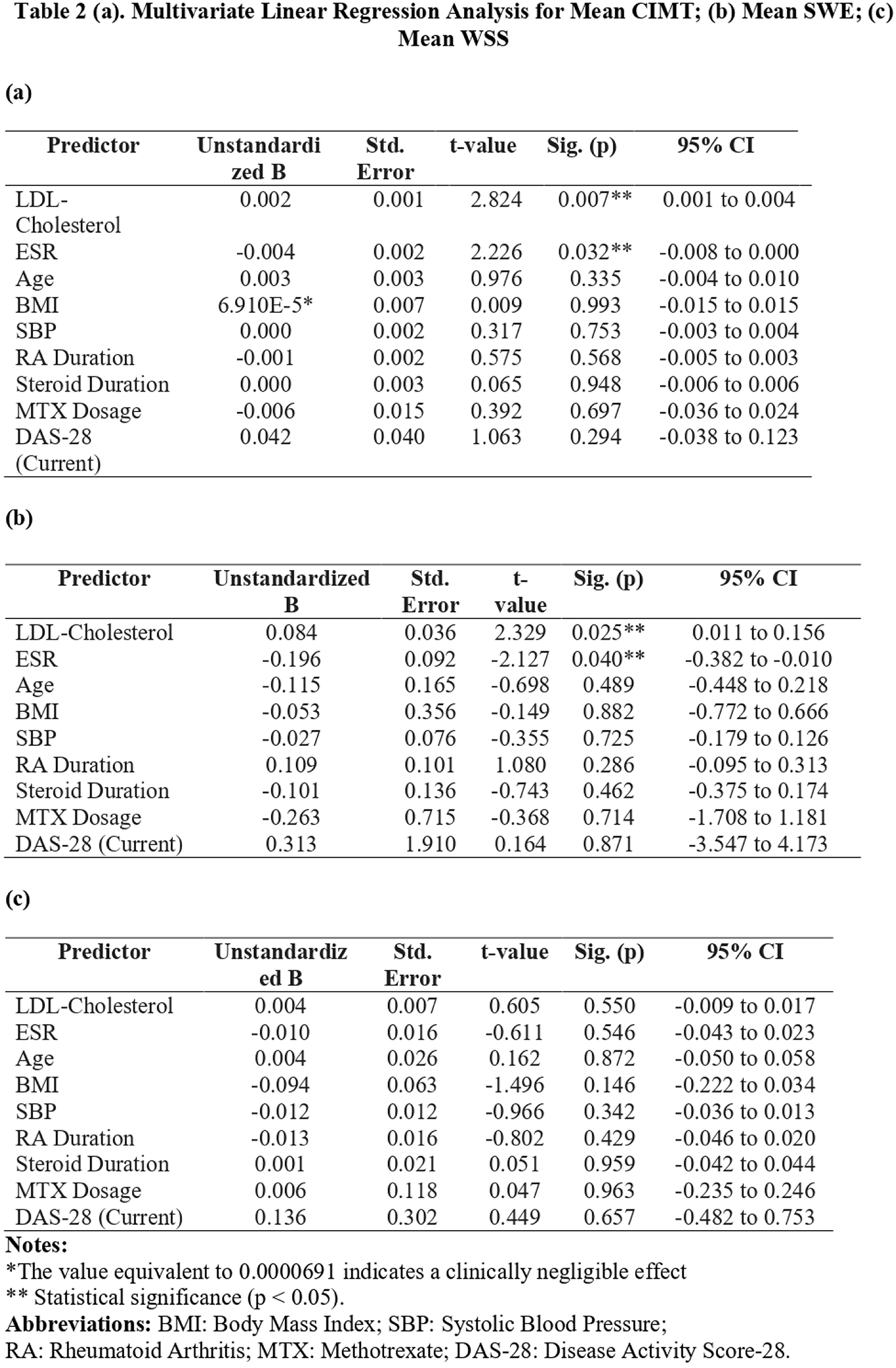
Results: Our study included 60 patients with RA, predominantly female (86.7%), with a median age of 42.50 years and a median RA duration of 4.0 years. We found mean DAS-28 of 2.87 ± 1.02 and a mean LDL-cholesterol level of 148.17 mg/dL. Multivariate analysis indicated that LDL-cholesterol served as significant independent predictor for both structural alterations (mCIMT: B=0.002, p=0.007) and arterial stiffness (mSWE: B=0.084, p=0.025). Moreover, ESR was identified as a significant independent predictor for mCIMT (p=0.032) and mSWE (p=0.040), underscoring the enduring effects of chronic inflammation. Functional flow interactions (mWSS) exhibited a negative correlation with systolic blood pressure in bivariate analysis (r = -0.351, p = 0.014) but did not provide independent predictions in the multivariate model (p > 0.05).
Conclusions: Premature vascular aging in RA is driven by a synergistic double-hit of systemic inflammation and dyslipidemia. While mWSS captures early functional flow dysfunction, CIMT and SWE provide definitive evidence of irreversible structural and mechanical remodeling. Comprehensive CV risk management in RA must aggressively target both ESR and LDL-cholesterol levels.
REFERENCES: [1] Dijkshoorn, B., Raadsen, R. & Nurmohamed, M. T. Cardiovascular Disease Risk in Rheumatoid Arthritis Anno 2022. JCM 11 , 2704 (2022).
[2] Ma Hannawi, S., Hannawi, H. & Al Salmi, I. Cardiovascular Risk in Rheumatoid Arthritis: Literature Review. Oman Med J 36 , e262–e262 (2021).
[3] Choy, E., Ganeshalingam, K., Semb, A. G., Szekanecz, Z. & Nurmohamed, M. Cardiovascular risk in rheumatoid arthritis: recent advances in the understanding of the pivotal role of inflammation, risk predictors and the impact of treatment. Rheumatology 53 , 2143–2154 (2014).
[4] Fernández-Alvarez, V. et al. Evaluation of Intima-Media Thickness and Arterial Stiffness as Early Ultrasound Biomarkers of Carotid Artery Atherosclerosis. Cardiol Ther 11 , 231–247 (2022).
[5] Coburn, B. W. et al. Association of Cardiovascular Outcomes With Low‐Dose Glucocorticoid Prescription in Patients With Rheumatoid Arthritis. Arthritis & Rheumatology 76 , 1585–1593 (2024).
[6] Anyfanti, P. et al. Arterial Stiffness in Rheumatoid Arthritis: Current Knowledge and Future Perspectives. Indian Journal of Rheumatology 17 , 157–165 (2022).
[7] Venetsanopoulou, A. I., Pelechas, E., Voulgari, P. V. & Drosos, A. A. The lipid paradox in rheumatoid arthritis: the dark horse of the augmented cardiovascular risk. Rheumatol Int 40 , 1181–1191 (2020).
[8] Santos-Moreno, P. et al. Inflammaging as a link between autoimmunity and cardiovascular disease: the case of rheumatoid arthritis. RMD Open 7 , e001470 (2021).
[9] Taverner, D. et al. Assessment of arterial stiffness variables in patients with rheumatoid arthritis: A mediation analysis. Sci Rep 9 , 4543 (2019).
[10] Shi, L., Li, X., Liao, W., Wu, W. & Xu, M. Real-Time Elastography versus Shear Wave Elastography on Evaluating the Timely Radiofrequency Ablation Effect of Rabbit Liver: A Preliminary Experimental Study. Diagnostics 13 , 1145 (2023).
[11] Myasoedova, E. et al. Lipid paradox in rheumatoid arthritis: the impact of serum lipid measures and systemic inflammation on the risk of cardiovascular disease. Annals of the Rheumatic Diseases 70 , 482–487 (2011).
[12] Paszkowiak, J. J. & Dardik, A. Arterial Wall Shear Stress: Observations from the Bench to the Bedside. Vasc Endovascular Surg 37 , 47–57 (2003).
[13] Zhou, M. et al. Wall shear stress and its role in atherosclerosis. Front. Cardiovasc. Med. 10 , 1083547 (2023).
Acknowledgments: NIL.
Disclosure of Interests: None declared.