fetching data ... 
Background: For rheumatoid arthritis (RA), the HLA-DRB1 ‘shared epitope’ (SE) allele has been proposed as a predictive biomarker for the effectiveness of mainly abatacept but also other biologic disease-modifying antirheumatic drugs (bDMARDs). Results are, however, inconsistent and often based on smaller cohorts of mainly Asian ancestry.
Objectives: To explore the relative impact of SE-positivity on the effectiveness of different bDMARDs in European patients with RA.
Methods: This was a nested case-control analysis in two prospective, longitudinal cohorts of patients with RA treated with bDMARDs in real-life settings including patients from the Swiss (SCQM) and Danish (DANBIO) clinical rheumatology registries. RA patients with available DNA samples to assess SE were included (Switzerland: SCQM, Denmark: The Biomarker protocol). The presence of one or two HLA-DRB1 alleles was defined as SE-positivity. In Switzerland, HLA-DRB1 polymorphisms were assessed by reverse polymerase chain reaction (PCR) - sequence-specific oligonucleotide primers (SSP) hybridization and by PCR - sequence-specific primers. For Danish samples, genotyping was performed at deCode Genetics (Illumina platform, Graphtyper software). Four bDMARD groups were defined: abatacept, TNF-inhibitors (TNFi), rituximab, tocilizumab. Patients were matched 1:1:1:1 (calendar year, history of b/tsDMARD treatment(s), sex, country) using propensity scores. The primary outcome measure was treatment retention during follow-up. Retention was estimated by Kaplan-Meier retention curves with Log-rank test (by SE-status for each of the four bDMARD groups) and by adjusted Cox regression analysis with hazard ratio (HR) including interaction terms (SE-positive/negative and bDMARD group) and relevant covariates (see footnote Figure 1 ). For sensitivity, number of SE alleles were included. Secondary endpoints were low disease activity (LDA) and remission (at one, two years of follow-up) compared between patients being SE-positive versus negative (for each of the four bDMARD groups) using confounder-adjusted response rate with attrition correction (CARRAC). Missing baseline covariates were imputed using multiple imputations with chained equations.
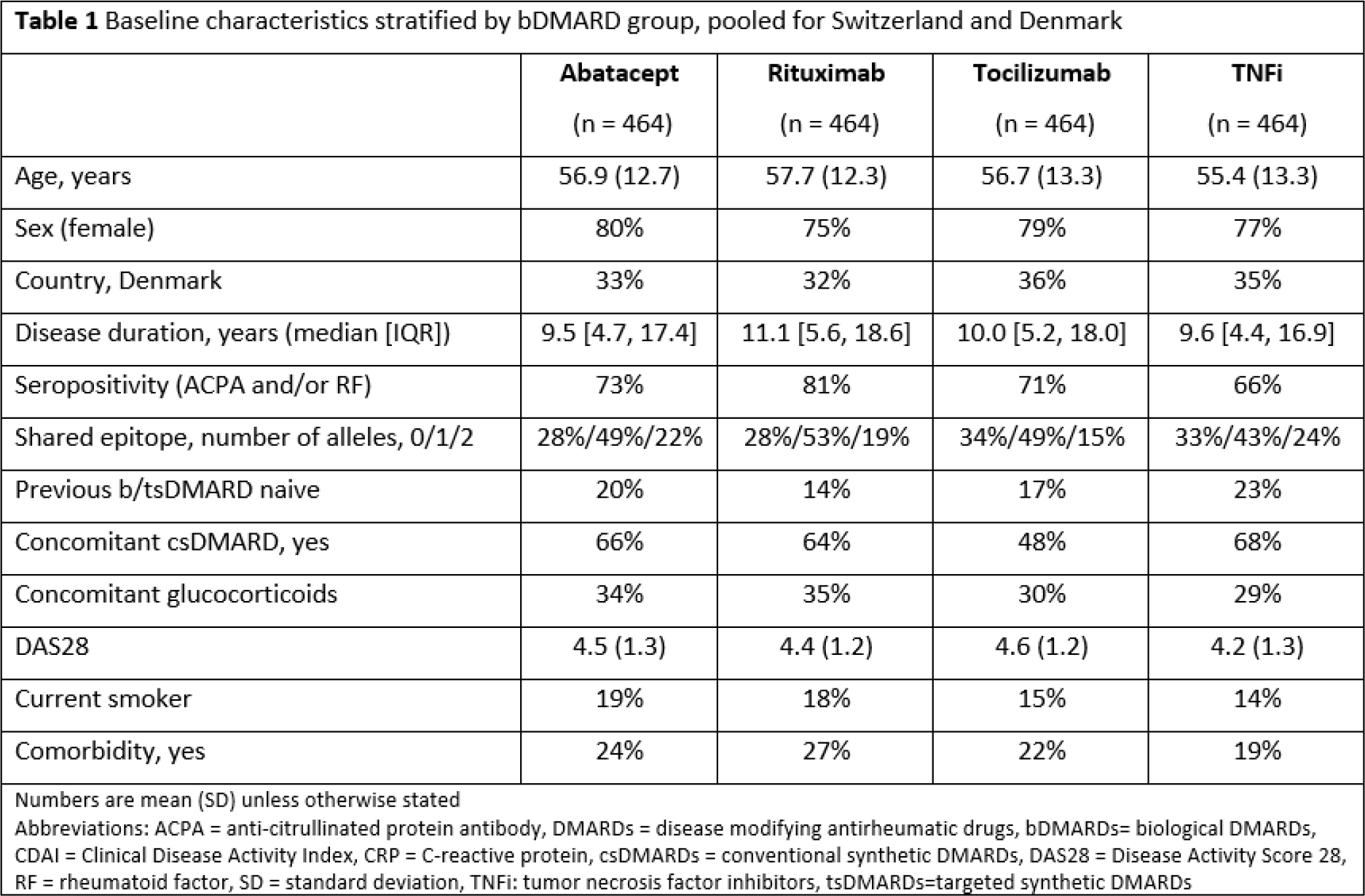
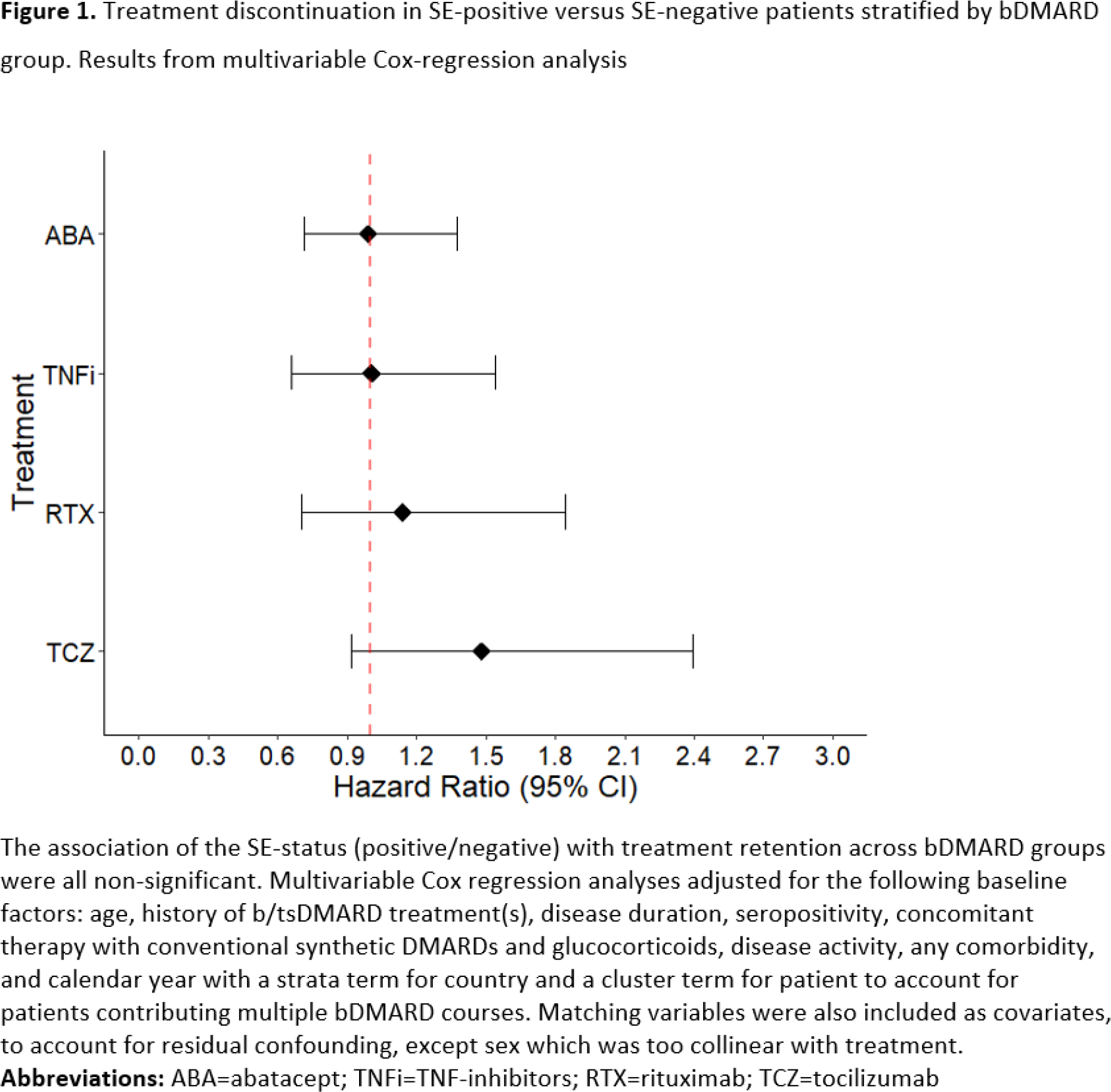
Results: Of the 5,248 treatment courses initially identified, 1,856 patients were included, i.e. 464 patients in each of the four bDMARD groups were matched (SE-negative: 31%, one SE allele: 48%, two alleles: 21%). The number of SE alleles were numerically similar between the groups and approximately 2/3 of patients were SE positive ( Table 1 ). Patients on rituximab tended to have longer disease duration and were more often seropositive. Baseline disease activity was numerially higher in patients treated with abatacept and tocilizumab ( Table 1 ). No effect modification was observed across countries, allowing to pool the data for analysis. For all bDMARD groups, the crude one-year treatment retention was similar in SE-postive versus SE-negative patients (Kaplan-Meyer treatment survival curves, log rank, all p>0.1, details not shown). The association of the SE with treatment retention did not differ significantly across bDMARD groups: abatacept: HR=0.99 (95% CI 0.71, 1.38), TNFi:1.01 (0.66, 1.54), rituximab:1.14 (0.71, 1.84), tocilizumab:1.48 (0.92, 2.40) ( Figure 1 ). Sensitivity analyses taking number of alleles into account showed similar results. LDA and remission rates at one and two years were unassociated with SE status for all four bDMARDs (details not shown).
Conclusions: In this large observational European cohort, approximately 2/3 of patients were SE positive. SE-status had no influence on effectiveness for abatacept, TNF-inhibitors, rituximab or tocilizumab. Thus, SE status was not a valuable biomarker asociated with bDMARD effectiveness in RA patients of mainly European ancestry.
REFERENCES: NIL.
Acknowledgments: NIL.
Disclosure of Interests: Axel Finckh AbbVie, AstraZeneca, BMS, Eli Lilly, MSD, Pfizer, UCB. SCQM affiliated authors: SCQM affiliated authors: The SCQM Foundation is supported by partners as listed on SCQM website (