fetching data ... 
Background: CD161 + regulatory T cells (Tregs) are involved in rheumatoid arthritis (RA) pathogenesis [1]. This study aimed to investigate the levels of circulating CD161 + Tregs in RA patients and to evaluate their associations with clinical features, laboratory indicators, and therapeutic responses.
Objectives: To investigate circulating CD161 + regulatory T cells (Tregs) levels in RA patients and healthy controls (HCs), and evaluate their associations with RA clinical features, laboratory indicators, disease activity, as well as dynamic changes post-treatment and potential as a disease/therapeutic biomarker.
Methods: A total of 172 RA patients meeting the 2010 ACR/EULAR criteria and 110 age- and sex-matched HCs were enrolled. The proportion of CD161 + Tregs in peripheral blood was quantified by flow cytometry. Correlations between CD161 + Treg levels and clinical manifestations, laboratory parameters, and disease activity scores (DAS28-ESR/DAS28-CRP) were assessed. Twenty-four RA patients were longitudinally followed to assess post-treatment changes in CD161 + Tregs and disease activity.
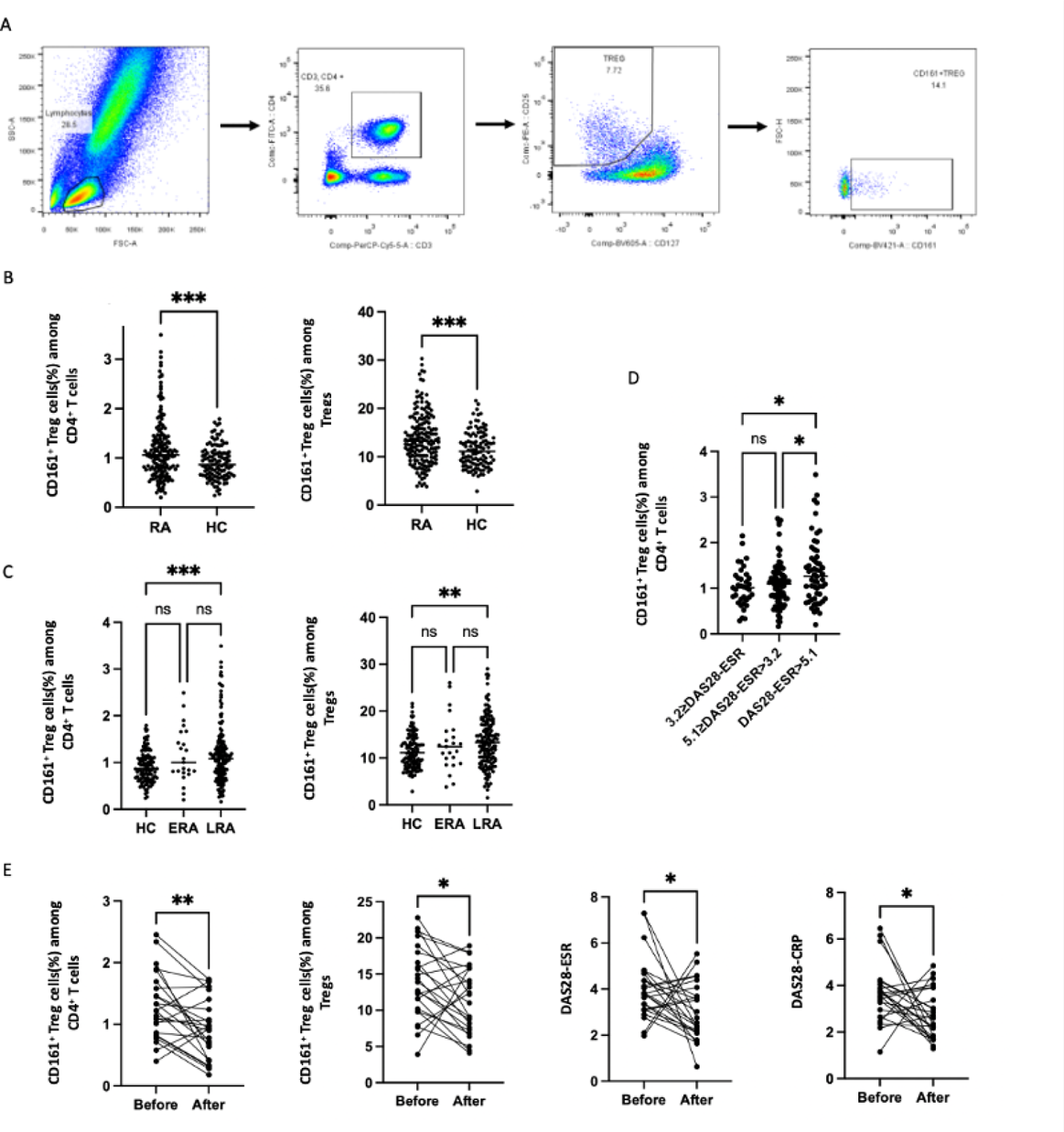
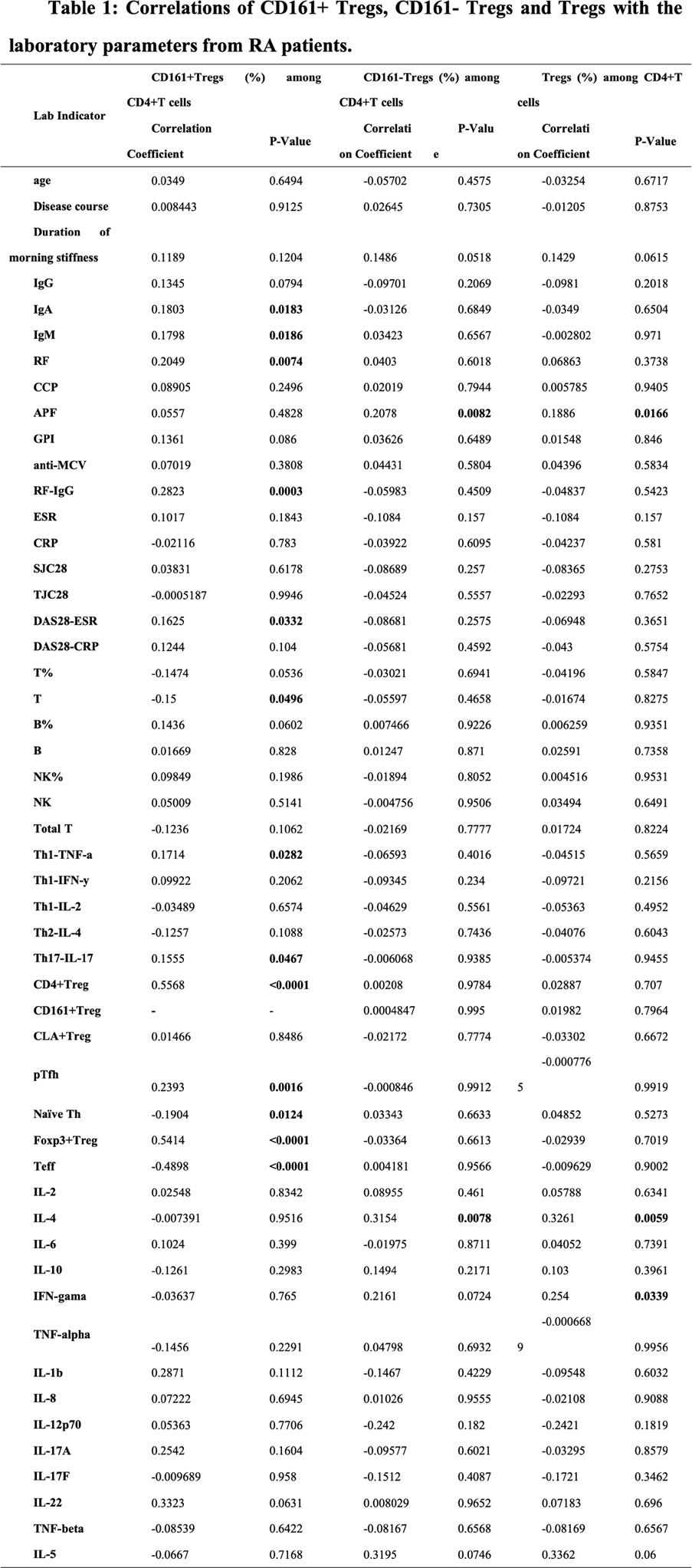
Results: The proportions of CD161 + Tregs within both the total Treg and CD4 + T cell populations were significantly elevated in RA patients compared to HCs (P<0.001, Figure 1A, B ). CD161 + Treg showed positive correlations with IgA, IgM, rheumatoid factor (RF), RF-IgG, Th1-TNF-α, Th17-IL-17, and DAS28-ESR (P<0.05), while exhibiting negative correlations with naïve Th cells and effector T (Teff) cells (P<0.05) ( Table 1 ). CD161 + Treg levels were significantly higher in patients with long-standing RA (LRA) than in HCs (P<0.05, Figure 1C ), and in patients with high disease activity (DAS28-ESR > 5.1) compared to those with moderate/low activity (P<0.05, Figure 1D ). Following treatment, both CD161 + Treg levels and disease activity scores showed significant reductions (P<0.05, Figure 1E ).
Conclusions: CD161 + Tregs are abnormally elevated in RA and closely associated with disease activity, specific clinical manifestations, and key laboratory indicators. Their dynamic changes following treatment support the potential of CD161 + Tregs as a useful biomarker for assessing RA disease status and monitoring therapeutic efficacy.
Characterization of CD161 + Tregs and their association with disease Stages, activity and therapeutic response in rheumatoid arthritis. (A )Representative flow cytometric plots of CD161 + Treg cell subsets were shown. (B ) Percentages of CD161 + Treg cells among Tregs and CD4 + T cells in RA patients (n=172) and HC (n=110) were compared (P < 0.001). (C ) The percentages of CD161+Treg cells among CD4+ T cells and Tregs were significantly elevated in LRA compared to HC (P < 0.05), while no significant differences were observed between HC vs. ERA or ERA vs. LRA (P > 0.05). (D ) The percentage of CD161 + Treg cells among CD4 + T cells was significantly higher in DAS28-ESR>5.1 subgroup than in 3.2≤DAS28-ESR≤5.1 subgroup and DAS28-ESR≤3.2 subgroup (P < 0.05), and a marginal significance was detected between DAS28-ESR≤3.2 and 3.2≤DAS28-ESR≤5.1 subgroup (P > 0.05). (E ) The percentage of CD161 + Treg cells among CD4 + T cells and Tregs were significantly decreased after treatment. DAS28-ESR and DAS28-CRP was significantly reduced after treatment.
REFERENCES: [1] Wang T, Sun X, Zhao J, Zhang J, Zhu H, Li C et al (2015) Regulatory T cells in rheumatoid arthritis showed increased plasticity toward Th17 but retained suppressive function in peripheral blood. Ann Rheum Dis 74(6):1293-301.
Acknowledgments: NIL.
Disclosure of Interests: None declared.