fetching data ... 
Background: Sjögren’s syndrome–related dry eye (SJS) and non–Sjögren dry eye syndrome (DES) present with highly overlapping ocular symptoms, which frequently complicates differential diagnosis and may delay appropriate immunologic evaluation and treatment selection. Although the Ocular Surface Disease Index (OSDI) is widely used to assess symptom severity, its ability to capture disease-specific symptom organization and underlying pathophysiological differences remains limited. Conventional machine learning approaches applied to questionnaire data have shown modest discriminative performance, likely reflecting the nonlinear and interactive nature of dry eye symptoms.
Objectives: To determine whether an interpretable Transformer-based self-attention framework, combined with angular-margin–based classification, can differentiate SJS-related dry eye from non–Sjögren DES using item-level OSDI responses and to identify disease-specific symptom interaction patterns.
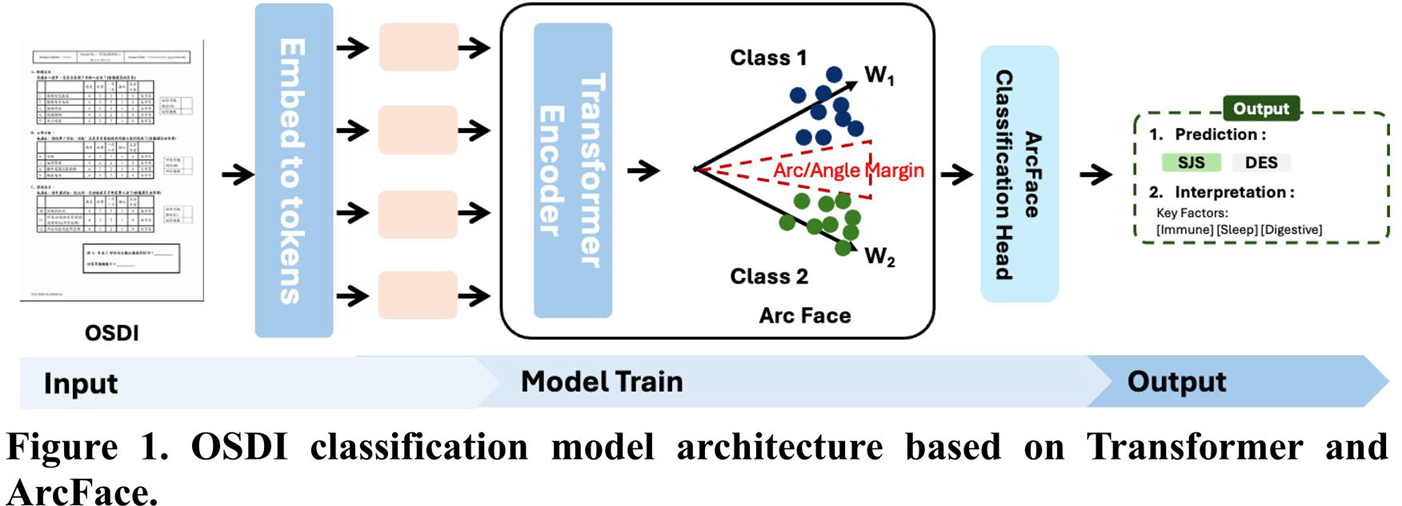
Methods: Item-level OSDI responses were encoded using a Transformer model with self-attention mechanisms to generate semantic feature representations. To enhance class separability under conditions of highly overlapping symptom profiles, an ArcFace (additive angular margin loss) classification strategy was applied to the learned embeddings (Figure 1). Model performance was evaluated using accuracy, F1 score, and area under the receiver operating characteristic curve (AUC) and compared with support vector machine, random forest, and XGBoost classifiers. Attention weights were analyzed to characterize symptom-to-symptom interaction structures, and a difference attention matrix was constructed to isolate disease-specific interaction patterns between groups. Model performance was further assessed after aggregation of OSDI items into predefined clinical domains to evaluate the impact of feature engineering. The training dataset comprised two TBDESJS cohorts and 80% of the ACUDESJS cohort (136 participants), with the remaining 20% of ACUDESJS participants (34 participants) reserved for testing. Subject-level 5-fold cross-validation was performed within the training set to enhance generalizability.
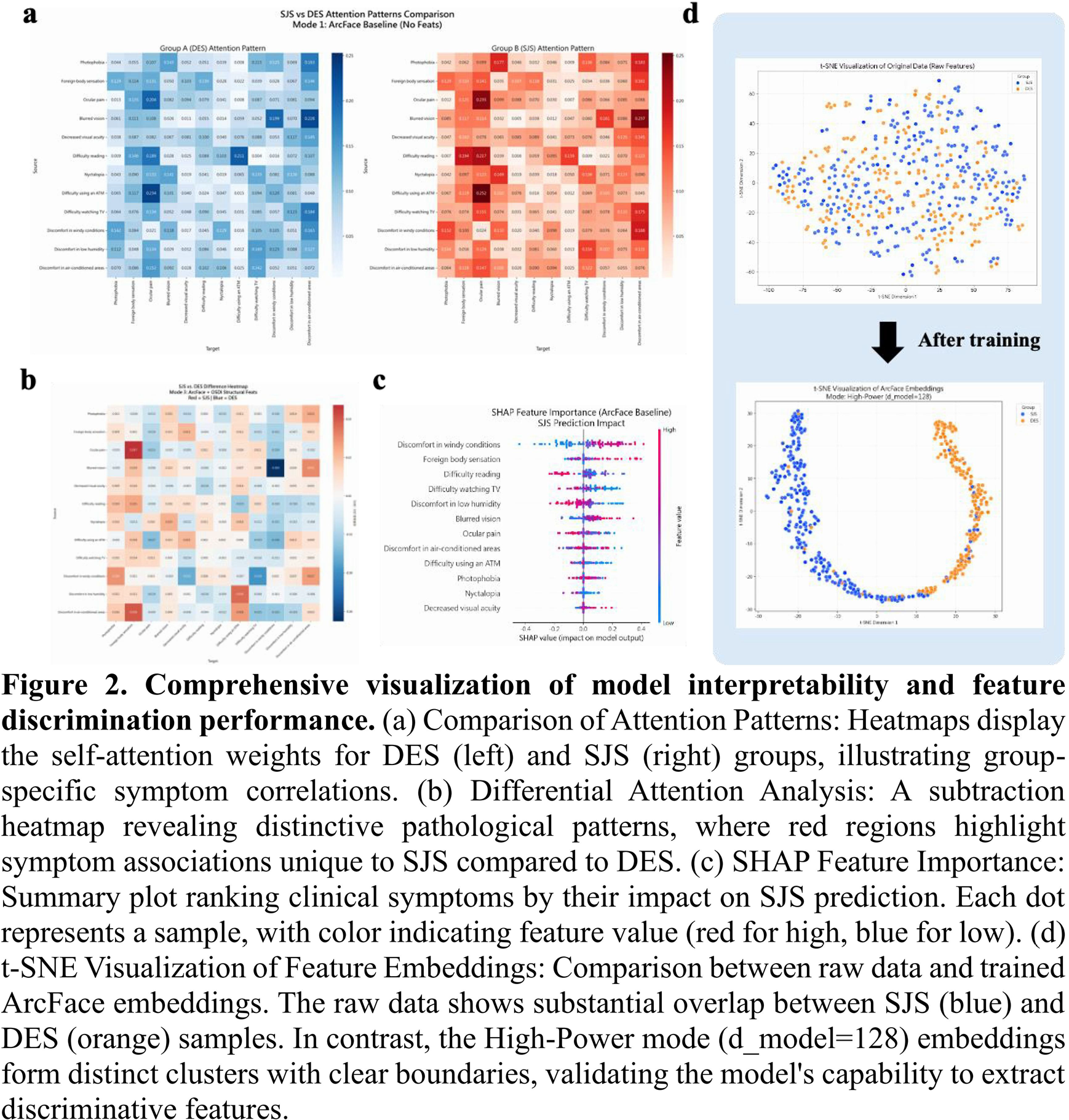
Results: The Transformer model using raw OSDI item–level responses demonstrated superior discriminative performance compared with traditional machine learning approaches. The best-performing Transformer model achieved an accuracy of 0.856, an F1 score of 0.854, and an area under the receiver operating characteristic curve (AUC) of 0.848. In comparison, support vector machine, random forest, and XGBoost classifiers showed substantially lower discriminative performance, with accuracies of 0.629, 0.676, and 0.674, respectively, and AUC values ranging from 0.641 to 0.722. Class-specific performance metrics further highlighted differences between disease groups. For SJS-related dry eye, the Transformer model achieved a precision of 0.79, recall of 0.77, and F1 score of 0.78. For non–Sjögren DES, precision was 0.68, recall was 0.70, and the F1 score was 0.69, indicating balanced classification performance across groups. When OSDI items were aggregated into predefined clinical domains through feature engineering, overall model performance declined. Accuracy decreased from 0.856 to 0.811, F1 score from 0.854 to 0.807, and AUC from 0.848 to 0.813, indicating that aggregation of symptom-level information reduced discriminative capacity relative to item-level modeling. Attention weight analysis demonstrated distinct disease-specific symptom interaction patterns. In SJS-related dry eye, the highest attention weights (range, approximately 0.20–0.25) were observed between prolonged visual tasks (eg, reading difficulty or difficulty using digital devices) and ocular pain or foreign body sensation, as well as between environmental dryness–related symptoms (eg, air-conditioned dryness) and ocular discomfort. In contrast, non–Sjögren DES exhibited stronger interactions between wind sensitivity and visual fluctuation, task-related visual difficulty, and visual fatigue, with attention weights generally exceeding the random baseline threshold (approximately 0.08). Difference attention matrix analysis further isolated interaction pairs with high discriminative value. Symptom interactions exceeding the predefined difference threshold (|Δ| > 0.03) showed minimal overlap between groups and consistently differentiated SJS-related dry eye from non–Sjögren DES. These interactions reflected differences in symptom interaction structure rather than differences in individual symptom severity alone.
Conclusions: An interpretable Transformer-based analysis incorporating angular-margin–based classification differentiated SJS-related dry eye from non–Sjögren DES using item-level OSDI responses and revealed clinically meaningful, disease-specific symptom interaction patterns. Preservation of symptom-level granularity was essential, as conventional feature aggregation obscured opposing pathological signals. Attention-based analysis of patient-reported outcomes provides a noninvasive and potentially clinically applicable framework for phenotypic stratification and early differentiation of dry eye subtypes. Future large-scale studies are warranted to validate the stability of symptom interaction patterns, enable robust patient-level stratification, and assess generalizability across independent cohorts.
OSDI classification model architecture based on Transformer and ArcFace.
REFERENCES: NIL.
Acknowledgments: NIL.
Disclosure of Interests: None declared.