fetching data ... 
Background: Sjögren’s disease (SjD) is a chronic autoimmune disorder characterized by exocrine gland dysfunction, leading to xerostomia (dry mouth), keratoconjunctivitis sicca (dry eyes), and systemic complications. Early detection remains challenging due to heterogeneous clinical manifestations and the lack of reliable blood-based biomarkers. Mucosal-associated invariant T (MAIT) cells, particularly those expressing the immune checkpoint molecules CD226 and TIGIT (T cell immunoreceptor with Ig and ITIM domains), may reflect disease activity and serve as clinically actionable biomarkers, but their role in SjD remains unclear.
Objectives: This study investigates the frequency, functional characteristics, and clinical relevance of CD226 + TIGIT + MAIT cells in early-stage Sjögren’s disease, and evaluates their potential as peripheral blood biomarkers for early diagnosis and patient stratification.
Methods: Peripheral blood mononuclear cells (PBMCs) from 35 newly diagnosed, treatment-naïve SjD patients and 34 age- and sex-matched healthy controls were analyzed by flow cytometry. MAIT cells were defined as CD3 + TCRVα7.2 + CD161^hi and stratified into CD4 + , double-positive (DP), double-negative (DN), and CD8 + subsets. CD226 + TIGIT + MAIT cells were further characterized for activation markers (CD152, LAMP1) and regulatory/homing markers (Tim 3, CD62L, PD-1). Correlations with clinical parameters were assessed, and receiver operating characteristic (ROC) analysis was performed to evaluate diagnostic potential.
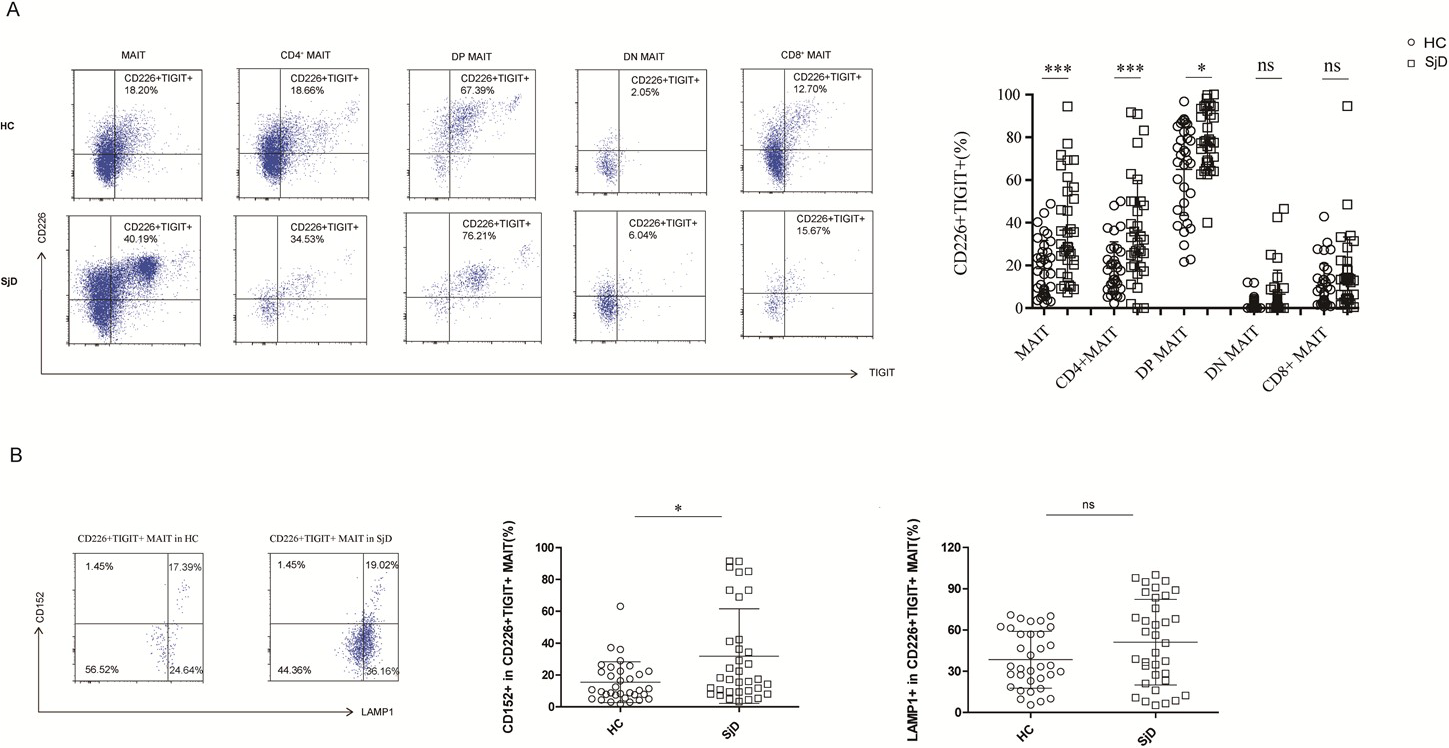
Results: Flow cytometry analysis revealed that CD226 + TIGIT + MAIT cells were predominantly enriched in double-positive (CD4 + CD8 + ) MAIT cells and exhibited elevated expression of activation and effector markers CD152 and LAMP1, as well as regulatory and trafficking markers Tim3 and CD62L. Compared with healthy controls, patients with early, treatment-naïve Sjögren’s disease (SjD) showed significantly increased frequencies of total CD226 + TIGIT + MAIT cells, particularly within CD4 + and double-positive subsets, accompanied by upregulated functional markers. Receiver operating characteristic analysis demonstrated that total CD226 + TIGIT + MAIT cells distinguished early SjD patients from controls with an area under the curve of 0.754, supporting their potential as clinically relevant diagnostic biomarkers.
Conclusions: CD226 + TIGIT + MAIT cells represent a distinct, functionally active subset that is expanded in early SjD and correlates with clinical manifestations. These cells are promising blood-based biomarkers for early diagnosis and potential therapeutic targets, linking immunological insights with patient-centered clinical applications.
Comparison of CD226 + TIGIT + MAIT cell frequencies and CD152/LAMP1 expression in Sjögren’s disease patients versus healthy controls
Peripheral blood mononuclear cells (PBMCs) were isolated from treatment-naïve Sjögren’s disease (SjD) patients and age- and sex-matched healthy donors. Expression of CD226, TIGIT, CD152, and LAMP1 was assessed by flow cytometry.
(A) Representative flow cytometry plots and quantification of CD226 + TIGIT + MAIT cells across total MAIT cells and defined subsets. (B) Representative plots and quantification of CD152 + and LAMP1 + cells within the CD226 + TIGIT + MAIT population in patients versus controls.
Data are shown as mean ± standard deviation. ns, not significant; *p < 0.05; ***p < 0.001.
REFERENCES: NIL.
Acknowledgments: NIL.
Disclosure of Interests: None declared.