fetching data ... 
Background: Physical activity is the cornerstone of non-pharmacological management in axial spondyloarthritis (axSpA), as outlined in ASAS-EULAR recommendations [1]. The modified Short QUestionnaire to ASsess Health enhancing physical activity (mSQUASH) is a feasible, valid, reliable and responsive questionnaire for assessing the amount and type of physical activity in patients with axSpA. The mSQUASH was initially developed and validated in Dutch and subsequently translated and cross-culturally validated in English (USA) [2,3].
Objectives: To translate and cross-culturally adapt the mSQUASH into 11 languages across 14 countries for use in patients with axSpA.
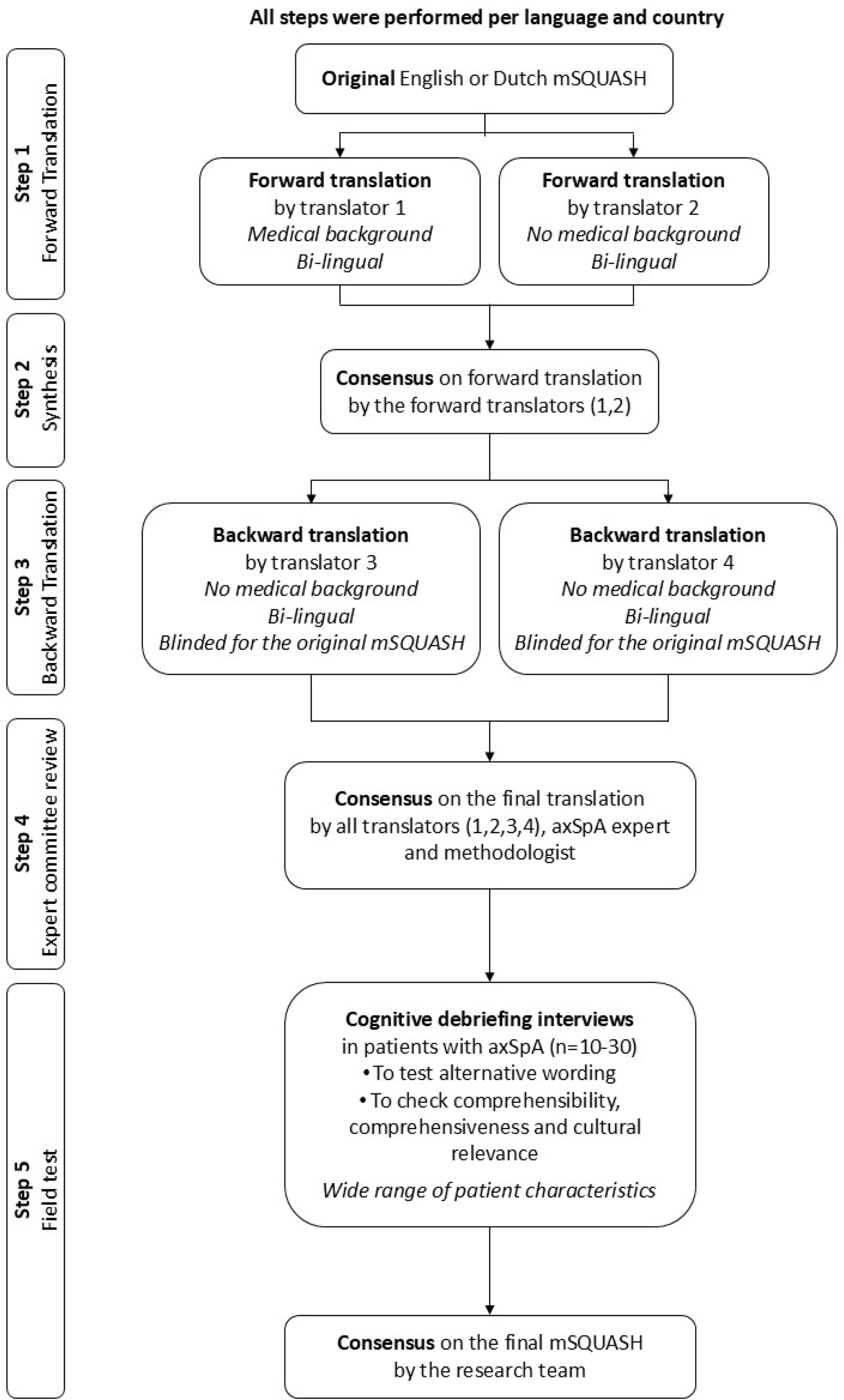
Methods: This study is part of a young-ASAS collaborative project. Participating countries were included based on their expressed interest at the annual ASAS meetings. The mSQUASH assesses self-reported physical activity during a normal week in the past month and evaluates four domains: 1) commute to/from work or school and commute to/from other destinations; 2) work (paid/unpaid) or school/study; 3) household activities; 4) leisure activities, sports and exercise. For each question, patients are asked if the activity applies to them (with an option for “not applicable”), the frequency (days per week), the average duration (in hours and minutes), and the perceived physical demand of the activity, categorized as slow/light, moderate, or fast/high. The Dutch or English mSQUASH was translated into target languages according to the protocol of Beaton [4] with two independent forward translations, consensus, two independent backward translations and expert committee review for each language. Field testing consisted of individual semi-structured interviews with 10-30 patients with axSpA in each country (Figure 1). All patients were ≥18 years of age, diagnosed with axSpA, fulfilling the ASAS classification criteria and were literate and able to read. Patients per country represented a broad range of age, sex, educational level and disease characteristics. They were asked about relevance, comprehensiveness (no missing key concepts), and comprehensibility (clarity of instructions, appropriateness of wording, and alignment of response options with questions) of the mSQUASH.
Results: The mSQUASH was successfully translated and field tested into the following languages: Spanish (Spain, Argentina, Chile, and Colombia), French (France), German (Germany), Turkish (Turkey), Portuguese (Portugal), Italian (Italy), Greek (Greece), Swedish (Sweden), Hindi (India), Korean (South Korea) and Chinese (Singapore). In total, 170 patients with axSpA from all 14 countries participated in cognitive debriefing interviews. Across all countries, 111 (65%) patients were male, mean (SD) age 44.8 (14.4) years, 120 (71%) lived in urban area, 83 (49%) had high level of education, mean symptom duration was 13.2 (11.0) years, time since diagnosis 9.7 (10.3) years, 114 (67%) patients were classified with radiographic axSpA, 114 (67%) were HLA-B27 positive, 82 (48%) had peripheral involvement and 63 (34%) had history of extra-musculoskeletal manifestations. NSAIDs were used by 137 (81%) patients, and 120 (71%) used biologic or targeted synthetic DMARDs. Mean (SD) ASDAS was 2.2 (3.1), BASDAI 3.0 (2.1), CRP level 3.0 (5.5) mg/L and BASFI score 2.3 (2.2). The mSQUASH was completed in a mean time of 5.0 ± 2.5 minutes. The mSQUASH was well understood and considered clear and relevant. The translation process was generally straightforward, with only minor linguistic and cultural adaptations. No concerns were raised regarding structure or content of these domains. Five participants mentioned that certain aspects of their daily physical activity were not fully captured by the questionnaire. Reported examples included playing recreational games (Singapore), carrying luggage while traveling overseas (Singapore), bathing (Chile), driving (Portugal), playing with children (Portugal), or sexual activity (Chile). Five participants noted that contextual factors including hybrid remote working styles (Singapore) and variable weekly routines (Portugal, South Korea, Singapore) could influence their interpretation and responses. In the Singaporean version of the Chinese translation, the term “not applicable” required rewording to better reflect the intended meaning in the locally used Chinese language. Some concepts, such as “Gardening” (South Korea), “Home maintenance” (Portugal, Chile, South Korea) and “Shopping” (Portugal, Italy, South Korea, Singapore) required clarification with additional examples or rewording. Five patients (from Spain, Portugal and Italy) noted that cycling was not relevant to their daily physical activities. Nevertheless, it was retained in the questionnaire to ensure inclusivity, with “not applicable” provided as answer option. Nine patients (from Spain, Portugal, Italy, South Korea, and Singapore) reported difficulty distinguishing between walking for commuting (to/from work or school and other destinations), leisure activity or sports and exercise. Team discussions and minor adaptations addressed all issues, enhancing clarity and cross-cultural relevance.
Conclusions: The mSQUASH was translated and cross-culturally adapted into 11 languages across 14 countries, enabling standardized assessment of daily physical activity in patients with axSpA worldwide.
Flowchart forward-backward procedure according to Beaton protocol
REFERENCES: [1] Ramiro et al. ASAS-EULAR recommendations for the management of axial spondyloarthritis: 2022 update. Ann Rheum Dis 2023;82:19–34.
[2] Carbo et al. The mSQUASH; a valid, reliable and responsive questionnaire for daily physical activity in patients with axial spondyloarthritis. Semin Arthritis Rheum 2021;51:719–27.
[3] van der Kraan et al. The mSQUASH is a feasible and valid measurement tool to uniformly assess daily physical activity in patients with rheumatic diseases. RMD Open 2024;10:e004696.
[4] Beaton et al. Guidelines for the Process of Cross-Cultural Adaptation of Self-Report Measures. Spine 2000;25:3186–91.
Acknowledgments: NIL.
Disclosure of Interests: Yvonne M. van der Kraan ASAS research fellowship grant, J.P.L Spoorenberg: None declared, Davy Paap: None declared, Diego Benavent: None declared, Victoria Navarro-Compán: None declared, Clementina López-Medina: None declared, Anna Molto: None declared, David Kiefer: None declared, Xenofon Baraliakos: None declared, Gizem Ayan: None declared, Levent Kiliç: None declared, Alexandre Sepriano: None declared, Ana Catarina Moniz: None declared, Maria Sole Chimenti: None declared, Luigi Fiannacca: None declared, Maria Konsta: None declared, Mirjam de Vries: None declared, Sara Brolin: None declared, Hernan Maldonado Ficco: None declared, Rodolfo Perez Alamino: None declared, Sebastián Ibáñez: None declared, Dominga García: None declared, Wilson Bautista-Molano: None declared, Bhowmik Meghnathi: None declared, Pooja Patel: None declared, TAEJONG KIM: None declared, Seung Cheol Shim: None declared, Warren Fong: None declared, Yu Heng Kwan: None declared, Lianne S Gensler: None declared, Uta Kiltz: None declared, Sofia Ramiro: None declared, Suzanne Arends: None declared.