fetching data ... 
Objectives: Thrombosis is a major cause of morbidity and mortality in early systemic lupus erythematosus (SLE). Although multiple prothrombotic pathways have been identified, most studies examine them in isolation or in patients already receiving treatment, leaving their interactions and relationship to disease activity poorly understood. We aimed to characterize these interactions in early treatment-naïve SLE using an integrated longitudinal approach.
Methods: In a prospective inception cohort, 20 treatment-naïve patients with newly diagnosed SLE were studied during high disease activity at diagnosis and again after 6 months of standard treatment. Laboratory profiling of key prothrombotic molecular systems was integrated with plasma proteomic and N-terminomic analyses. Cross-system interactions were assessed using correlation network analysis and principal component analysis.
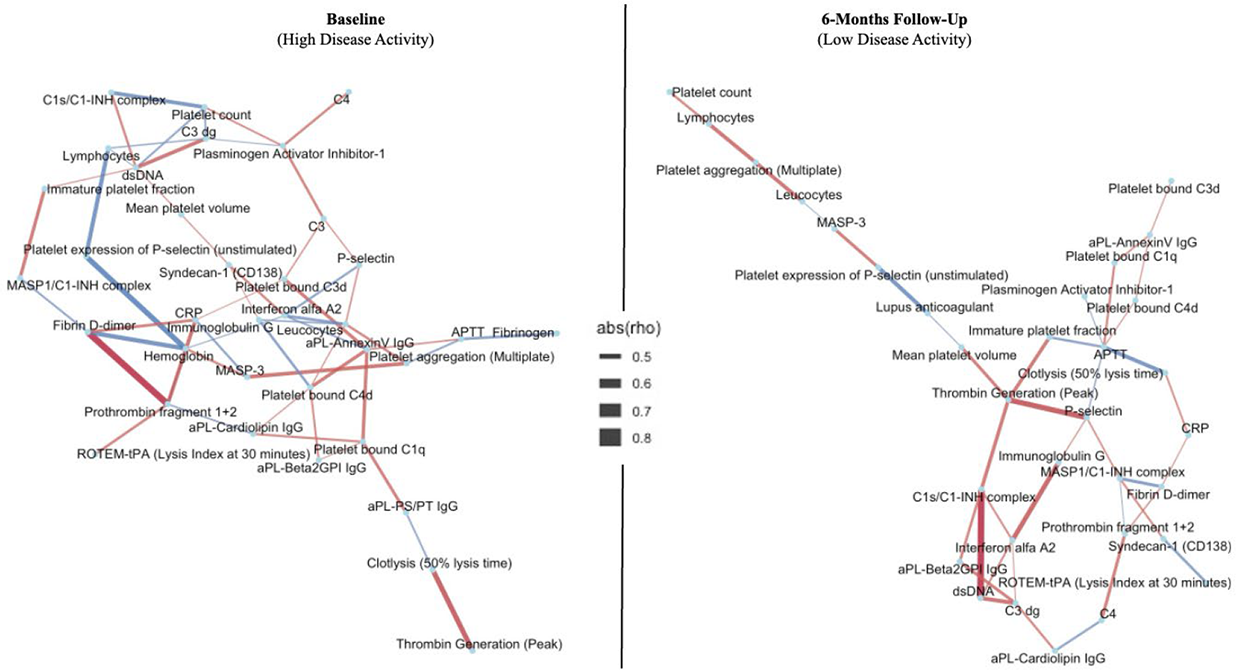
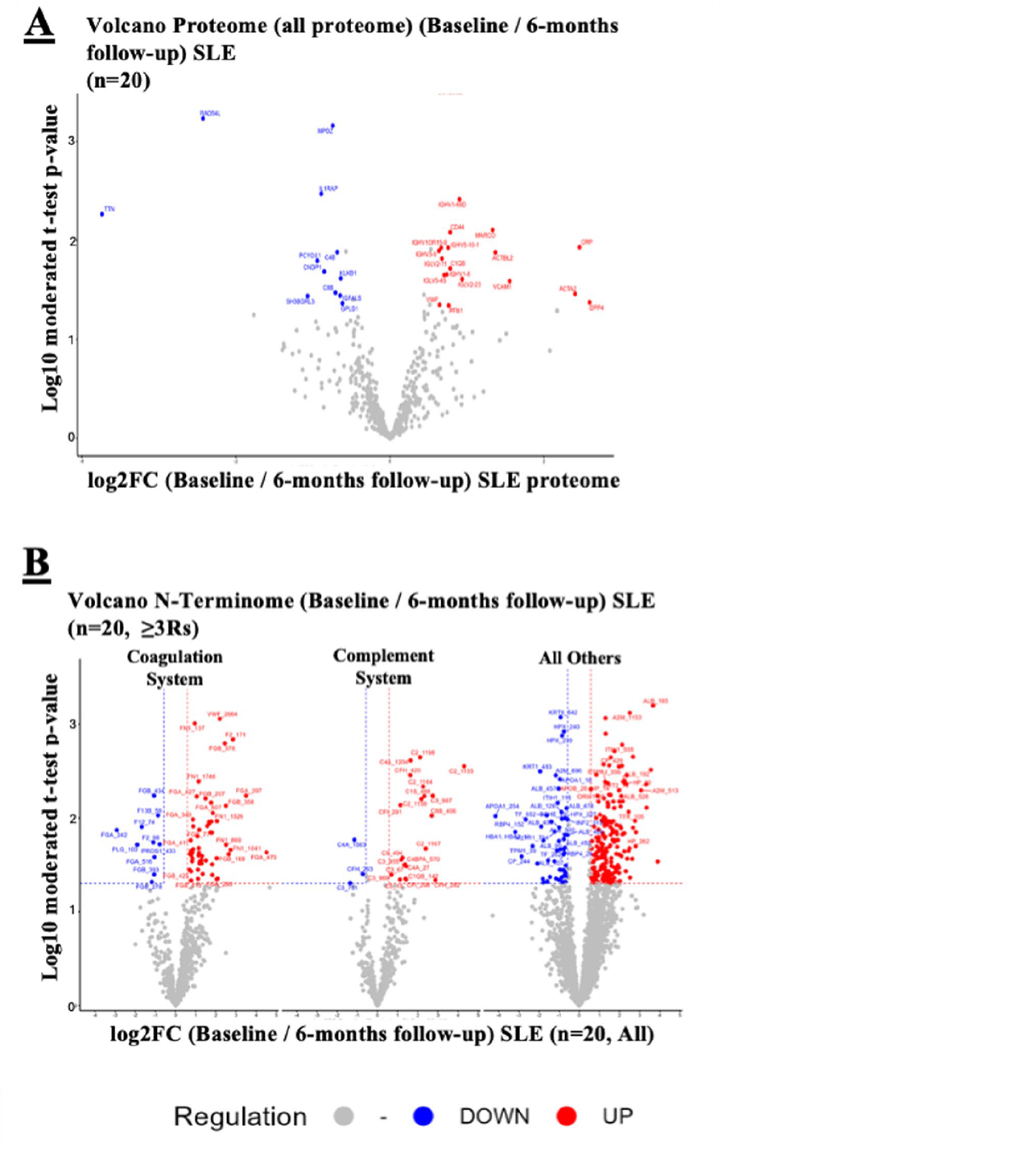
Results: The mean age of patients with SLE was 42.7 years, and 70% were female. Median SLEDAI-2K decreased from 13.5 at baseline to 2 at 6-month follow-up. High disease activity was characterized by a highly interconnected prothrombotic network with 55 significant cross-system correlations, compared with 40 correlations during low disease activity (27% reduction; Figure 1 ). Proteomic and N-terminomic analyses revealed coordinated activation of complement and coagulation pathways during active disease, with enrichment of pathway-specific proteolytic cleavages that attenuated following clinical improvement ( Figure 2 ). In contrast, platelet activation and antifibrinolytic signatures remained persistently elevated despite reduced disease activity. Multivariate analyses demonstrated a platelet-dominated interaction profile, particularly pronounced in antiphospholipid antibody–positive patients.
Conclusions: In treatment-naïve early SLE, prothrombotic biology reflects dynamic, disease-activity-dependent interactions across multiple molecular systems rather than isolated pathway activation. While inflammatory and complement–coagulation activation resolves with clinical improvement, persistent platelet-driven mechanisms may confer residual thrombotic risk despite low disease activity. These findings support the need for individualized thrombosis risk assessment and targeted preventive strategies in SLE.
Cross-system prothrombotic interactions are amplified during high disease activity.
Network visualization of significant cross-system Spearman correlations (p<0.05) between laboratory parameters at baseline (high disease activity) and 6-months follow-up (low disease activity). Nodes represent individual biomarkers, grouped by prothrombotic system; edges represent positive (red) or negative (blue) correlations.
MASP: Mannan-binding Lectin-Associated Serine Protease, ROTEM-tPA: Rotational Thromboelastometry with tissue plasminogen activator, aPL: anti-phospholipid antibody, IgG: immunoglobulin G, Beta2GP1: beta-2 glycoprotein I, Multiplate: MultiplateÒ analyzer, dsDNA: anti-double-stranded DNA antibody, aPTT: Activated Partial Thromboplastin Time, PS/PT: Phosphatidylserine/Prothrombin
Proteomics- and N-Terminomics analyses categorized by coagulation and complement system.
(A) Volcano plot showing differences in protein abundance between baseline and follow-up.
(B) Volcano plot showing differences in abundance of endogenous N-terminal peptides (present in 3 3 samples), highlighting increased complement- and coagulation-derived cleavage products during high disease activity.
REFERENCES: NIL.
Acknowledgments: NIL.
Disclosure of Interests: Mads Christian Lamm Larsen MLL reports receiving travel reimbursement from AstraZeneca, Fatih Demir: None declared, Henrik Zachar Langkilde: None declared, Petrus Linge: None declared, ELSA GRENMYR: None declared, Ellen-Margrethe Hauge EMH has received fees for speaking and/or consulting from Novo, Novartis, AbbVie, SynACT Pharma, UCB, research funding to Aarhus University Hospital from Independent Research Fund Denmark, Novo Nordic Foundation, Danish Rheumatism Association, Aarhus University, Danish Regions Medicine Grants, Galapagos, AbbVie, SynACT Pharma, travel expenses from Sobi, AbbVie, Novartis, Boehringer-Ingelheim. principal investigator in trials by SynACT Pharma and involved as site principal investigator in trials by AbbVie, Novartis, Novo Nordisk, Sanofi, AstraZeneca, Janssen-Cilag, Anne Voss PI in trials from BMS and UCB, Received travel expenses from AstraZeneca, Markus M. Rinschen MMR received research funding from Novo Nordisk A/S paid to Aarhus University, Anders Bengtsson: None declared, Julie B Larsen JBL has received lecture honoraria (paid to her institution) from Bristol-Myers Squibb and Merck, Anne Troldborg has received honoraria for educational activities for AstraZeneca.