fetching data ... 
Background: Social disparities are considered to negatively impact disease outcome among patients with autoimmune diseases. Few studies focused on clinical characteristics among systemic sclerosis (SS) patients with a low-income, low-literacy profile. Although peripheral vascular manifestations may be affected by environmental issues, studies addressingSSc patients living in low latitude, where higher stable temperatures and exposure to sunlight may impact peripheral blood flow, are lacking.
Objectives: To determine the influence of socioeconomic issues, namely literacy and income, on long-term outcomes in patients with SS with social disparities as well as the possible impact of living in low latitude.
Methods: Clinical and demographic data of 90 patients with SS diagnosis, according to the SSc ACR/EULAR 2013 criteria, followed in an outpatient tertiary service in Fortaleza-CE, Brazil were revised. The modified Rodnan skin score (mRSS), digital ulcers, and gastrointestinal manifestations of each and every patient were checked by a rheumatologist. Monthly family income (</≥ 1 minimal wage; 1MW≈ 300US$) and literacy [</≥ 8 school-years(SY)] were registered.
Results: Mean age was 54.9 ± 13.5 years with 83(92.2%) females; 50 (55.5%) were classified as diffuse SS and 40 (44.4%) as presenting with localized disease. 60 (73.3%) declared <8/SY and 22 (30.1%), out of 73 that declared income, were considered as of very low-income individuals, with a monthly family income below 300 US$. All parameters but time to diagnosis, which has a trend towards being significantly higher among patients of very low-income, were similar regardless of declared income. Outcomes were also similar regardless of literacy, measured by the number of SY of formal education. We should also remark that among patients declaring ≥8SY, only two had a superior level.
Conclusions: Social disparities appear not to significantly impact disease outcome in a long term follow up of a low-income, low-literacy cohort. To our knowledge, this is the first study focusing socioeconomic issues in a low-income SS cohort. Our data suggest that pathogenetic issues related to SSc may actually drive disease course, irrespective of inequalities, possibly due to a lack of available treatments that decisively modify the natural course of this disease.
Table 1. Demographics and clinical characteristics of low-income scleroderma patients: impact of monthly family income
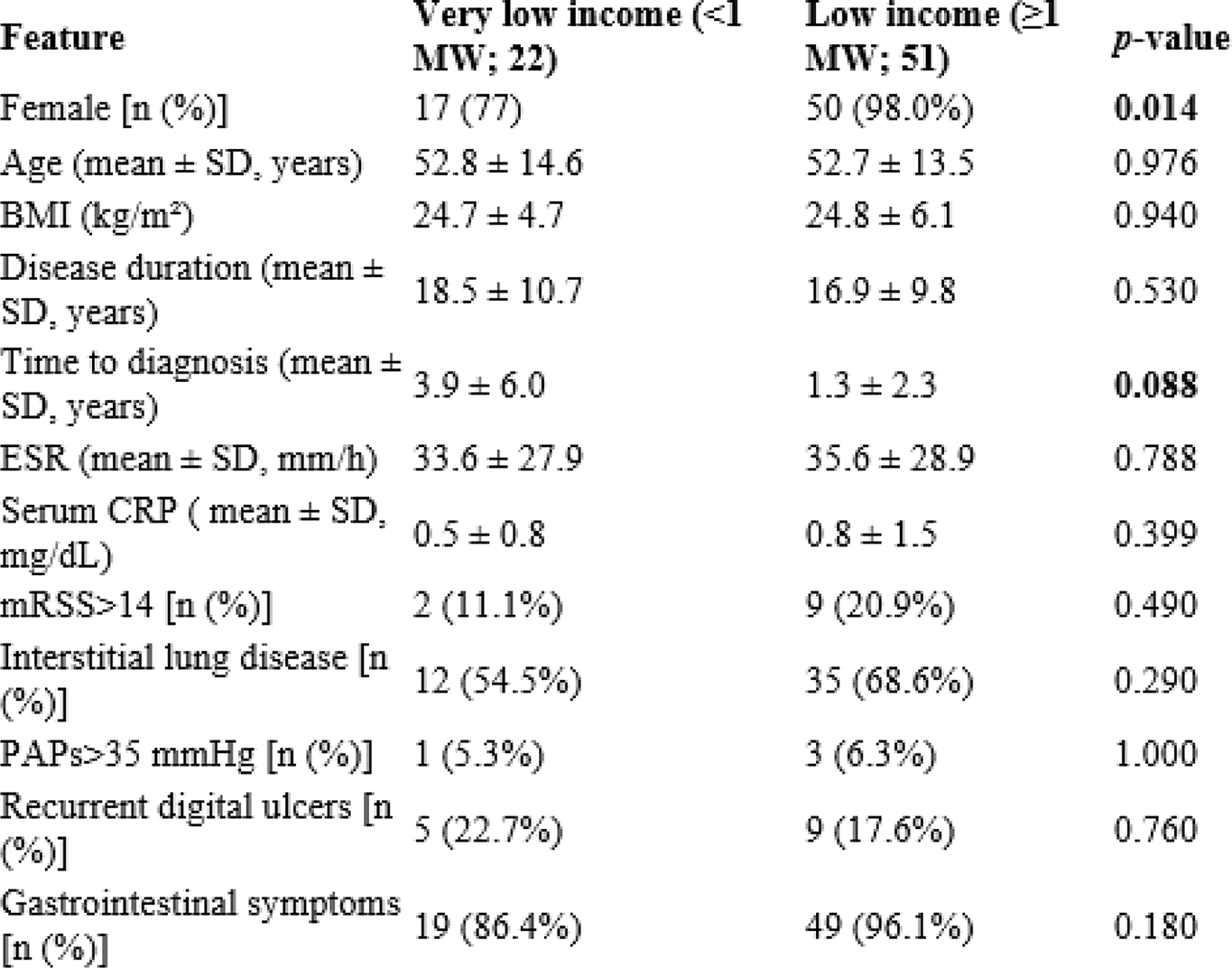
BMI, body mass índex; ESR, erythrocyte sedimentation rate; mRSS, modified Rodnan skin score; MW, minimal wage; PAPs, pulmonary arterial pressure
Table 2. Demographics and clinical characteristics of low-income scleroderma patients: impact of literacy
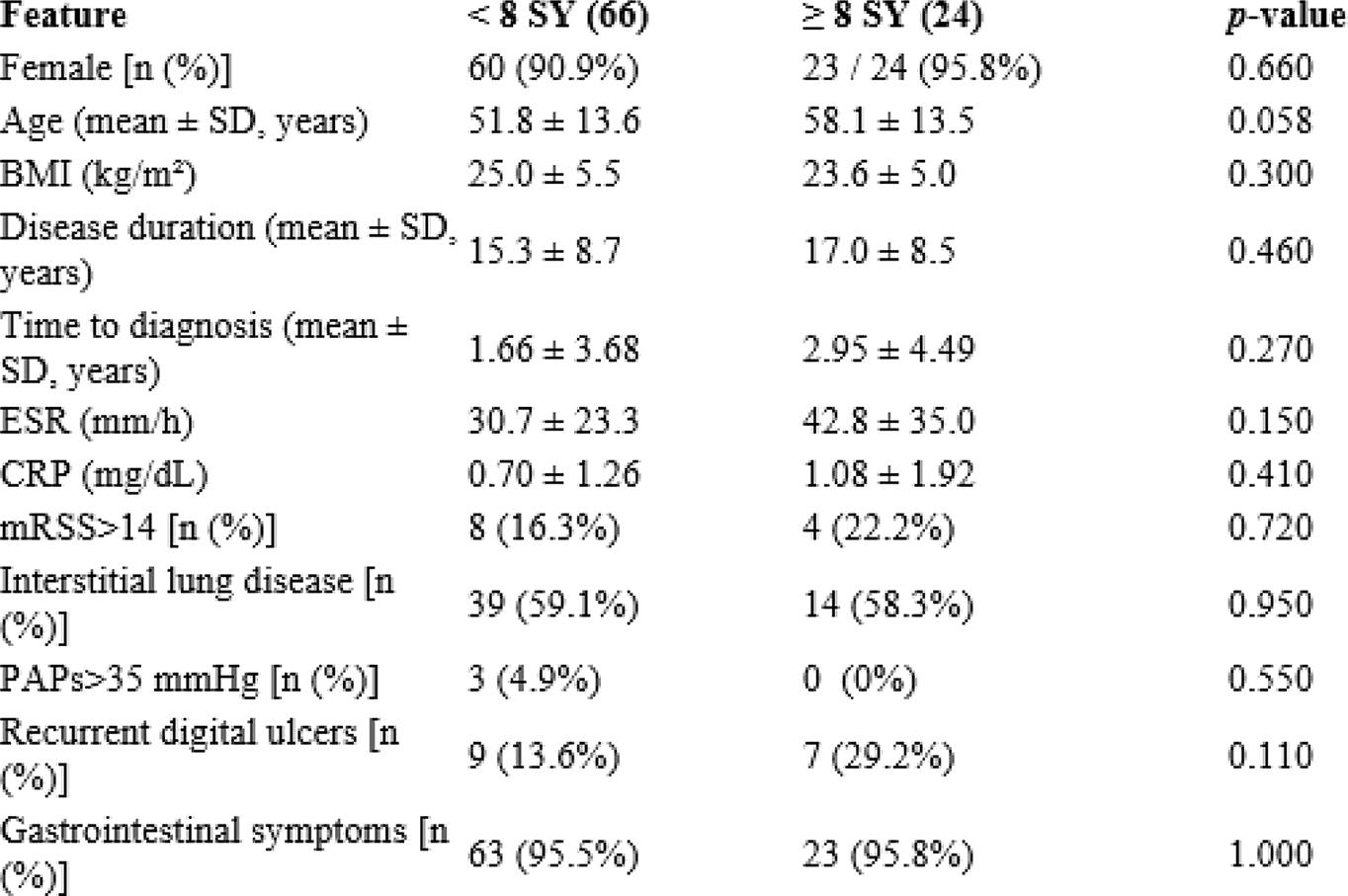
BMI, body mass índex; ESR, erythrocyte sedimentation rate; mRSS, modified Rodnan skin score; MW, minimal wage; PAPs, pulmonary arterial pressure
REFERENCES: NIL.
Acknowledgments: NIL.
Disclosure of Interests: None declared.