fetching data ... 
Background: Women with systemic sclerosis (SSc) present reduced muscle strength and impaired muscle function compared with healthy matched subjects [1]. Although resistance training improves muscle strength [2] and muscle mass in SSc, access to supervised programs may be limited.
Objectives: This study compared the effects of supervised moderate-intensity resistance training (RT-MI) and minimally supervised home-based training (HBT) on lower-limb muscle strength and muscle thickness in women with SSc.
Methods: This randomized clinical trial (REBEC: RBR-8xg74vp) included women with SSc aged ≥45 years who had not participated in structured exercise programs in the previous three months. Participants were allocated to a 12-week RT-MI or minimally supervised HBT intervention. Pre- and post-intervention assessments included lower-limb muscle strength, evaluated using one-repetition maximum (1RM) tests for leg press (LP), knee extension (KE), knee flexion (KF), and plantar flexion (PF), and muscle thickness of the vastus lateralis (VL), rectus femoris (RF), vastus intermedius (VI), and vastus medialis (VM), assessed by ultrasound. The RT-MI group performed 4 supervised lower-limb resistance training twice weekly at 60–70% of 1RM, with load adjustments guided by the Borg perceived exertion scale (6–20), completing 3–4 sets of 10–15 repetitions. The HBT group followed a minimally supervised home-based program, provided by a booklet with the training protocol, using body weight and a chair, performing 4–6 lower limb exercises and 2–3 sets of 10–15 repetitions. Exercise prescription and supervision were provided by an experienced physical education professional. Assessments and statistical analyses were conducted by blinded researchers. Analyses followed the intention-to-treat (ITT) principle. Intervention effects were examined using repeated-measures ANOVA to assess time and time × group interactions (p < 0.05), with Bonferroni-adjusted post hoc analyses when appropriate.
Results: Twenty-four women were randomized; three were excluded prior to analysis, resulting in 21 participants included in the analyses. Four participants did not complete the training protocol but were retained in the analyses according to the ITT principle. Baseline characteristics did not differ significantly between groups (Table 1). Both interventions resulted in significant improvements in lower-limb muscle strength across all 1RM outcomes, with no significant time × group interactions. Muscle thickness remained unchanged, except for a significant time × group interaction in vastus medialis thickness, favoring HBT in post hoc analyses. Functional and morphological outcomes are summarized in Table 2.
Conclusions: RT-MI and HBT both improved lower-limb muscle strength in women with SSc, with comparable functional benefits between interventions. Despite being powered to detect the superiority of RT-MI, both interventions improved muscle strength, and HBT showed a greater increase in vastus medialis muscle thickness. These findings suggest that HBT may represent a feasible alternative when supervised RT-MI programs are not available; however, further investigation is warranted.
Table 1. Baseline characteristics of the participants
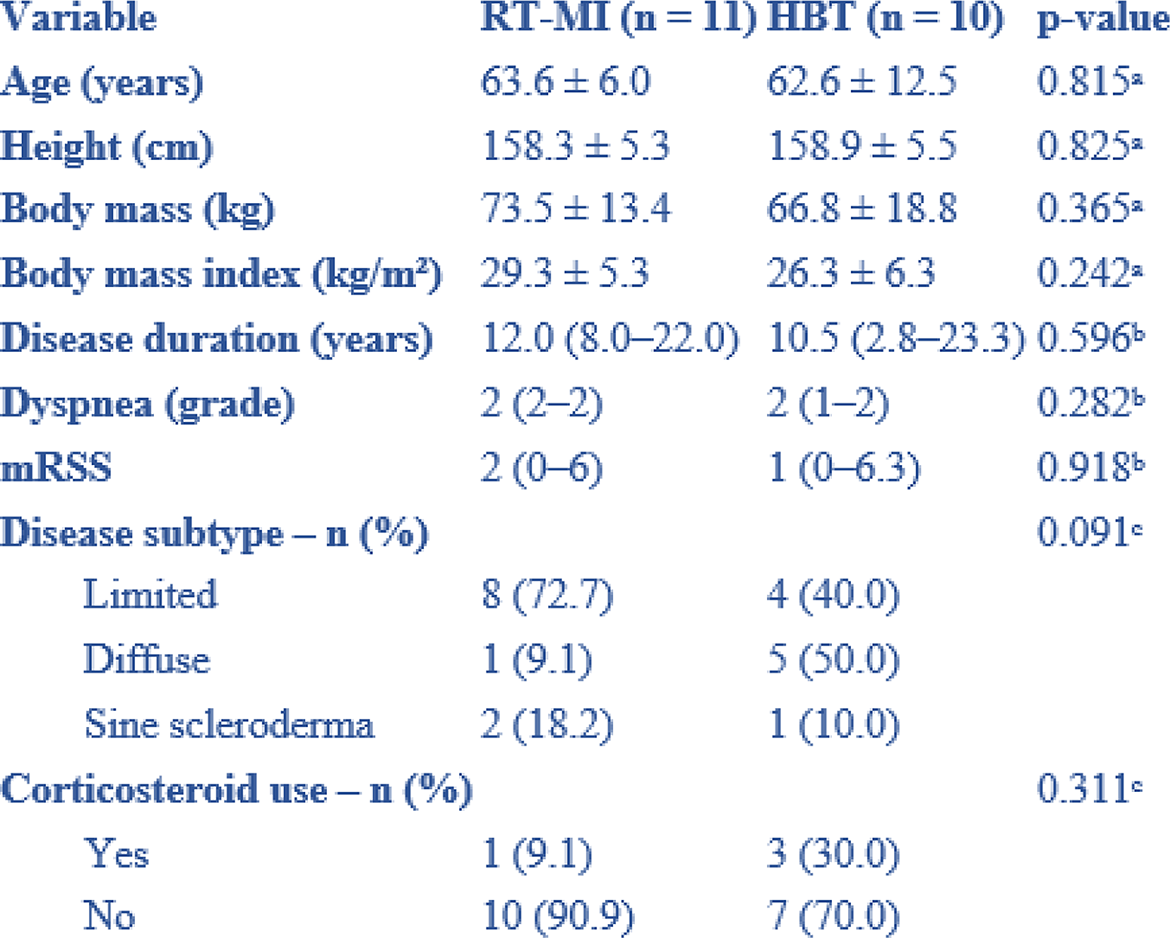
Values are presented as mean ± standard deviation, median (P25–P75), or number (%), as appropriate. RT-MI: moderate-intensity resistance training; HBT: home-based training; mRSS: modified Rodnan skin score. Between-group comparisons were performed using independent-samples t tests for normally distributed variables, Mann–Whitney U tests for non-normally distributed variables, and Fisher’s exact tests for
Table 2. Effects of resistance training moderate intensity and home-based training on lower-limb strength and muscle thickness
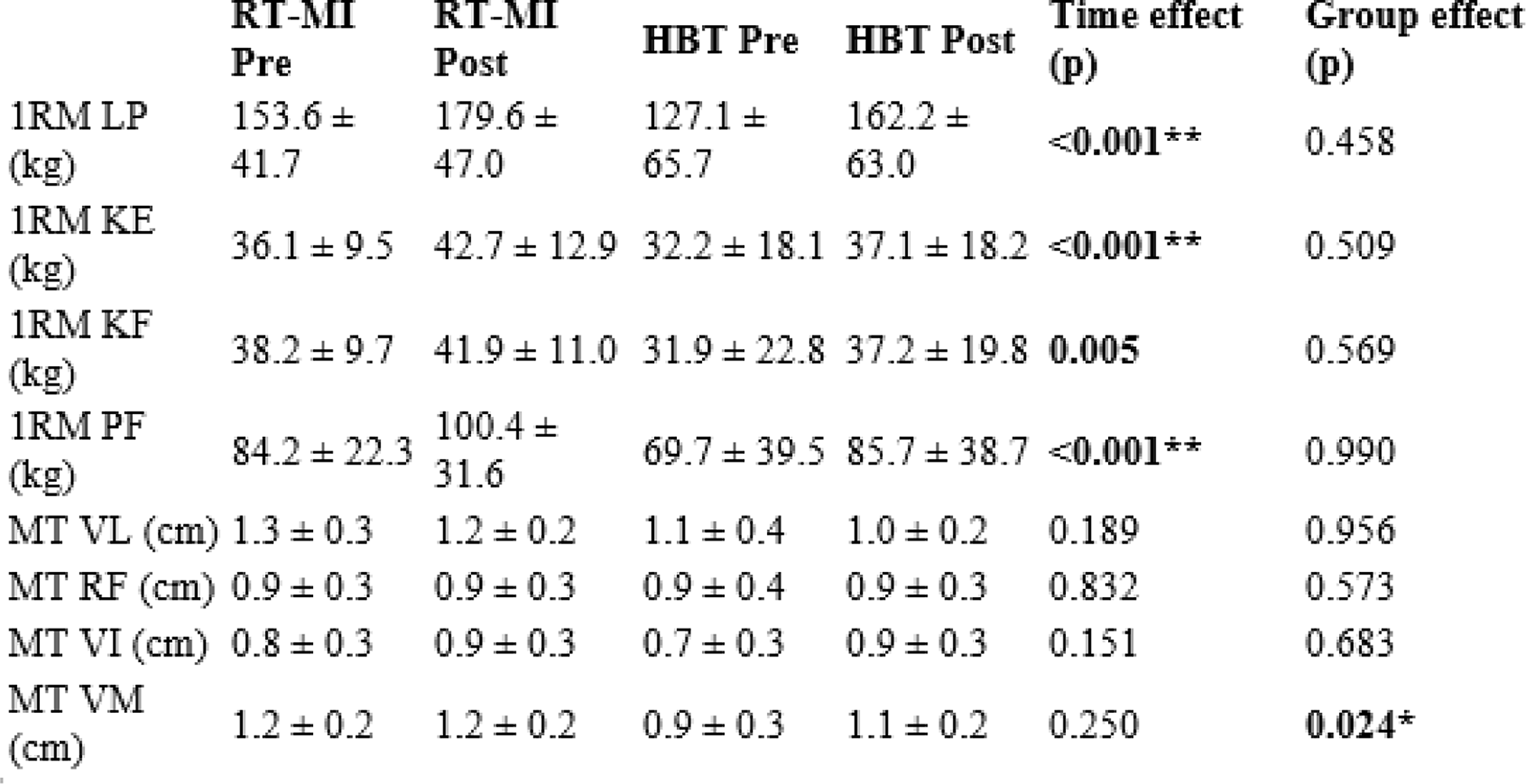
Values are presented as mean ± SD. RT-MI: resistance training moderate intensity; HBT: home-based training; 1RM: one-repetition maximum; LP: leg press; KE: knee extension; KF: knee flexion; PF: plantar flexion; MT: muscle thickness; VL: vastus lateralis; RF: rectus femoris; VI: vastus intermedius; VM: vastus medialis; *: statistically significance. **: highly statistically significant.
REFERENCES: [1] Justo AC, Guimarães FS, Ferreira AS, Soares MS, Bunn PS, Lopes AJ. Muscle function in women with systemic sclerosis: Association with fatigue and general physical function. Clin Biomech (Bristol). 2017 Aug;47:33-39. doi: 10.1016/j.clinbiomech.2017.05.011. Epub 2017 May 26. PMID: 28575704.
[2] Mallmann ALS, de Moraes DN, Dória LD, Dos Santos LP, Pilotti S, de Souza Antunes MA, Steinmetz LF, de Souza TJS, Hax V, Ribeiro JL, Xavier RM, da Silva Chakr RM. Effects of interventions with resistance exercises on muscle strength, physical disability, and quality of life in systemic sclerosis patients: a systematic review with meta-analysis. Adv Rheumatol. 2025 Jul 28;65(1):34. doi: 10.1186/s42358-025-00468-1. PMID: 40721843.
Acknowledgments: NIL.
Disclosure of Interests: None declared.