fetching data ... 
Background: The One-Minute Sit-To-Stand Test (1-STST) is a simplealternative to the Six-Minute Walk Test (6MWT), but its clinical utility in systemic sclerosis (SSc) remains insufficiently characterized.
Objectives: This study aimed to evaluate the agreement between the 1-STST and 6MWT and to examine their associations with clinical characteristics in patients with SSc.
Methods: In this cross-sectional study, 80 adults with SSc performed both the 1-STST and the 6MWT on the same day; 40 participants repeated testing after one week to assess test–retest reliability. Clinical characteristics, lung function, imaging, comorbidities, patient-reported outcomes, and physiological responses were collected. Correlation and reliability analyses were performed, and ROC curves assessed the discriminatory ability of both tests to identify impaired lung function.
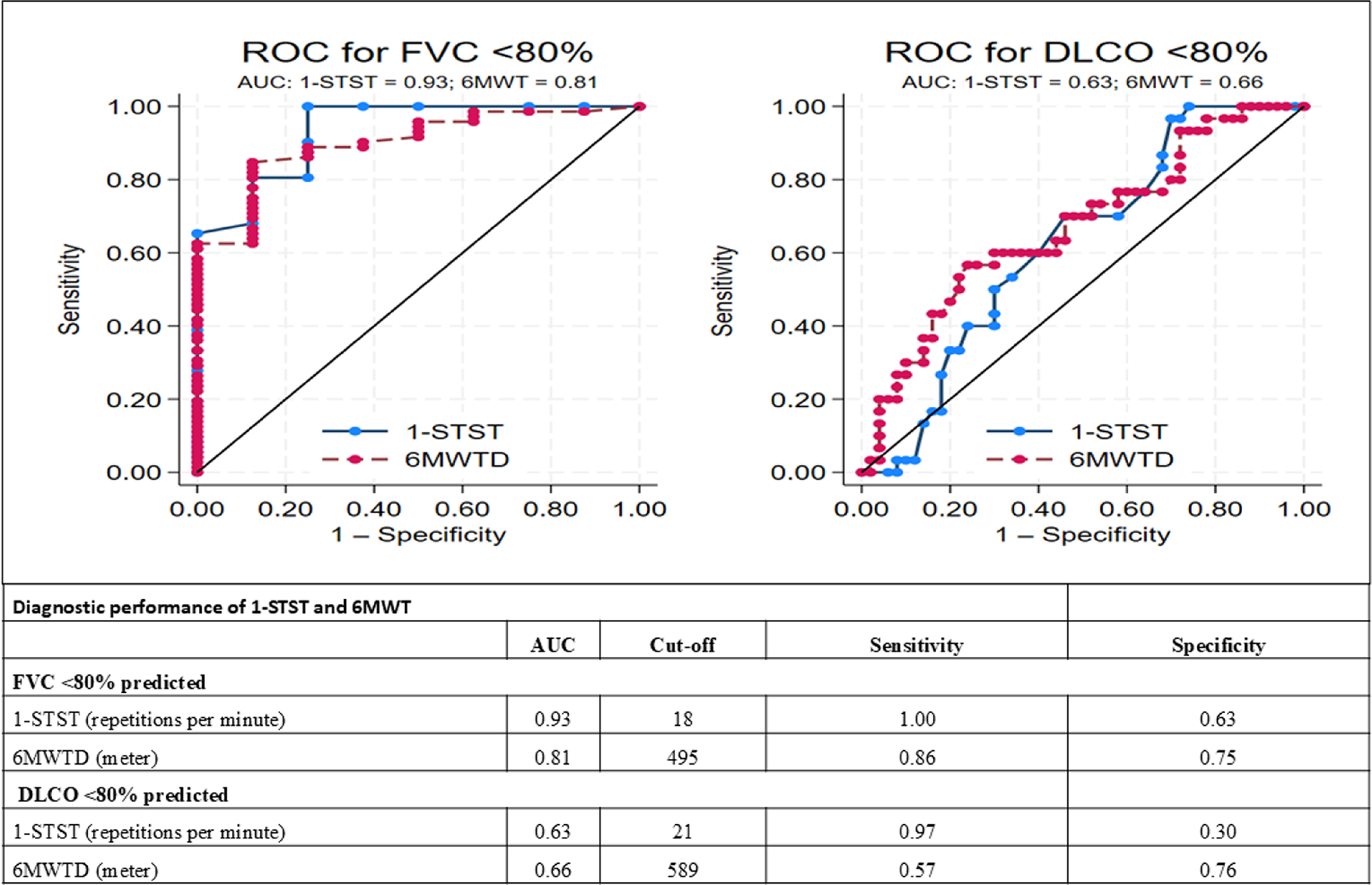
Results: The number of repetitions during the 1-STST correlated strongly with the 6MWT distance (r = 0.78; p < 0.001), and the test-retest reliability of the 1-STST was good (ICC 0.85). The 1-STST elicited less desaturation and heart rate increase than the 6MWT. Most patients reported limitations (1-STST 69%, 6MWT 51%), with muscular pain more frequent in the 1-STST (34% vs. 14%; p < 0.005). Both tests correlated moderately with the degree of dyspnea and weakly with lung function parameters (Table 1). The 1-STST demonstrated excellent accuracy for identifying Forced Vital Capacity < 80% (AUC 0.93), comparable to the 6MWT (Figure 1).
Conclusions: The 1-STST is a valid, reliable, and pragmatic alternative to the 6MWT in patients with SSc. It provides clinically relevant information on functional capacity, pulmonary involvement, and musculoskeletal limitations. Its simplicity and ease of administration support its integration into routine clinical assessment and home monitoring in patients with SSc.
Correlation of 1-stst and 6 with clinical and patient reported meausures
| Age | BMI | Disease duration | mRSS | FVC | FEV1 | DLCO | SOBQ-score | Scleroderma HAQ | ||
|---|---|---|---|---|---|---|---|---|---|---|
|
1-STST
|
r
| -0.33
| -0.06
| -0.05
| 0.12
| 0.32
| 0.35
| 0.27
| -0.51
| -0.32
|
|
6MWT
|
r
| -0.48
| -0.18
| -0.05
| 0.03
| 0.26
| 0.34
| 0.32
| -0.44
| -0.27
|
| Correlation after exclusion of patients with limitation due to musculoskeletal pain during exercise tests | ||||||||||
|
1-STST
|
r
| -0.53
| -0.09
| 0.03
| 0.15
| 0.36
| 0.41
| 0.39
| -0.58
| -0.37
|
|
6MWT
|
r
| -0.52
| -0.09
| -0.12
| 0.02
| 0.28
| 0.36
| 0.38
| -0.46
| -0.32
|
| Abbreviations: BMI, Body mass index; DLCO, Diffusing Capacity of Carbon monoxide; FVC, Forced Vital Capacity; mRSS, Modified Rodnan skin score SOBQ, The University of California San Diego Shortness of Breath Questionnaire; TLC, Total lung capacity | ||||||||||
ROC curves of 1-STST and 6MWT for detecting reduced FVC and DLCO (< 80% predicted).
The figure shows both the ROC curves and a table summarizing diagnostic performance, including area under the curve (AUC), optimal cut-off values, sensitivity, and specificity for each test. Abbreviations: 1-STST, 1-Minute Sit-To-Stand Test; 6MWTD, Six-Minute Walk Test Distance; FVC, forced vital capacity; DLCO, diffusing capacity of the lung for carbon monoxide; ROC, receiver operating characteristic; AUC, area under the curve.
REFERENCES: NIL.
Acknowledgments: NIL.
Disclosure of Interests: Esben Naeser MSD, Boehringer Ingelheim, Amanda Lynggaard Riis Novo Nordisk, Katja Thorup Aaen: None declared, Klaus Søndergaard Boehringer Ingelheim, Boehringer Ingelheim, Boehringer Ingelheim, Elisabeth Bendstrup Boehringer Ingelheim, Astra Zeneca, Bristol-Myers Squibb, Daiichi Sankyo, Boehringer Ingelheim.