fetching data ... 
Background: Takayasu arteritis is a large vessel vasculitis that predominantly affects young women and is associated with increased mortality. Existing prognostic scores are seldom used in clinical practice. Broader, data-driven approaches may enable more accurate individualized risk stratification.
Objectives: To investigate the feasibility and accuracy of a supervised ML model based on clinical and biological data to predict all-cause mortality in Takayasu arteritis, and to compare its predictive performance with traditional regression models and a previously published score [1].
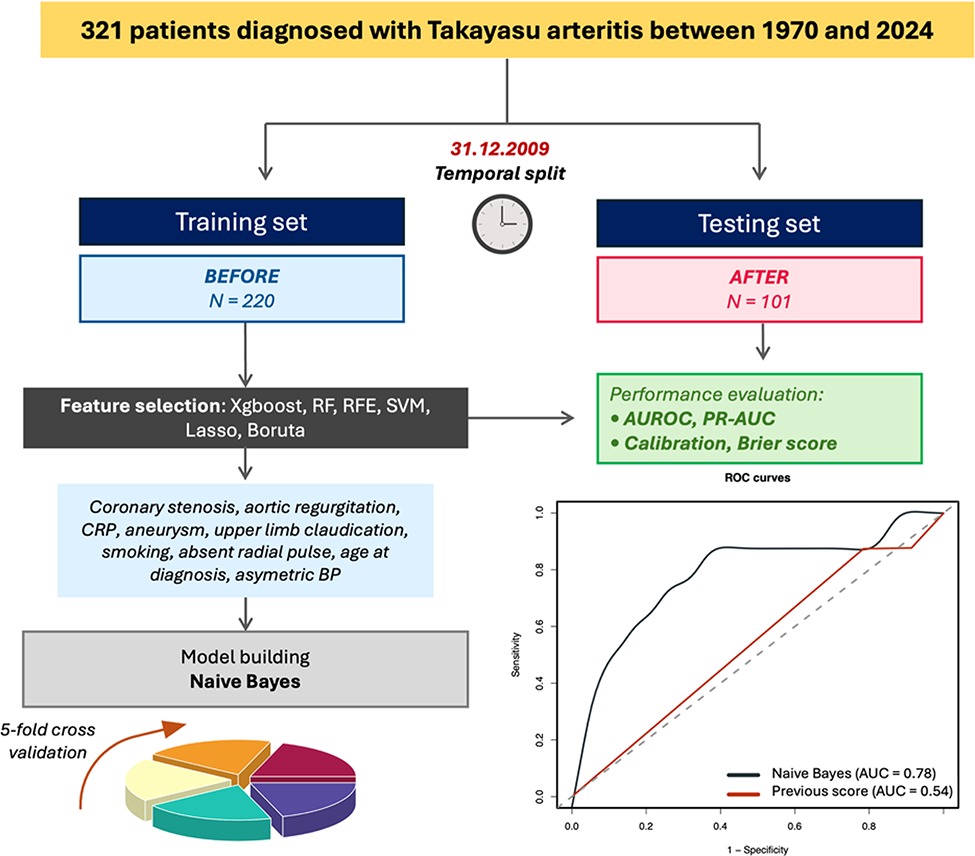
Methods: We conducted a retrospective multicentric enrolling patients diagnosed with Takayasu arteritis between 1970 and 2024, with a median follow-up of 18 [13-17] years. Sixty-seven baseline variables were considered as entry data for the ML model. Feature selection was performed using least absolute shrinkage and selection operator, recursive feature elimination, Boruta, random forest and XGBoost algorithms, followed by ranking according to mean variable importance. The final predictive model was built using the Naïve Bayes algorithm. The primary outcome was all-cause mortality, ascertained from the French electronic National Death Registry. Model performance was assessed using area under the receiver operating characteristic curve (AUC) and compared with a previously published score. A probability threshold for risk stratification was defined using a conditional inference tree.
Results: Among 321 consecutive patients (mean age 36 years, 86 % female), 47 (15%) deaths occurred. Following feature selection, 8 clinical variables (including aortic regurgitation, age at diagnosis, smoking, absent radial pulse, arterial aneurysm, upper limb claudication, coronary stenosis and inter-arm blood pressure difference) and 1 biological variable (C-reactive protein) were included for model building. Higher C-reactive protein, absent radial pulse and the presence of an upper limb claudication were associated with a decreased predicted probability of death. The ML algorithm exhibited a higher AUC (0.78) for all-cause mortality prediction compared with the previously published mortality score (AUC 0.54) in the external validation dataset, also outperforming logistic regression (AUC 0.65). A predicted probability threshold of 0.2 identified high- versus low-risk groups with significant survival discrimination (log-rank p-value=0.049). The predictive model exhibited good calibration performances with a Brier score of 0.08 on the test set.
Conclusions: A supervised ML model integrating clinical and biological data provided better performance in predicting long-term mortality compared to conventional approaches in Takayasu arteritis. Such models have potential to facilitate individualized risk stratification in this vasculitis.
REFERENCES: [1] Mirouse A, Biard L, Comarmond C, et. al, French Takayasu network. Overall survival and mortality risk factors in Takayasu’s arteritis: A multicenter study of 318 patients. J Autoimmun. 2019 Jan;96:35-39. doi: 10.1016/j.jaut.2018.08.001. Epub 2018 Aug 17. PMID: 30122419.
Acknowledgments: NIL.
Disclosure of Interests: None declared.