fetching data ... 
Background: Anti-neutrophil cytoplasmic antibody (ANCA)-associated vasculitis (AAV) is a group of vasculitis characterized by necrotizing inflammation, primarily affecting small blood vessels. Although GPA and MPA overlap significantly in terms of clinical, histopathological, and treatment strategies, EGPA partially differs from these two subtypes with its unique clinical manifestations and treatment regimens. AAV predominantly affects individuals in middle age, with peak onset between 45 and 60 years. In recent years, the incidence of AAV in the elderly population has increased along with rising life expectancy. Recent data suggest that MPO-ANCA positivity and mortality rates are elevated in older patients with AAV.
Objectives: The aim of our study is to evaluate the effect of age at onset of the disease on clinical features, laboratory findings, treatment regimens, disease course, and survival in patients with GPA and MPA.
Methods: This retrospective cohort study included patients with ANCA-associated vasculitis (AAV) diagnosed between January 2010 and July 2025 at two tertiary referral centers. Patients fulfilling the 2022 ACR/EULAR classification criteria for granulomatosis with polyangiitis (GPA) or microscopic polyangiitis (MPA) were included. Patients were stratified by age at diagnosis using a cutoff of 65 years as elderly-onset or younger-onset AAV. Disease activity and baseline functional status at diagnosis were assessed using the Birmingham Vasculitis Activity Score (BVAS) and the Eastern Cooperative Oncology Group (ECOG) performance status, respectively. Primary outcomes included differences in clinical characteristics, relapse rates, end-stage renal disease, and mortality between age groups.
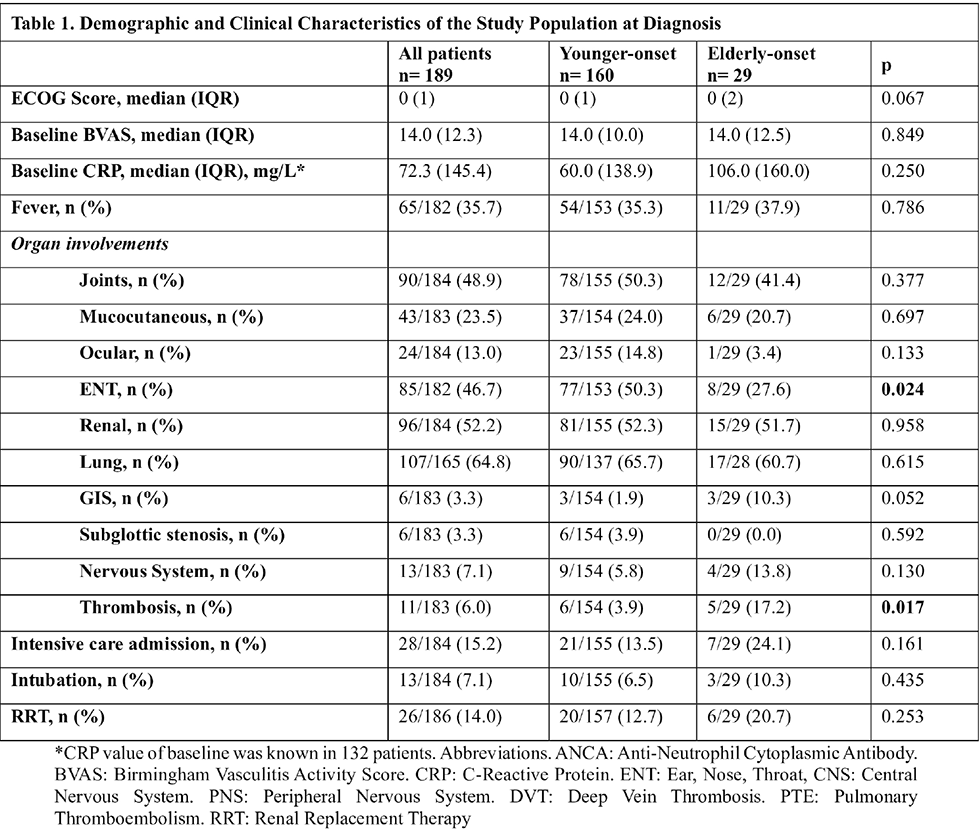
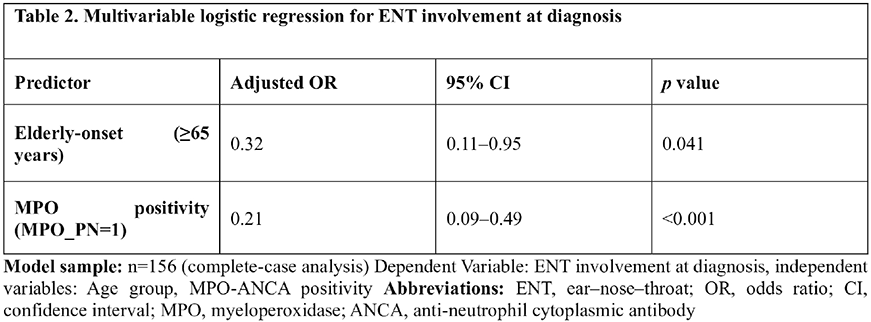
Results: Of 227 patients with ANCA-associated vasculitis (AAV) screened, 189 were included; 160 (84.7%) were classified as younger-onset (<65 years) and 29 (15.3%) as elderly-onset (≥65 years). The mean age of the overall cohort was 48.6 ± 15.5 years, with similar sex distribution between groups. PR3-ANCA positivity and GPA were more frequent in younger-onset patients, whereas MPO-ANCA positivity was significantly higher in elderly-onset patients. Tobacco consumption and thrombotic events were also more common in the elderly-onset group, while relapse rates were lower. Median follow-up duration was significantly shorter in elderly-onset patients (Table 1). Treatment regimens, including induction and maintenance therapies, did not differ significantly between elderly-onset and younger-onset AAV patients. Baseline disease activity and functional status, assessed by the Birmingham Vasculitis Activity Score and Eastern Cooperative Oncology Group performance status, were comparable between groups. Ear, nose, and throat (ENT) involvement was significantly less frequent in elderly-onset patients, whereas renal and pulmonary involvement did not differ (Table 1). In multivariable logistic regression analysis including age group and MPO-ANCA positivity, elderly-onset disease remained independently associated with a lower likelihood of ENT involvement (adjusted OR 0.32, 95% CI 0.11–0.95), as did MPO-ANCA positivity (adjusted OR 0.21, 95% CI 0.09–0.49) (Table 2). Crude mortality rates were similar between groups; however, Kaplan–Meier analysis demonstrated significantly reduced overall survival in elderly-onset patients (log-rank p = 0.005). In Cox regression analysis, elderly-onset disease and impaired baseline functional status (ECOG ≥ 2) were independently associated with mortality.
Conclusions: In our study, differences in clinical features and outcomes were observed according to age at disease onset. Compared with younger-onset AAV, elderly-onset AAV was associated with a higher frequency of MPO-ANCA positivity, less frequent ENT involvement, a higher occurrence of thrombotic events, and lower overall survival. In our cohort, tobacco consumption was more prevalent among older patients. In our cohort, baseline ECOG performance status was associated with mortality. Previous studies, including the cohort reported by Titeca-Beauport et al., have similarly shown that poor baseline clinical status is associated with adverse outcomes in elderly patients with ANCA-associated vasculitis. Prospective cohort studies with larger sample sizes are needed to further clarify the relationships between age, lifestyle factors, and clinical outcomes in ANCA-associated vasculitis.
REFERENCES: NIL.
Acknowledgments: NIL.
Disclosure of Interests: None declared.