fetching data ... 
Background: Gout is a chronic inflammatory arthritis caused by monosodium urate crystal deposition and represents a substantial and increasing public health burden. High body mass index (BMI) is a well-established and modifiable risk factor for gout, largely through its effects on serum urate metabolism[1, 2]. Global Burden of Disease (GBD) studies have documented sustained increases in gout prevalence and disability burden worldwide, with consistently higher burden observed among males than females [3]. However, comprehensive assessments of long-term trends, sex-specific disparities, and cross-national variation in the burden of gout attributable to high BMI across European Union (EU) member states remain limited.
Objectives: To characterise long-term trends, sex disparities, and cross-national variation in the burden of gout attributable to high BMI across EU countries from 1990 to 2023.
Methods: Data for this study were derived from the GBD 2023, a global health metrics initiative that integrates multi-source health data, including population-based surveys and vital registration systems, to estimate fatal and non-fatal health losses for 375 diseases and injuries across 204 countries and territories. We assessed the burden of gout attributable to high BMI across the 27 EU member states from 1990 to 2023, using years lived with disability (YLDs) as the primary outcome. Estimates were stratified by sex and country, with absolute counts and age-standardised YLD rates (ASYRs, per 100,000 population) reported alongside corresponding 95% uncertainty intervals (UIs). Long-term temporal trends in ASYRs were assessed using Joinpoint regression analysis, with changes summarised by average annual percentage change (AAPC).
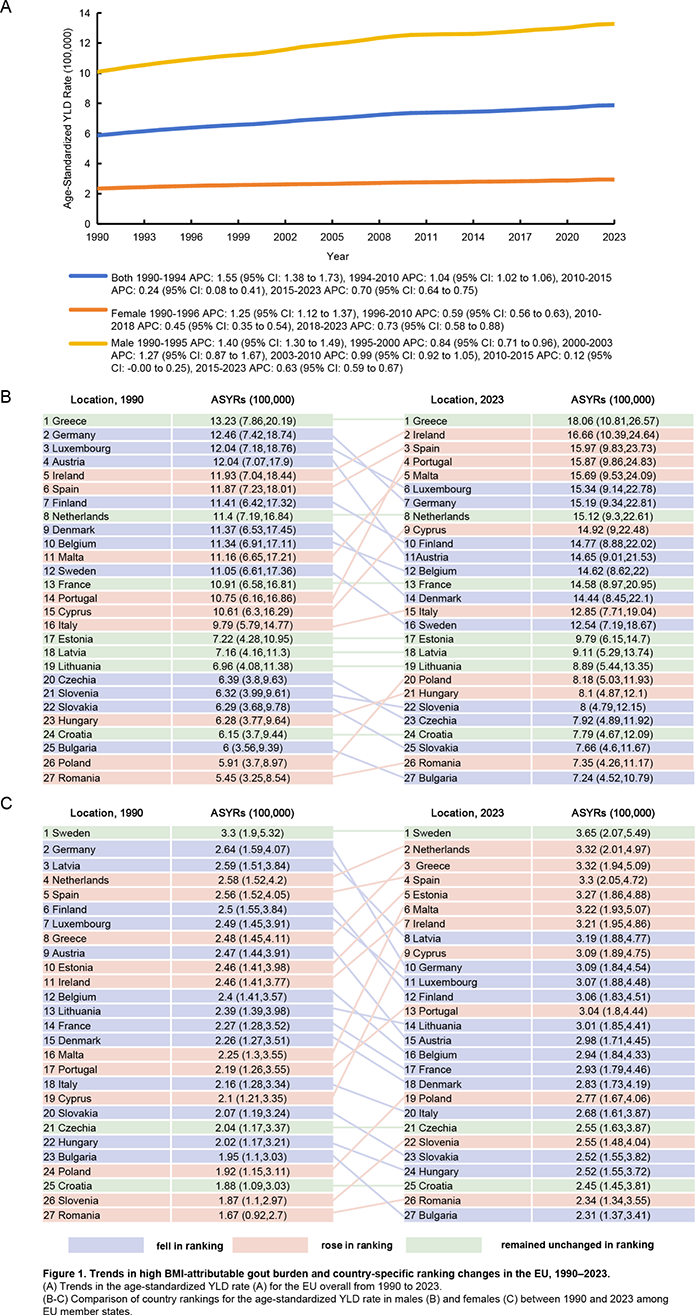
Results: From 1990 to 2023, ASYRs for gout attributable to high BMI increased steadily across the EU, rising from 5.87 per 100,000 population (95% uncertainty interval [UI] 3.55–8.97) in 1990 to 7.87 (4.86–11.64) in 2023, corresponding to an AAPC of 0.83 (95% UI 0.79–0.88). Throughout this period, the BMI-attributable gout burden remained substantially higher among males than among females, with male ASYRs approximately 4.5 times those observed in females. In addition, the increase over time was steeper among males (AAPC 0.90, 95% UI 0.86–0.93) than among females (AAPC 0.70, 95% UI 0.66–0.74) (Figure 1A). Marked cross-national heterogeneity in BMI-attributable gout burden was observed across EU member states. Among males, Greece consistently ranked among the countries with the highest ASYRs at both the beginning and end of the study period. Germany and Luxembourg featured prominently in 1990, whereas Ireland and Spain emerged among the highest-burden countries by 2023. Among females, Sweden maintained the highest ASYRs throughout the study period; Germany and Latvia ranked highly in 1990, while the Netherlands and Greece were among the highest-burden countries in 2023. Beyond overall heterogeneity, sex-specific ranking patterns also diverged across countries. Several member states exhibited contrasting trends between males and females; for example, Italy and Hungary showed rising relative rankings among males alongside declining rankings among females, whereas Slovenia demonstrated the opposite pattern (Figure 1B and 1C).
Conclusions: The burden of gout attributable to high body mass index has increased steadily across the European Union since 1990, accompanied by pronounced sex disparities and substantial cross-country heterogeneity. Taken together, these findings underscore the need for sex-responsive and country-specific strategies to effectively address the growing impact of BMI-related gout across the EU.
REFERENCES: [1] Larsson SC, Burgess S, Michaëlsson K. Genetic association between adiposity and gout: a Mendelian randomization study. Rheumatology (Oxford). 2018;57(12):2145-8.
[2] Choi HK, Atkinson K, Karlson EW, Curhan G. Obesity, weight change, hypertension, diuretic use, and risk of gout in men: the health professionals follow-up study. Arch Intern Med. 2005;165(7):742-8.
[3] C. M, Ong. KL, Culbreth. GT, Steinmetz. JD, Cousin. E, Lenox. H, et al. Global, regional, and national burden of gout, 1990-2020, and projections to 2050: a systematic analysis of the Global Burden of Disease Study 2021. Lancet Rheumatol. 2024;6(8):e507-e17.
Acknowledgments: NIL.
Disclosure of Interests: None declared.