fetching data ... 
Background: Rheumatoid arthritis (RA) is a chronic autoimmune inflammatory disease primarily affecting multiple joints, leading to pain, functional impairment, and long-term disability [1]. While the global RA prevalence has increased substantially and is projected to continue rising through 2050 [2], long-term trends in age-standardized prevalence in the U.S. remain uncertain, particularly across sociodemographic groups.
Objectives: Using the National Health and Nutrition Examination Survey (NHANES) data (2001-2023), we assessed temporal trends in age-standardized RA prevalence and disparities across key sociodemographic subgroups.
Methods: Data from the NHANES spanning 2001 to 2023 were used in this study. NHANES is a nationally representative, cross-sectional survey that employs a complex, multistage probability sampling design to assess the health and nutritional status of the U.S. population. Over the study period, the unweighted response rate declined from 84% in 2001–2002 to 34.5% in 2021–2023. To ensure adequate sample sizes and improve estimate precision, data from every two consecutive NHANES cycles were pooled. The study included nonpregnant adults aged ≥20 years. Sociodemographic variables included age, sex, race/ethnicity, education, and family poverty-to-income ratio (PIR). RA was defined as self-reported physician diagnosis using the standardized NHANES questionnaire. Prevalence estimates were age-standardized to the 2010 U.S. Census population and weighted in accordance with NHANES guidelines. Trends and subgroup differences were assessed using multivariable linear regression. All statistical analyses were conducted using R version 4.4.0, with statistical significance defined as a two-sided P value < 0.05.
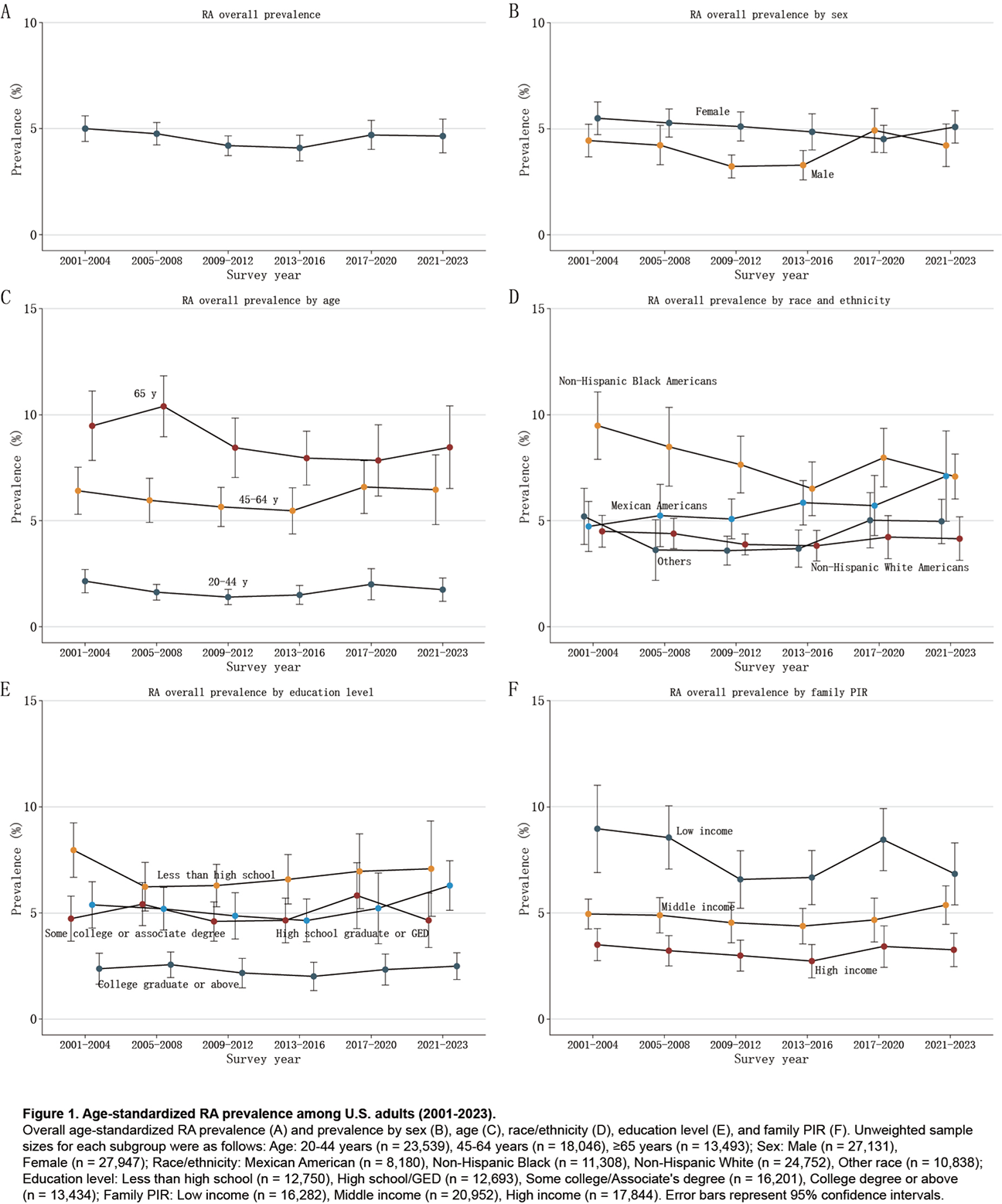
Results: The unweighted study population included 55,078 adults (weighted mean age 46.8 years; 51.01% female), with 3,230 RA cases. Overall, the age-standardized RA prevalence declined significantly from 2001-2004 to 2013-2016 (-0.91%; 95% CI, −1.76% to −0.06%; P = 0.047), followed by a non-significant increase through 2017-2020 (0.62%; 95% CI, −0.30% to 1.53%) and stabilization during 2021–2023 (Figure 1A). Stratified analyses showed temporal patterns broadly consistent with the overall trend among adults aged 20–44 years and 45–64 years, non-Hispanic White individuals, those with a college education or higher, and individuals with high income (Figure 1C–F). Notably, prevalence among non-Hispanic Black individuals declined significantly from 2001-2004 to 2021-2023 (−2.40%; 95% CI, −4.31% to −0.49%; P = 0.005), with a pronounced reduction already evident by 2013-2016 (−2.97%; 95% CI, −5.00% to −0.94%; P = 0.003). Moreover, RA prevalence increased with age and was highest among adults aged ≥65 years, followed by those aged 45-64 years and 20-44 years. Prevalence was consistently higher among women (Figure 1B) and among non-Hispanic Black individuals. A clear socioeconomic gradient was observed, with higher prevalence among individuals with lower education and income.
Conclusions: RA prevalence followed a non-linear trajectory characterized by an initial decline, a subsequent increase, and then stabilization. Despite this overall trend, substantial and persistent disparities remained evident, particularly among non-Hispanic Black individuals and socioeconomically disadvantaged groups. These findings emphasize the need for targeted public health strategies to improve diagnosis and ensure equitable access to treatment for socioeconomically disadvantaged populations.
REFERENCES: [1] Bombardier C, Barbieri M, Parthan A, Zack D J, Walker V, Macarios D, et al. The relationship between joint damage and functional disability in rheumatoid arthritis: a systematic review. Ann Rheum Dis 2012;71 (6): 836-44.
[2] Global, regional, and national burden of rheumatoid arthritis, 1990-2020, and projections to 2050: a systematic analysis of the Global Burden of Disease Study 2021. Lancet Rheumatol 2023;5 (10): e594-e610.
Acknowledgments: NIL.
Disclosure of Interests: None declared.