fetching data ... 
Background: Interoceptive awareness is a complex multidimensional construct, and it involves the conscious awareness one has of their internal body sensations, requiring the interplay between perceptual body states and cognitive appraisal of those body states [1]. There is theoretical evidence of a dynamic relationship between physical activity and interoception [2]. Patients with axial spondyloarthritis (axSpA) are more prone to physical inactivity than the general population, despite evidence that increased physical activity leads to improved outcomes [3].
Objectives: The aim of this pilot study was to explore the role of interoception awareness in the levels of physical activity reported by axSpA patients.
Methods: This was a cross-sectional study including adults diagnosed with axSpA recruited via the National Axial Spondyloarthritis Society (NASS) website. Patients completed on-line questionnaires, covering data on demographics, comorbidities, disease activity, physical activity, and interoception awareness. Physical activity was measured by International Physical Activity Questionnaire (IPAQ) Short Form [4], reported as MET-minutes for walking, moderate, vigorous activities, and total; or categorically as inactive, minimally active, or highly active (HEPA). Interoceptive awareness was assessed with the eight-subscale Multidimensional Assessment of Interoceptive Awareness (MAIA) questionnaire [5].
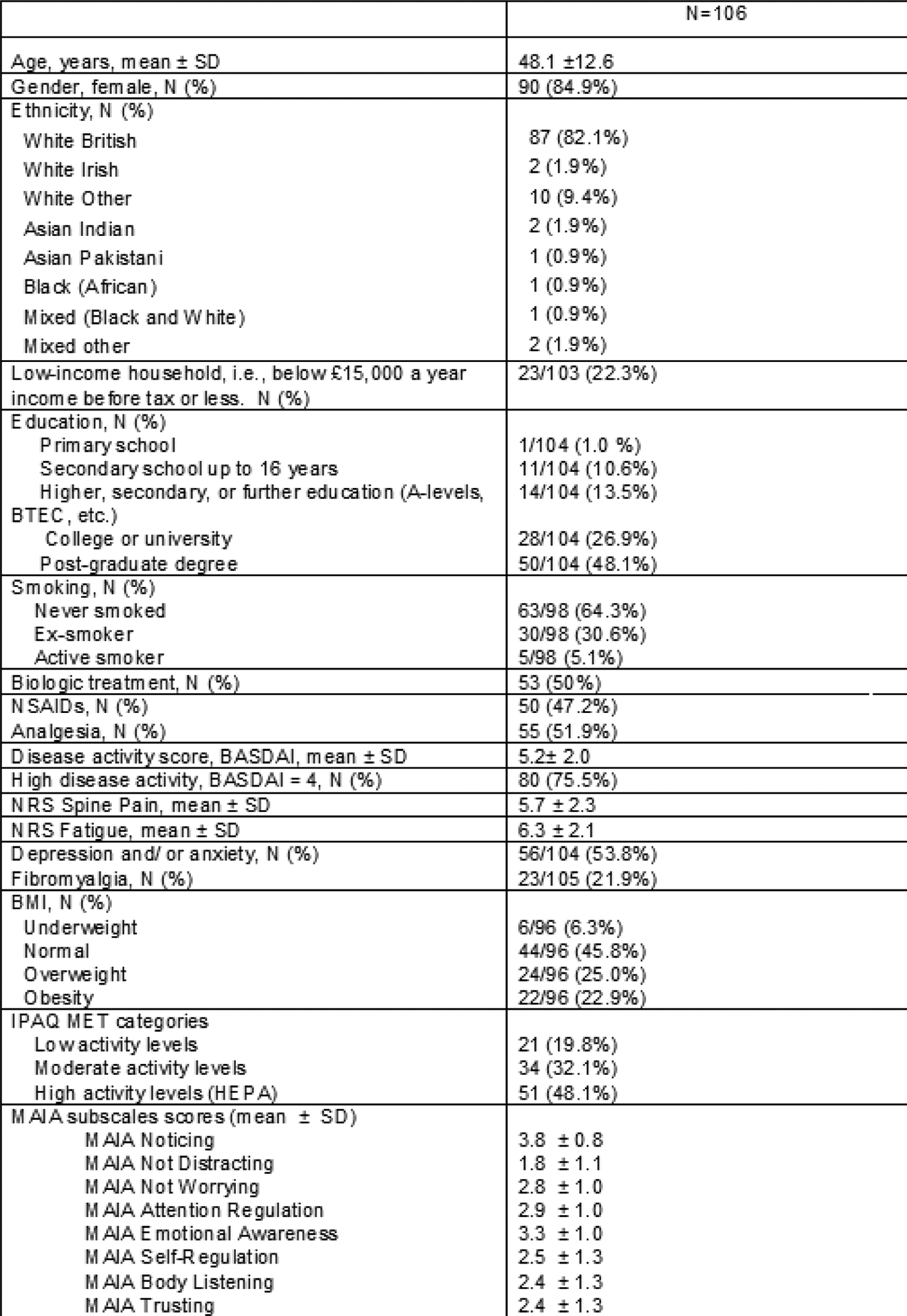
Results: 106 people with axSpA were included in the analysis ( table1 ). The majority reported high disease activity and high scores of pain and fatigue. Less than half of participants (48.1%) were HEPA active. MET-Vigorous scores were associated with MAIA Noticing (β=0.208, p=0.033), Attention Regulation (β =0.216, p=0.026), Emotional Awareness (β =0.207, p=0.033), and Body Listening (β =0.326, p=0.001). Total MET scores were not associated with any of the MAIA sub-scales, nor any of the disease-related variables.
Conclusions: Patients with axSpA who have stronger interoceptive abilities—the capacity to notice, attend to, and actively listen to their internal physiological sensations and the emotional responses arising from bodily experiences—tend to engage in more vigorous exercise behaviours. This relationship specifically with vigorous exercise suggests that patients with enhanced bodily awareness may better distinguish between harmful pain and normal exercise discomfort, allowing them to confidently engage in higher-intensity activity without fear of triggering flares. In contrast, those with lower interoceptive awareness might avoid beneficial vigorous exercise altogether due to difficulty differentiating between activity-related sensations and disease symptoms. This finding suggests that interoceptive training could be a valuable addition to physical therapy interventions, potentially enabling more patients to safely engage in higher-intensity exercise with its associated health benefits.
Table 1. Characteristics of 106 patients with axial Spondyloarthritis (axSpA) included in the study:
Legend: N: number; SD: standard deviation; NSAIDs: Non-steroidal anti-inflammatory drugs; BASDAI: Bath Axial Spondyloarthritis Disease Activity Index; NRS: Numeric Rating Scale; BMI: Body Mass Index; IPAQ: International Physical Activity Questionnaire; MET minutes represent the amount of energy expended carrying out physical activity; MAIA: Multidimensional Assessment of Interoceptive Awareness.
REFERENCES: [1] Mehling WE, Price C, Daubenmier JJ, Acree M, Bartmess E, Stewart A. The Multidimensional Assessment of Interoceptive Awareness (MAIA). PLoS One. 2012;7(11):e48230. DOI: 10.1371/journal.pone.0048230. Epub 2012 Nov 1. PMID: 23133619; PMCID: PMC3486814.
[2] Wallman-Jones A, Perakakis P, Tsakiris M, Schmidt M. Physical activity and interoceptive processing: Theoretical considerations for future research. Int J Psychophysiol. 2021.
[3] Ortolan A, Webers C, Sepriano A, Falzon L, Baraliakos X, Landewé RB, Ramiro S, van der Heijde D, Nikiphorou E. Efficacy and safety of non-pharmacological and non-biological interventions: a systematic literature review informing the 2022 update of the ASAS/EULAR recommendations for the management of axial spondyloarthritis. Ann Rheum Dis. 2023 Jan;82(1):142-152. DOI: 10.1136/ard-2022-223297. Epub 2022 Oct 19. PMID: 36261247.
[4] Lee PH, Macfarlane DJ, Lam T, Stewart SM. Validity of the international physical activity questionnaire short form (IPAQ-SF): a systematic review. Int J Behav Nutr Phys Act. 2011; 8 :115. DOI: 10.1186/1479-5868-8-115.
[5] Mehling WE, Price C, Daubenmier JJ, Acree M, Bartmess E, Stewart A. The Multidimensional Assessment of Interoceptive Awareness (MAIA). PLoS One. 2012;7(11):e48230. DOI: 10.1371/journal.pone.0048230. Epub 2012 Nov 1. PMID: 23133619; PMCID: PMC3486814.
Acknowledgments: NIL.
Disclosure of Interests: None declared.