fetching data ... 
Background: Platelet-rich plasma (PRP) injections and topical non-steroidal anti-inflammatory drugs are both commonly used conservative interventions for knee osteoarthritis (OA), despite substantial differences in invasiveness, cost, and proposed mechanisms of action. Existing literature suggests that both approaches may be associated with short-term symptomatic improvements; however, the magnitude and clinical relevance of these effects remain debated.
Objectives: To compare the short-term effects of intra-articular platelet-rich plasma injections and topical diclofenac gel on pain, physical function, performance-based outcomes, and health-related quality of life in individuals with knee osteoarthritis.
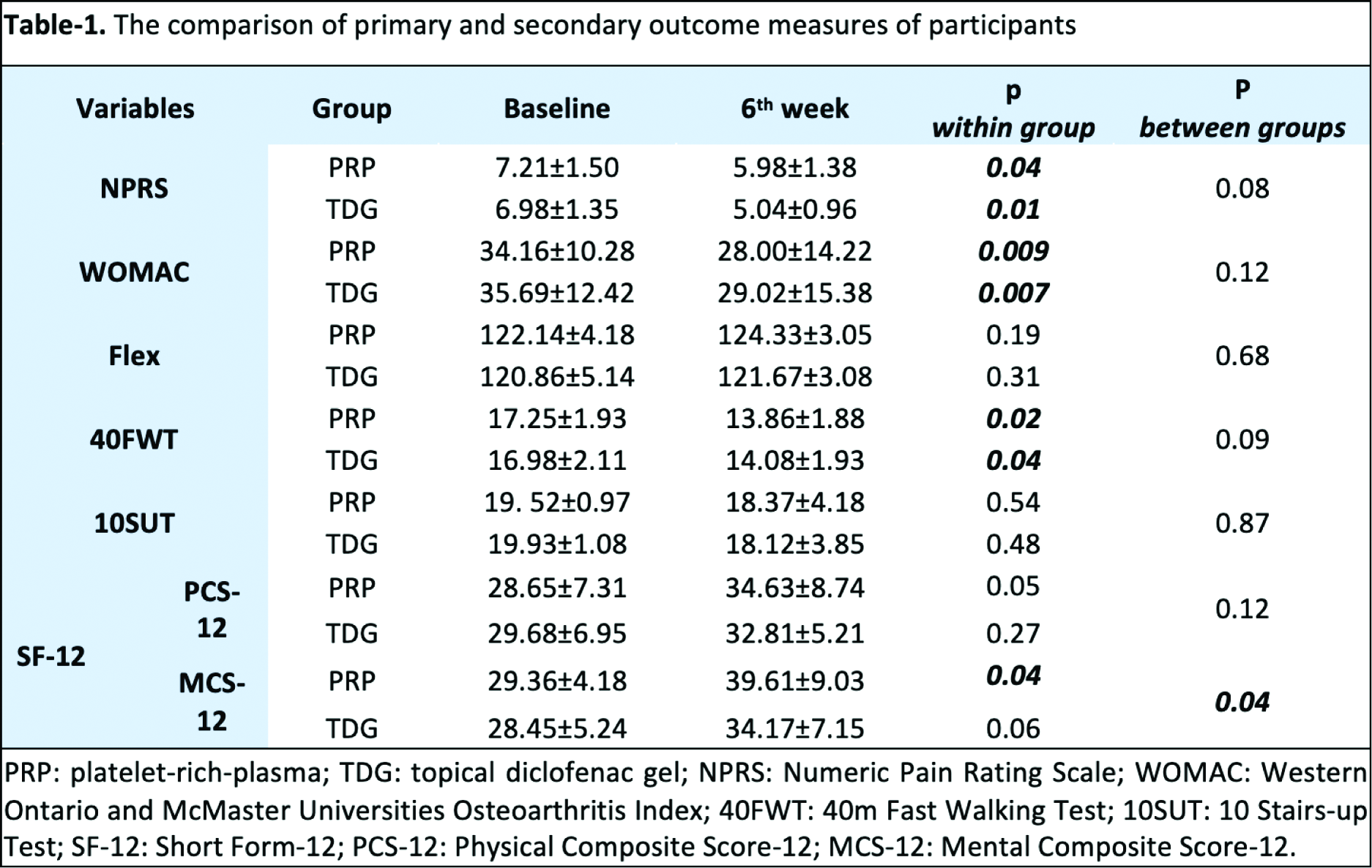
Methods: This pilot study included 39 individuals with knee osteoarthritis (mean age: 58.12 ± 8.15 years). Participants met the American College of Rheumatology diagnostic criteria for knee OA and were classified as Kellgren–Lawrence grade II or III. Eligible participants were randomly allocated to either a PRP group (n = 19), receiving three intra-articular injections over six weeks, or a topical diclofenac gel group (TDG; n = 20), applying the agent twice daily for the same duration. Assessments were conducted at baseline and at week 6 and included pain intensity (Numeric Pain Rating Scale, NPRS), disease-specific function (Western Ontario and McMaster Universities Osteoarthritis Index, WOMAC), knee flexion range of motion, physical performance (40-m Fast Walking Test and 10-Stair Up Test), and health-related quality of life (SF-12 Physical and Mental Component Scores). Within- and between-group comparisons were performed. The study was conducted in accordance with the Declaration of Helsinki and was approved by the Institutional Ethics Committee for Interventional Clinical Research (Approval No: 2024/1771).
Results: Both groups demonstrated statistically significant within-group improvements in pain intensity and WOMAC scores at six weeks (p < 0.05). Numerically greater improvements were observed in the topical diclofenac gel group across several outcomes; however, no statistically significant differences were detected between groups. Improvements in fast walking performance were observed in both groups, while no meaningful changes were found in knee range of motion or stair-climbing performance. No significant between-group differences were observed in the SF-12 Physical Component Score. A significant improvement in the SF-12 Mental Component Score was observed in the PRP group, with a statistically significant between-group difference favouring PRP at week 6 (p = 0.04).
Conclusions: In this pilot study, topical diclofenac gel demonstrated short-term improvements in pain and physical function that were comparable to, and in some outcomes numerically greater than, those observed following platelet-rich plasma injections; however, no statistically significant between-group differences were identified. PRP did not confer short-term advantages in physical or performance-based outcomes. The isolated improvement observed in mental health-related quality of life in the PRP group may reflect non-specific or contextual influences associated with the intervention. These findings underscore the importance of cautious interpretation of early outcomes following biologic treatments and highlight the need for longer-term comparative studies to determine whether biological effects translate into sustained clinical benefits.
REFERENCES: [1] Bannuru RR, Osani M, Vaysbrot E, Arden N, Bennell K, Bierma-Zeinstra S, et al. OARSI guidelines for the non-surgical management of knee, hip, and polyarticular osteoarthritis. Osteoarthritis and cartilage. 2019;27(11):1578-89.
[2] Bensa A, Previtali D, Sangiorgio A, Boffa A, Salerno M, Filardo G. PRP Injections for the Treatment of Knee Osteoarthritis: The Improvement Is Clinically Significant and Influenced by Platelet Concentration: A Meta-analysis of Randomized Controlled Trials. Am J Sports Med. 2025 Mar;53(3):745-754.
[3] Bennell KL, Paterson KL, Metcalf BR, et al. Effect of Intra-articular Platelet-Rich Plasma vs Placebo Injection on Pain and Medial Tibial Cartilage Volume in Patients With Knee Osteoarthritis: The RESTORE Randomized Clinical Trial. JAMA. 2021;326(20):2021–2030.
[4] Buendía-López D, Medina-Quirós M, Fernández-Villacañas Marín MÁ. Clinical and radiographic comparison of a single LP-PRP injection, a single hyaluronic acid injection and daily NSAID administration with a 52-week follow-up: a randomized controlled trial. J Orthop Traumatol. 2018 Aug 20;19(1):3.
[5] Chen ZR, Chen BK, Li P, Feng K. Efficacy and safety of different topical diclofenac formulations for the treatment of knee osteoarthritis: a meta-analysis of short-term and long-term treatment comparisons. BMC Musculoskelet Disord. 2025 Mar 10;26(1):230.
[6] Kolasinski SL, Neogi T, Hochberg MC, Oatis C, Guyatt G, Block J, et al. 2019 American College of Rheumatology/Arthritis Foundation Guideline for the Management of Osteoarthritis of the Hand, Hip, and Knee. Arthritis Rheumatol. 2020;72(2):220-33.
[7] Wang, C., Yao, B. Efficacy and safety of platelet-rich plasma injections for the treatment of knee osteoarthritis: a systematic review and meta-analysis of randomized controlled trials. Eur J Med Res 2025; 30, 992.
Acknowledgments: NIL.
Disclosure of Interests: None declared.