fetching data ... 
Background: Rheumatoid arthritis (RA) is a systemic autoimmune disease characterized by synovial inflammation that can involve the cervical spine [1]. Cervical involvement occurs in 43–86% of RA patients [2]. However, the precise manner in which morphological properties of cervical muscles in patients with RA are affected remains unclear.
Objectives: The aim of present study was to compare morphological and mechanical properties of cervical muscles evaluated with ultrasonographic (US) imaging in patients with RA and asymptomatic individuals and to examine the relationship between morphological/ mechanical properties of cervical muscles and neck pain, hand grip strength, and disability.
Methods: Forty-five patients with RA (38 females) and 38 sex, age, body mass index matched apparently healthy adults were included in this study. Pain severity, disability, physical activity level, hand grip strength, cervical muscle morphology and pressure pain threshold were evaluated with the Visual Analogue Scale (VAS), Neck Disability Index (NDI), International Physical Activity Questionnaire (IPAQ), hand dynamometer, US imaging and manuel algometer, respectively.
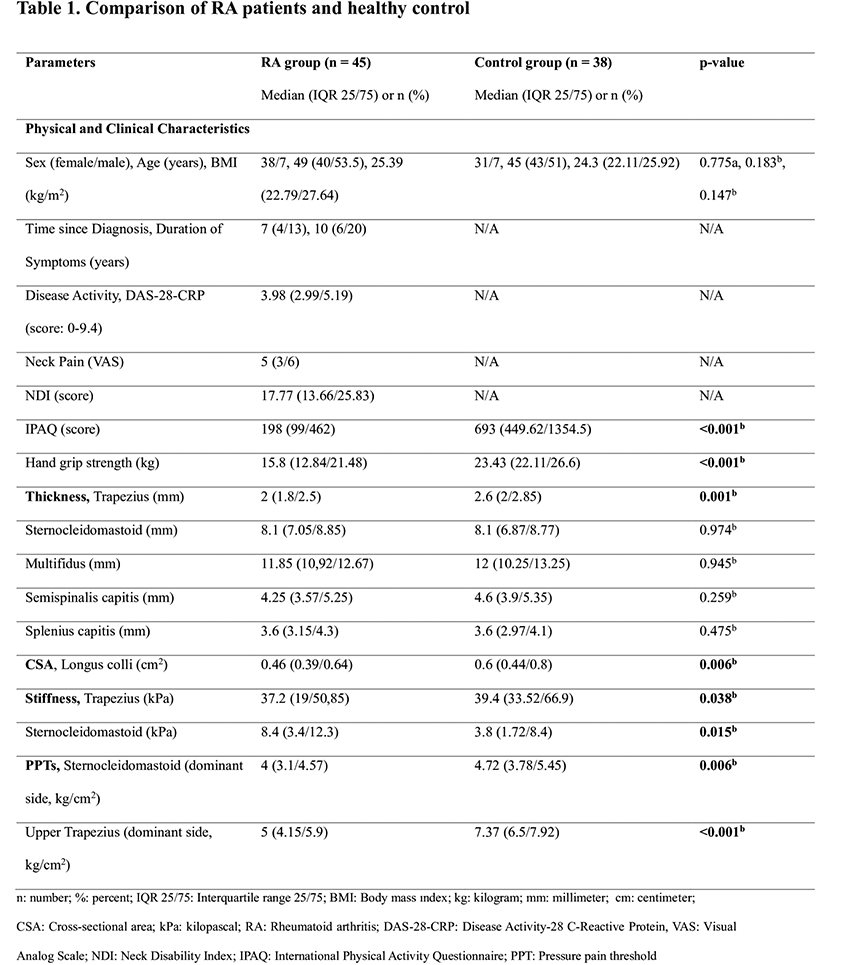
Results: A significant reduction in the cross-sectional area (CSA) of the longus colli muscle and thickness of trapezius muscle was observed in those with RA compared to those healthy control (p = 0.006, p=0.001; respectively). RA patients exhibited more stiffness in the trapezius and sternocleidomastoid (SCM) muscles (p = 0.038, p=0.015; respectively). There was no difference in the thickness scores for the SCM, multifidus, semispinalis capitis and splenius capitis muscles (p>0.05). Pressure pain threshold of upper trapezius and SCM muscles, physical activity levels and hand grip strength were lower in patients with RA compared with healthy controls (p<0.05) (Table 1). The CSA of the longus colli muscle was significantly correlated with neck pain and hand grip strength (p= 0.032, p=0.001; respectively) (Table 2).
Conclusions: Patients with RA exhibited diminished longus colli muscle CSA and heightened trapezius and SCM muscles stiffness compared to those health control. Furthermore, longus colli muscle CSA is associated with pain and hand grip strength in patients with RA. Cervical muscle morphologies should be considered by the clinician when planning treatment in patients with RA with neck pain.

REFERENCES: [1] Blom M, Creemers MC, Kievit W, Lemmens JA, van Riel PL. Long-term follow-up of the cervical spine with conventional radiographs in patients with rheumatoid arthritis. Scand J Rheumatol. 2013;42(4):281-8. DOI: 10.3109/03009742.2012.747625.
[2] Ulutatar F, Unal-Ulutatar C, Duruoz MT. Cervical proprioceptive impairment in patients with rheumatoid arthritis. Rheumatol Int. 2019 Dec;39(12):2043-2051. DOI: 10.1007/s00296-019-04419-0.
Acknowledgments: NIL.
Disclosure of Interests: None declared.