fetching data ... 
Background: Life satisfaction is a key component of subjective well-being in individuals with chronic illnesses. In rheumatoid arthritis (RA), Treat-to-Target (T2T) strategies have substantially improved clinical outcomes; however, achieving clinical remission does not necessarily translate into high life satisfaction. The factors that determine life satisfaction in the contemporary RA treatment landscape therefore remain to be clarified.
Objectives: To examine life satisfaction and its determinants among outpatients with RA across generations, with a particular focus on psychosocial and communicative factors beyond demographic characteristics and inflammatory disease activity.
Methods: One hundred nineteen outpatients with RA (median disease duration: 11.0 years) were enrolled. Collected variables included age, sex, Disease Activity Score in 28 joints with C-reactive protein (DAS28-CRP), the Health Assessment Questionnaire-Disability Index (HAQ-DI), pain intensity (Pain-VAS), the Pain Disability Assessment Scale (PDAS), the Pain Self-Efficacy Questionnaire (PSEQ), adequacy of patient–clinician communication, which was measured using a numerical rating scale (NRS), and the Patient Activation Measure-13 (PAM-13). The primary outcome was life satisfaction, which was measured using a numerical rating scale (NRS). Statistical analysis followed a three-step process. First, life satisfaction was compared across four generational categories: adults (25–44 years), middle-aged adults (45–64 years), young-old adults (65–74 years), and old-old adults (≥75 years). Second, analysis of covariance (ANCOVA) was performed adjusting for sex, disease duration, and CDAI to assess generational differences in life satisfaction. Finally, hierarchical multiple regression analysis was conducted to identify independent determinants of life satisfaction.
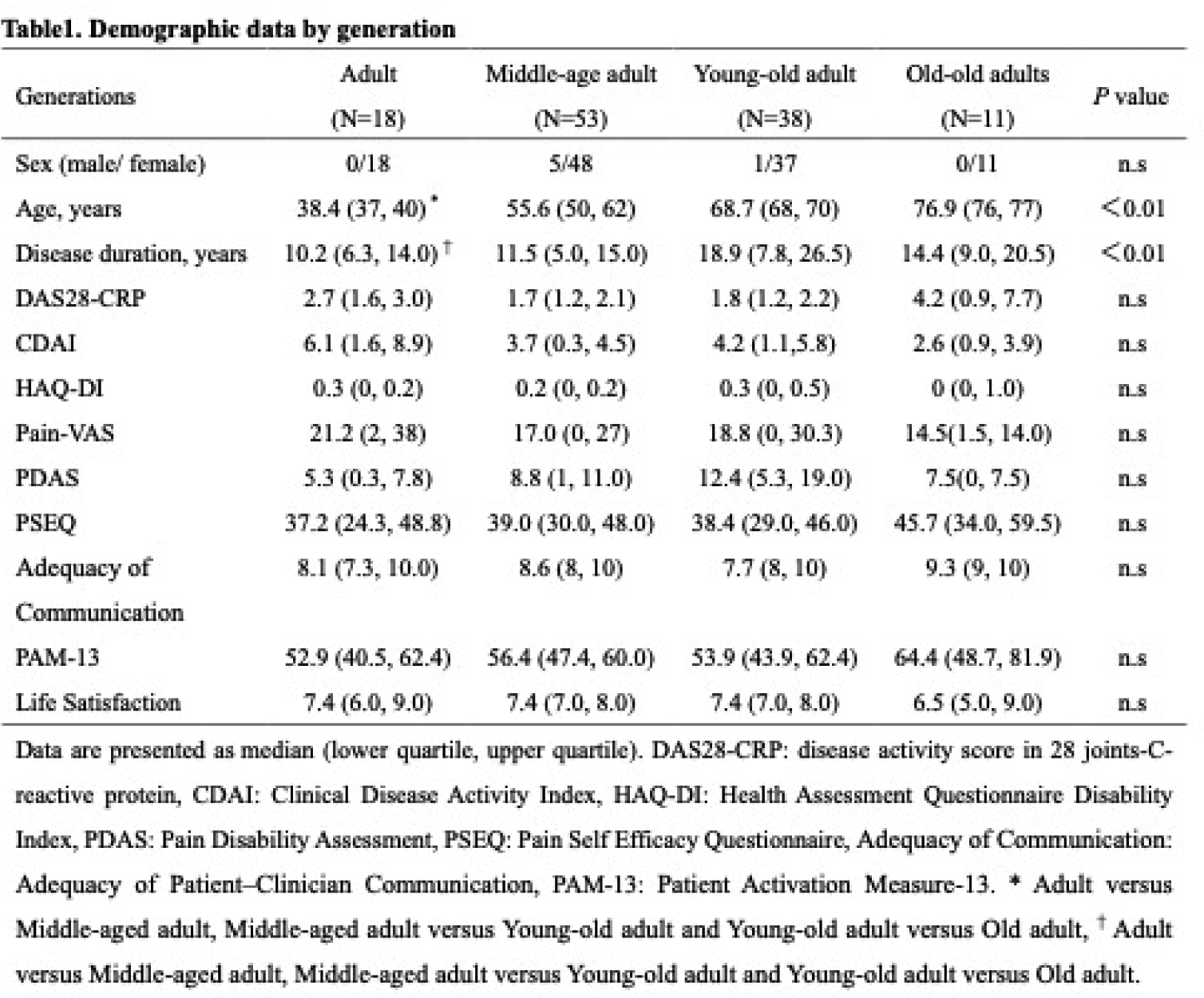
Results: Table 1 shows the demographic characteristics of the participants. Median life satisfaction was consistently high (8/10), with no significant differences observed across the four generations (p > 0.05). Similarly, disease activity, pain intensity, and psychosocial variables showed no significant generational differences (p > 0.05). Demographic and clinical variables (age, sex, disease duration, and CDAI) explained little variance in life satisfaction (R 2 = 0.026, p = 0.284). In contrast, the final regression model explained 59.1% of the variance (R 2 = 0.591, p < 0.001). Adequacy of patient–clinician communication (β = +0.359, p = 0.001), PSEQ (β = +0.272, p < 0.001), PDAS (β = −0.185, p = 0.012), PAM-13 (β = +0.155, p = 0.045) were independently associated with life satisfaction.
Conclusions: In the treat-to-target era, life satisfaction in patients with rheumatoid arthritis was largely associated with psychosocial factors and patient-perceived disability across all generations, rather than clinician-assessed inflammatory disease activity. These determinants particularly self-efficacy (PSEQ) and pain-related disability (PDAS) closely align with core components of the EULAR-recommended Rheumatoid Arthritis Impact of Disease (RAID) score, underscoring the relevance of patient-reported outcomes in understanding well-being beyond clinical remission. Our findings highlight the clinical relevance of Health Professionals in Rheumatology (HPR), suggesting that rehabilitation and effective clinician–patient communication may contribute to self-efficacy and subjective well-being in contemporary treat-to-target care.
REFERENCES: [1] Magdalena Staszkiewicz, et al: Life satisfaction, generalized sense of self-efficacy and acceptance of illness in rheumatoid arthritis patients depending on age and severity of the disease. Reumatologia :61, 3: 175-185 2023.
[2] Eduardo José Ferreira, et al: Determinants of happiness and quality of life in patients with rheumatoid arthritis: a structural equation modelling approach. Ann Rheum Dis :77:1118–1124 2018.
Acknowledgments: NIL.
Disclosure of Interests: None declared.