fetching data ... 
Background: Low back pain is a common healthcare issue with multiple causes, including inflammatory conditions such as axial spondyloarthritis (axSpA) (Hartvigsen et al., 2018; Poddubnyy et al., 2018). Inflammatory low back pain is frequently under-recognised, leading to diagnostic delays and adverse long-term outcomes (Zhao et al., 2021). Despite the inclusion of rheumatological content in physiotherapy education, many physiotherapists report feeling insufficiently prepared to recognise and screen for potential axSpA cases (Steen et al., 2020; Steen et al., 2023). This suggests a gap between educational training and its application to clinical decision-making, which may contribute to delayed recognition of inflammatory low back pain.
Objectives: This study aimed to compare diagnostic accuracy, clinical decision-making, and referral practices of physiotherapy students and practising physiotherapists in inflammatory and non-inflammatory low back pain conditions.
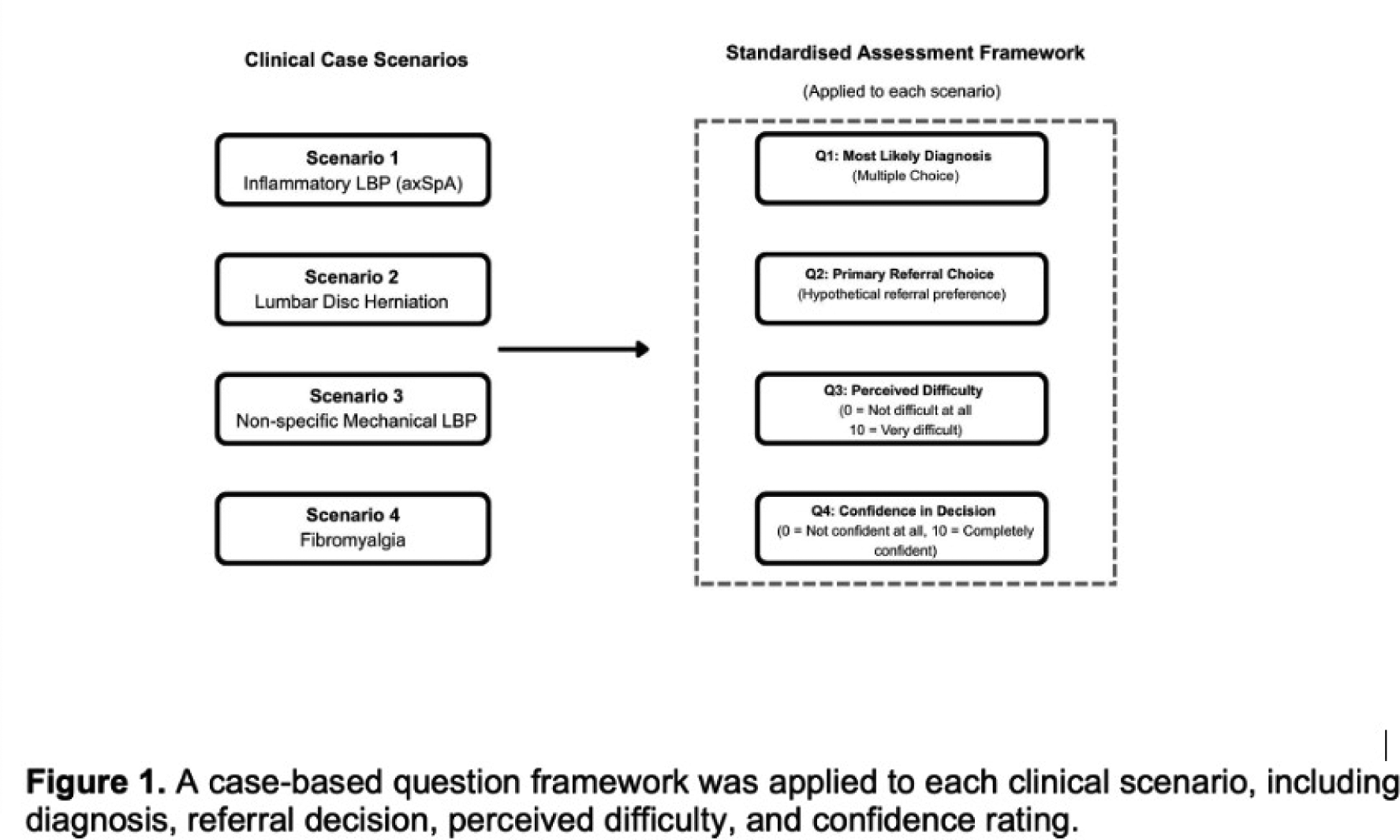
Methods: This cross-sectional study included final-year physiotherapy students who had completed their clinical internships and practising physiotherapists. Participants completed an online survey assessing clinical decision-making in low back pain using four standardised case scenarios (Figure 1): inflammatory low back pain, lumbar disc herniation, non-specific mechanical low back pain, and fibromyalgia. For each scenario, participants selected the most likely diagnosis, indicated referral preferences when appropriate, and rated perceived decision-making difficulty and confidence on a 0–10 scale. Appropriate referral was pre-defined for each scenario.
Results: A total of 191 participants were included (96 students, 95 clinicians). Group percentages and clinical decision-making scores are presented in Table 1. Diagnostic accuracy was comparable between groups across all scenarios (p>0.05), with a trend towards difference in inflammatory low back pain favoring clinicians (p=0.069). However, clinicians demonstrated significantly higher rates of appropriate referral in mechanical (p<0.001) and disc-related low back pain (p=0.028). Clinicians also reported significantly higher confidence in managing inflammatory (p=0.001), disc herniation (p=0.007), and mechanical low back pain scenarios (p<0.001). In contrast, in the fibromyalgia scenario, clinicians reported significantly greater decision-making difficulty (p<0.001) and lower confidence (p<0.001) than students despite similar diagnostic rates. In addition, clinicians demonstrated higher appropriate referral in the fibromyalgia scenario (27.4% vs 8.3%).
Conclusions: This study demonstrates that clinical experience strengthens appropriate referral decisions in common mechanical low back pain presentations; however, uncertainty may remain regarding the recognition of inflammatory causes such as axial spondyloarthritis. The differences observed between students and clinicians, particularly in inflammatory low back pain and fibromyalgia scenarios, indicate that clinical uncertainty and complex pain presentations may be insufficiently addressed in physiotherapy education (Roitenberg & Shoshana, 2021). Future research should focus on developing and evaluating structured educational approaches within physiotherapy training that emphasize differential diagnosis, inflammatory red flags, and biopsychosocial clinical reasoning.

REFERENCES: [1] Hartvigsen, J., Hancock, M. J., Kongsted, A., Louw, Q., Ferreira, M. L., Genevay, S., Hoy, D., Karppinen, J., Pransky, G., Sieper, J., Smeets, R. J., & Underwood, M. (2018). What low back pain is and why we need to pay attention. Lancet , 391 (10137), 2356–2367.
[2] Poddubnyy, D., Callhoff, J., Spiller, I., Listing, J., Braun, J., Sieper, J., & Rudwaleit, M. (2018). Diagnostic accuracy of inflammatory back pain for axial spondyloarthritis in rheumatological care. RMD Open , 4 (2), e000825.
[3] Roitenberg, N., & Shoshana, A. (2021). Physiotherapists’ accounts of fibromyalgia: role-uncertainty and professional shortcomings. Disabil Rehabil , 43 (4), 545–552.
[4] Steen, E., Cairns, M., & McCrum, C. (2020). Physiotherapists’ awareness, knowledge and confidence in screening and referral of suspected axial spondyloarthritis: a survey of UK clinical practice. Physiotherapy , 107 , e182–e183.
[5] Steen, E., McCrum, C., & Cairns, M. (2023). A UK survey evaluation of First Contact Practitioners’ and musculoskeletal physiotherapists’ confidence, recognition, and referral of suspected axial spondyloarthritis. Musculoskeletal Care , 21 (2), 380–396.
[6] Zhao, S. S., Pittam, B., Harrison, N. L., Ahmed, A. E., Goodson, N. J., & Hughes, D. M. (2021). Diagnostic delay in axial spondyloarthritis: a systematic review and meta-analysis. Rheumatology (Oxford ), 60 (4), 1620–1628.
Acknowledgments: NIL.
Disclosure of Interests: None declared.