fetching data ... 
Background: Newly diagnosed people with a rheumatic and musculoskeletal disease (RMD) often face uncertainty regarding symptoms, treatment options and self-management. Existing patient information about RMDs varies widely in clarity, length, health-literacy level and practical usability, making it difficult for patients, especially those with limited literacy, to fully understand their condition and available treatments. Previous consultations conducted by the National Association ReumaZorg Nederland (RZN) showed a strong need for clear, understandable, visually supported materials about RMDs, that can be used both during and after consultations to facilitate shared decision-making.
Objectives: To co-develop accessible, visually designed disease cards about the most common RMDs, that (1) provide clear and consistent information, (2) help patients understand their condition, (3) meet health literacy standards and (4) support shared decision-making.
Methods: A multi-phase co-creation process (2024-2025) was undertaken with patient-partners, rheumatology professionals, a health-literacy organization and an illustrator:
Literature review: Patient information from hospitals, patient organizations and national resources was analyzed to identify available content, preferred formats and essential topics per disease.
Prototype development: A standardized structure was drafted for all RMD cards (What is it; Symptoms; Diagnosis; Treatment; Therapy and self-management). A conversation card (visual, minimal text) for use during consultations and an information card (detailed background) for use at home were created for the following RMDs: rheumatoid arthritis; psoriatic arthritis; axial spondyloarthritis; osteoarthritis; fibromyalgia; juvenile idiopathic arthritis; systemic lupus erythematosus; osteoporosis; systemic sclerosis; gout; and Sjögren’s syndrome. A separate “Arthritis and You” card focusing on goals and self-management was also created.
Two focus groups:
People with RMDs (n=10) provided feedback on clarity, language, layout, icons and usability. Simple illustrations, brief text and a clear structure were preferred.
Rheumatologists and rheumatology nurses (n=9) assessed clinical accuracy, practical application and visual presentation. Recommendations emphasized logical content order, avoidance of complex terminology and improved visual clarity.
Health-literacy testing: Five people with limited health literacy (from Stichting ABC) tested the prototypes. Feedback focused on simplifying wording and clarifying icons.
Expert review and revision: Prototypes were repeatedly refined in project-group meetings with patient partners and clinicians. Final medical review was conducted by a rheumatologist, a rheumatology nurse and clinical pharmacist.
Final design: All cards were produced using a standardized visual style and icon set.
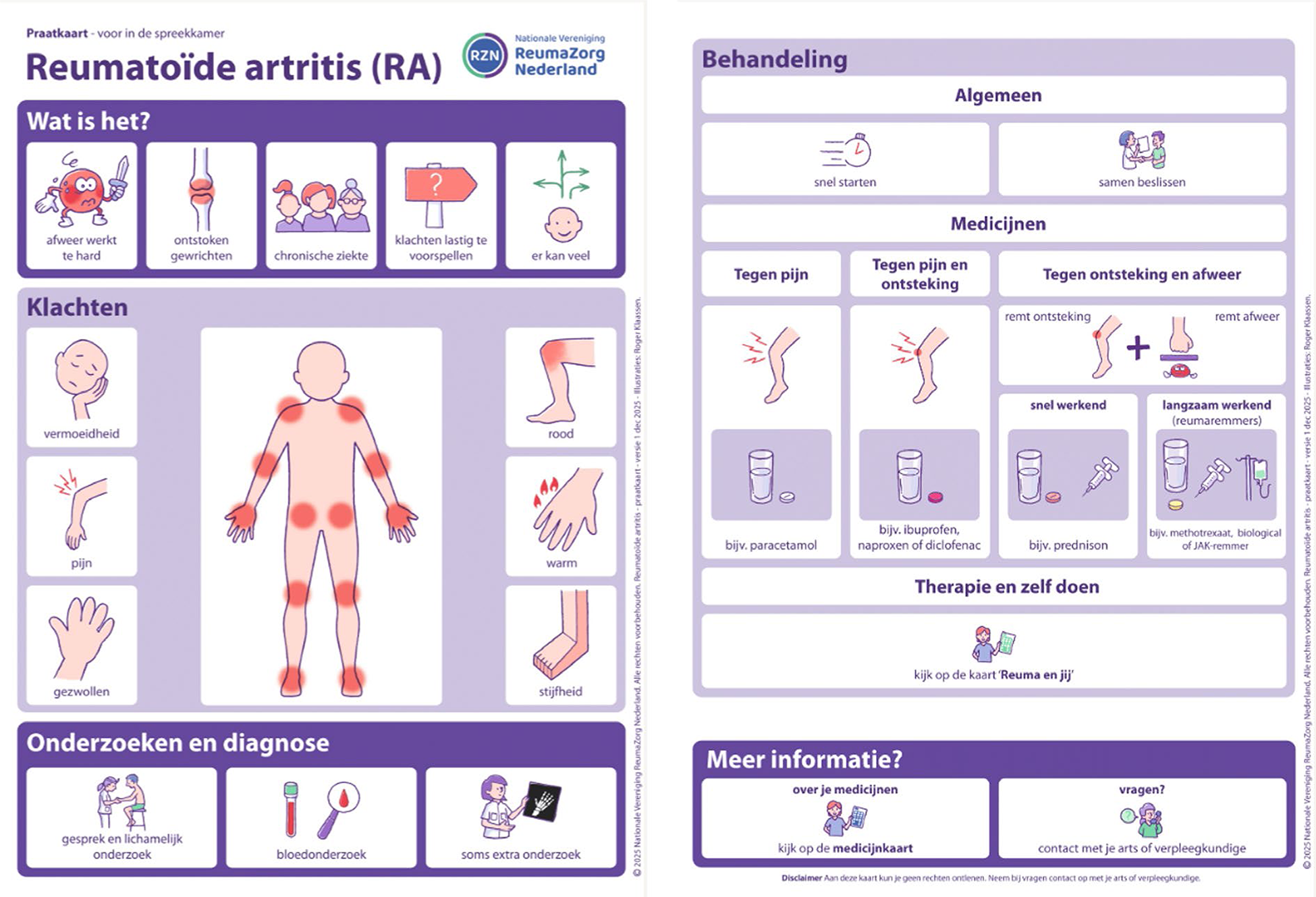
Results: Eleven complete RMD card sets were developed, each including a conversation and information card. An example of a conversation card is given in figure 1 . The public webpage of ReumaZorg Nederland (RZN) that will host all cards will be launched in 2026.
Conclusions: This national co-creation project demonstrates that accessible, visually supported RMD cards can effectively bridge important gaps in patient information. By integrating patient perspectives, clinical expertise and health-literacy principles, the project produced understandable and consistent tools that support shared decision-making and self-management. The project underscores the value of patient-led design and the inclusion of people with limited literacy in the development process. Ongoing evaluation will examine how these cards are implemented in daily practice.
Example of the conversation card for rheumatoid arthritis
REFERENCES: NIL.
Acknowledgments: NIL.
Disclosure of Interests: None declared.