fetching data ... 
Background: Psoriasis (PsO) and psoriatic arthritis (PsA) share key inflammatory circuits, yet targeted therapies typically achieve more robust responses in skin than in joints, implying compartment-specific pathogenic programs. Skin, enthesis, and synovium are anatomically distinct niches with different intrinsic hypoxia gradients, more pronounced in skin and at the entheseal interface, but comparatively lower in PsA synovium, which is typically hypervascularized. In this context, hypoxia/HIF-1α signalling, shaped by oxygen availability, inflammatory cues, and metabolic rewiring, has emerged as a determinant of chronic inflammation capable of imprinting exhaustion-like (Tex) T-cell states.
Objectives: To determine whether hypoxia/HIF-1α signals align with compartmental differences across psoriatic disease tissue microenvironments and whether CD8 Tex programs preferentially localize to psoriatic skin compared with PsA synovium and the enthesis.
Methods: HIF-1α IHC and multiplex IF evaluated nuclear vs cytoplasmic localisation and TIGIT/CD8 Tex features in psoriatic lesional skin (n=10) and PsA synovium (n=10). Bulk profiling (n=32) compared psoriatic skin with PsA/RA synovium using CD8 Tex-module GSEA (236 genes) and PCA/PERMANOVA. scRNA-seq datasets comprised GSE173706 (skin T cells), synovium GSE216651 (HC n=3) plus GSE200815 (PsA/RA n=9), GSE250242 (multi-compartment PsA; n=21), and EBIO entheseal biopsies (lateral epicondyle; ultrasound-guided; PsA n=10). scRNA-seq pipelines used QC/SCTransform, clustering and STCAT annotation; hypoxia/HIF was assessed by HIF1A, HALLMARK_HYPOXIA, fgseaMultilevel HIF-target enrichment and pseudotime hypoxia GO terms.
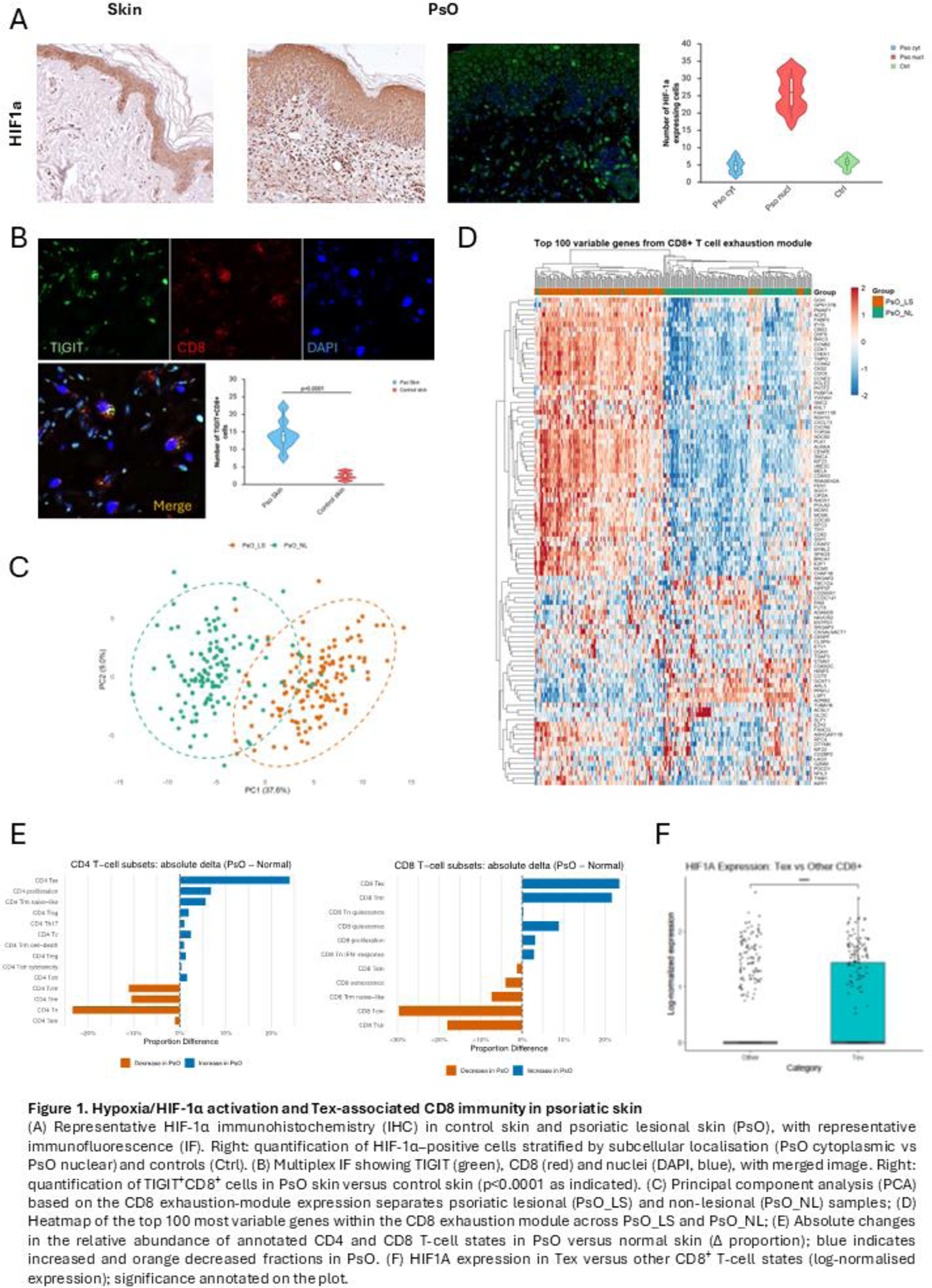
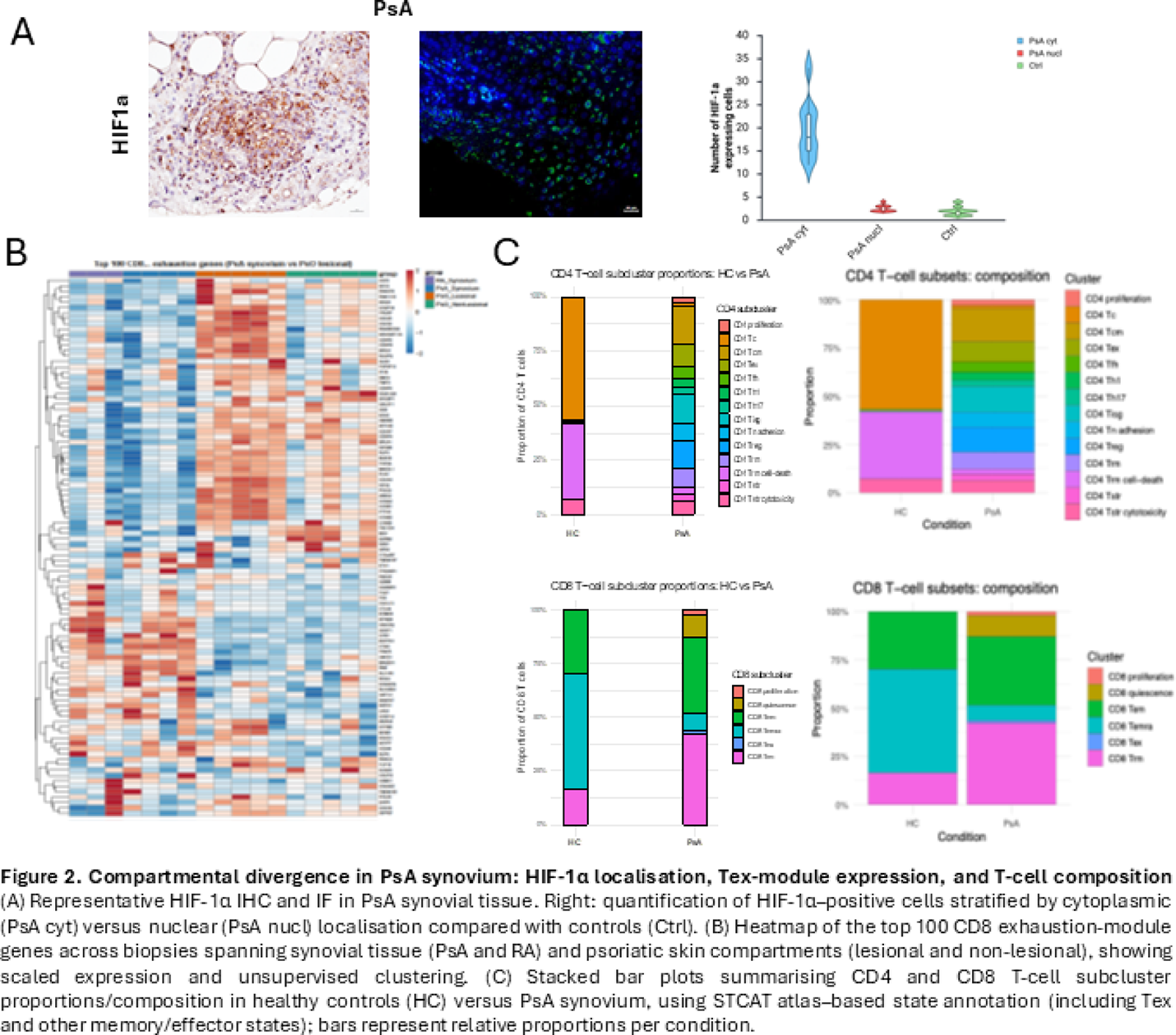
Results: Bulk transcriptomics across multiple PsA compartments (skin, synovial fluid, PBMCs and synovial tissue) revealed a HIF-1α expression gradient, highest in skin and progressively lower in synovial fluid, PBMCs and synovial tissue. At the protein level, psoriatic lesional skin showed predominantly nuclear HIF-1α, whereas PsA synovium was mainly cytoplasmic (skin n=10; synovium n=10) (Figure 1A, Figure 2A), supporting compartment-divergent HIF signalling. Concordantly, Tex-associated CD8 features were more prominent in PsO skin (Figure 1C–D), including increased TIGIT + CD8 + infiltration (p<0.001) (Figure 1B) and higher HIF1A expression in Tex versus other CD8 states (p<0.001) (Figure 1F). In cross-tissue bulk profiling (n=32), a CD8 Tex module was enriched in PsO skin versus synovium (NES=1.9986; FDR=5.48×10 −8 ) and separated compartments (PERMANOVA R 2 =0.6865, p=0.008) (Figure 2B); within synovium, the same programme was attenuated in PsA versus RA (NES=−1.5040; FDR=0.0037) (Figure 2B). At cellular resolution, skin scRNA-seq (GSE173706) showed lower heterogeneity and was dominated by CD4 and CD8 exhausted T cells, with Tex expansion (CD8 Tex Δabs=+0.2343; CD4 Tex Δabs=+0.2396) and clustering of Tex-high cells (80.5% in psoriatic vs 71.4% in normal skin) (Figure 1E). Despite this “exhausted” annotation, cytochemical profiling in lesional skin indicated a polyfunctional inflammatory phenotype producing IL-17, IFN-γ, IL-26, CCL20 and CXCL13. In contrast, PsA synovial scRNA-seq showed markedly higher compositional heterogeneity—particularly within CD4 T cells—with near-absence of CD8 Tex (Figure 2C). Hypoxia/HIF biology was state- and trajectory-restricted: HIF1A marked specific T-cell clusters (log2FC=1.688; p_adj<0.001), pseudotime modules were enriched for “response to hypoxia” (q=0.011), and CD8 Tex versus non-Tex comparisons showed a shift in HIF1A target enrichment (NES=−2.0513; FDR<0.001). Consistent with compartmental divergence, multi-tissue scRNA-seq (GSE250242; n=21) showed higher skin versus synovium HIF1A (0.577 vs 0; p<0.001) and higher hypoxia scores (0.149 vs 0.121; p<0.001). Extending to the tissue interface, entheseal scRNA-seq (EBIO; n=10) ranked CD8 Tex among the top upregulated programmes in inflamed versus healthy enthesis.
Conclusions: These data support a compartmental model in which hypoxia/HIF-1α acts as an upstream tissue constraint shaping CD8 T-cell adaptation across psoriatic disease sites. In skin and at the entheseal interface, hypoxic pressure may favour an exhaustion-like yet inflammatory CD8 program, whereas PsA synovitis reflects alternative microenvironmental cues with relative attenuation of Tex states. This compartmentalized hypoxia–immune coupling helps explain divergent skin versus joint/entheseal biology and therapeutic responses.
REFERENCES: [1] Subudhi, Immunity, 2024.
[2] Raimondo, Ann Rheum Dis, 2025.
[3] Shen, Nat Commun, 2024.
Acknowledgments: NIL.
Disclosure of Interests: Daniele Mauro Abbvie, Otzuka, Abbvie, UCB, J&J, Astrazeneca, Otzuka, GSK, Maria Gabriella Raimondo: None declared, Antonio Ciancio: None declared, Giulio Forte: None declared, Hashem Mohammadian: None declared, Saviana Gandolfo GSK, Otsuka, J&J, Novartis, Gennaro Ilardi: None declared, Rosa Giacca: None declared, Maura Raimondi: None declared, Alessia Salzillo: None declared, Kashif Ali: None declared, Gilberto Cincinelli: None declared, Antonina Parafioriti: None declared, Roberto F. Caporali: None declared, Andreas Ramming: None declared, Francesco Ciccia GSK, Otsuka, Lilly, UCB, Novartis, Vifor, Abbvie, J&J.