fetching data ... 
Background: The high mortality rate and irreversible progression of systemic sclerosis (SSc) underscore the critical importance of early recognition and diagnosis. Previous studies have showed that some patients exhibit signs of organ dysfunction during the Very Early Diagnosis of SSc (VEDOSS) stage, even before meeting the formal classification criteria. Based on these findings, our study focuses on the SSc-specific antibody-positive phase (SSAP), employing multi-omics approaches to investigate the pathophysiological changes from the antibody-positive phase, through the oligosymptomatic stage, and ultimately to the point at which classification criteria are met, in order to identify patients at high risk of rapid progression as early as possible.
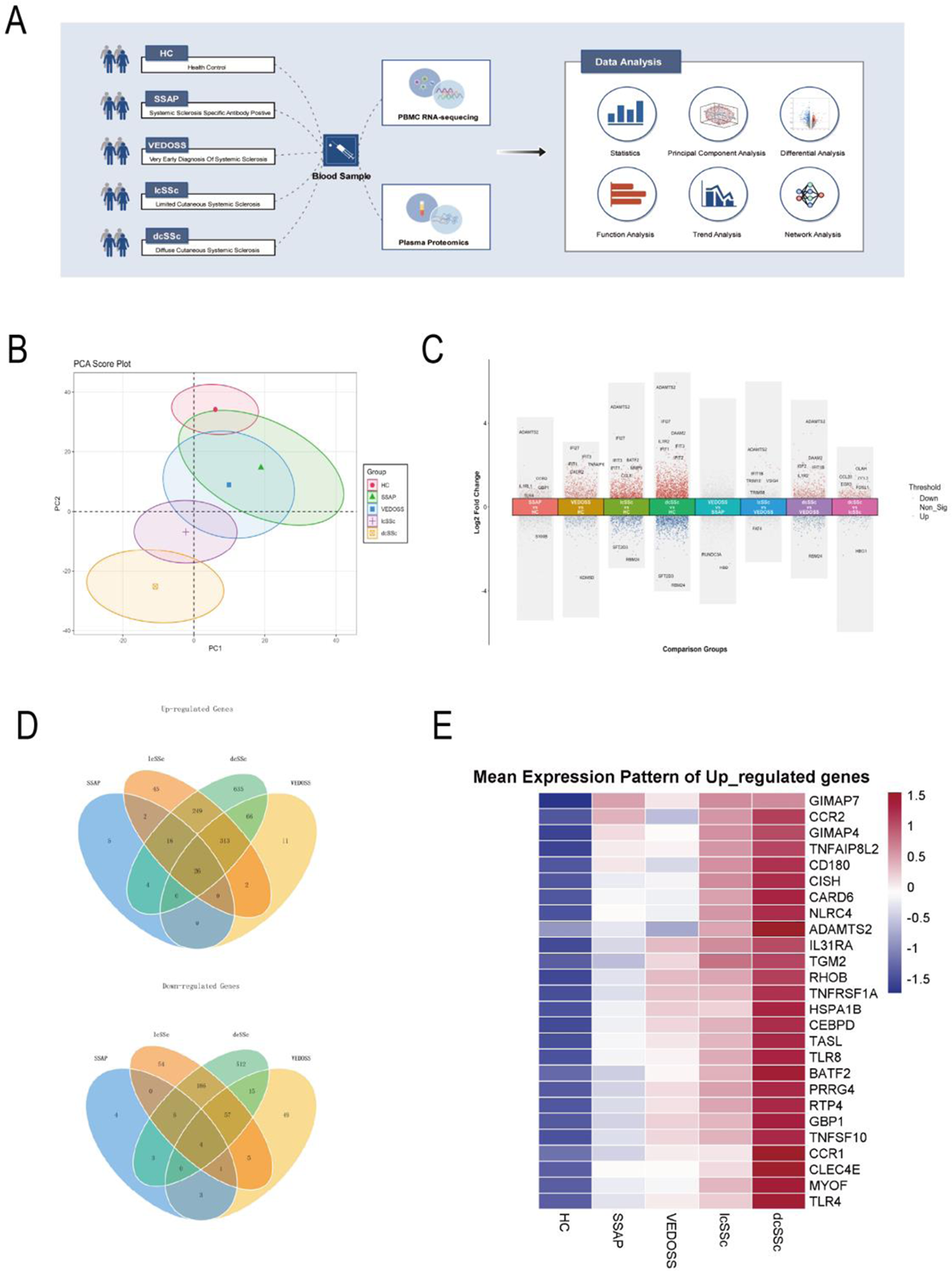
Objectives: To characterize the molecular and immunological changes across the SSc-specific antibody–positive phase, VEDOSS, and established SSc using multi-omics approaches, and to identify early biomarkers and patient subsets at high risk of disease progression (Figure 1A).
Methods: This study utilized samples from the Renji Scleroderma Longitudinal Cohort (Renji-SLOC). SSAP was defined as the presence of SSc-specific antibodies (ACA or ATA) in the absence of any other clinical manifestations. We included PBMC RNA data from 48 healthy control (HC), 18 SSAP, 28 VEDOSS, 99 lcSSc, and 57 dcSSc patients, as well as proteomic data from 48 HC, 32 SSAP, 44 VEDOSS, 123 lcSSc, and 97 dcSSc patients for analysis. Proteomic data were collected using a QE-HF mass spectrometer, while RNA sequencing was performed using the NovaSeq X Plus platform.
Results: Principal component analysis (PCA) revealed a progressive distribution of patients from HC to SSc (Figure 1B), suggesting that SSAP and VEDOSS may represent intermediate stages of disease development. Differential analysis further demonstrated that immune dysregulation is already present at the antibody-positive stage and progressively intensifies, reflected not only in the increasing number of differentially expressed genes and proteins but also in the magnitude of their fold changes (Figure 1C). We then analyzed molecules that were commonly up- or down-regulated across the four groups (FC > 1.5, adjusted p < 0.05) (Figure 1D, 1E). The commonly up-regulated molecules were significantly enriched in immune system activation–related pathways, particularly those associated with the innate immune system and interferon signaling.
Conclusions: Immune dysregulation is already evident at the SSc-specific antibody–positive stage and progressively intensifies during disease development. Multi-omics analysis may provide valuable insights for the early identification and intervention of preclinical SSc.
Progressive molecular changes from SSAP to established SSc.
(A) Study design and patient stratification across HC, SSAP, VEDOSS, lcSSc and dcSSc. (B) Principal component analysis (PCA) in transcriptome showing a gradual shift in patient distribution from HC to SSc, with SSAP and VEDOSS positioned as intermediate stages. (C) Multi-group differential expression analysis illustrating the distribution of differentially expressed genes among groups (adjusted p < 0.05), with up-regulated genes shown in red and down-regulated genes in blue. (D) Venn diagrams depicting the number of genes commonly up- or down-regulated across the four groups. (E) Heatmap showing the detailed expression patterns of the commonly up-regulated molecules identified in (D).
REFERENCES: NIL.
Acknowledgments: NIL.
Disclosure of Interests: None declared.