fetching data ... 
Background: Sexuality is a key determinant of health and quality of life, with well-established links to psychological well-being [1]. Evidence indicates that sexuality is substantially compromised in people living with rheumatic and musculoskeletal diseases (RMD), influenced by disease-related factors such as pain, fatigue, stiffness, altered body image, and treatment side effects [2]. Moreover, sexuality in RMD has predominantly been examined through a biomedical and functional lens. Consequently, the emotional, psychosocial, and sociocultural dimensions of sexuality remain insufficiently explored and poorly integrated within a comprehensive conceptual framework. Mitchell et al [3]. proposed a comprehensive framework that conceptualises sexuality across four pillars (sexual health, pleasure, well-being, and justice), offering a holistic lens for addressing this gap.
Objectives: To synthesise the literature on sexuality in adults with RMDs using Mitchell et al.’s framework [3], identify assessment tools and methods, and highlight conceptual, methodological and evidence gaps.
Methods: A systematic scoping review was conducted in accordance with Joanna Briggs Institute guidance [4] and a previously published protocol [5]. PubMed, Embase, Cochrane Central, CINAHL, PsycInfo, LGBTQIA+ Source, Web of Science, and grey literature sources were searched from inception to 19 December 2025. Primary qualitative and quantitative studies assessing sexuality in adults with RMD were included. Sexuality was examined using Mitchell et al.’s four pillars: sexual health (sexual function and reproductive health), pleasure (performance, and subjective and relational satisfaction), well-being (psychological and identity-related aspects), and justice (access to public health and equitable social, cultural, and legal conditions). Data were narratively synthesised by RMD category and sexuality pillar.
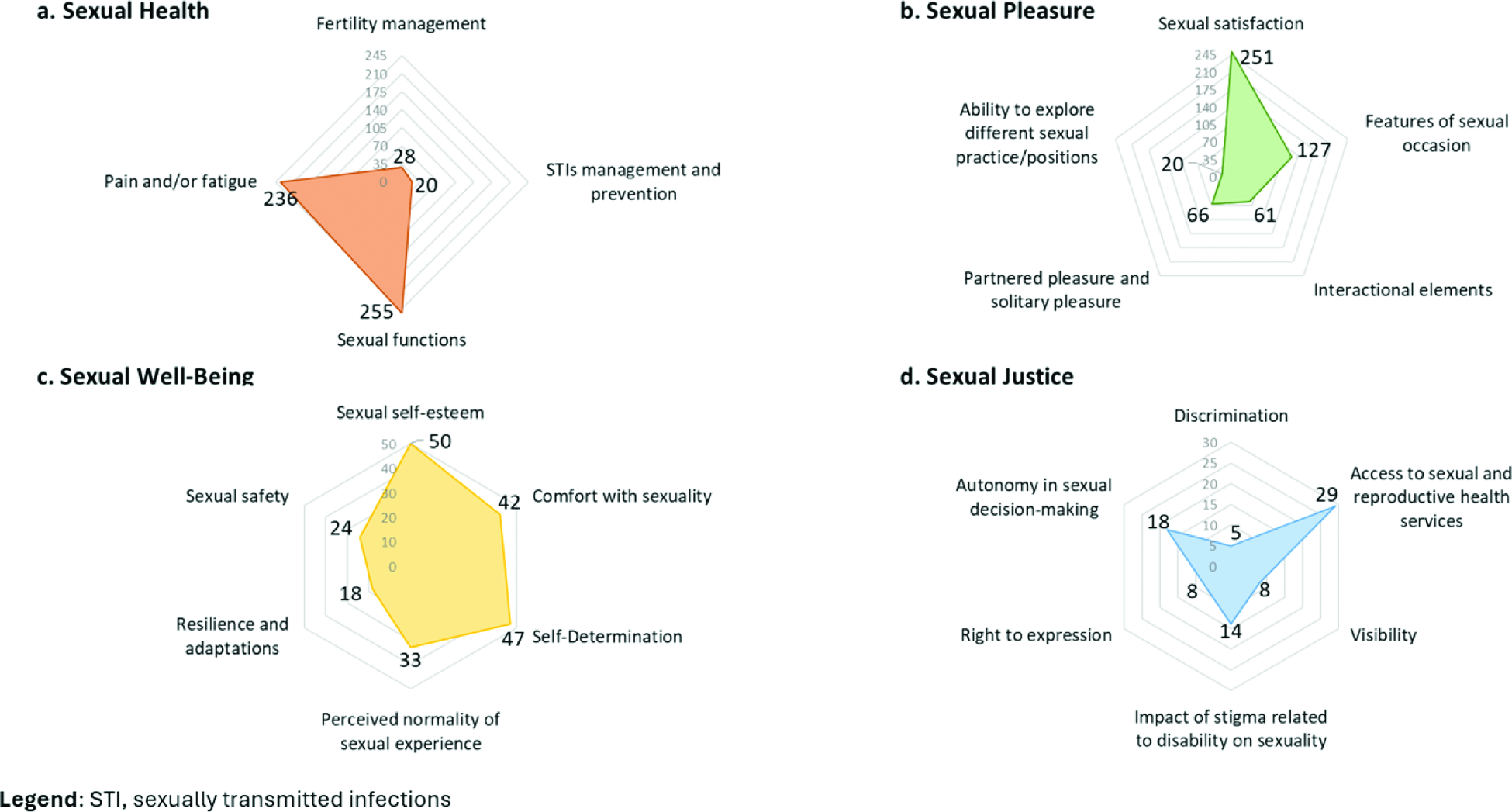
Results: A total of 14,505 records were identified through database searching. Following abstract and full-text screening, 294 studies published between 1979 and 2025 were included, with a marked increase in publications after 2011. Most studies were cross-sectional (n=214; 73%) and were most frequently conducted in Turkey (n=72; 24%), the USA (n=20; 7%), Brazil (n=18; 6%), and Italy (n=18; 6%). Rheumatoid arthritis (n=54; 20%), fibromyalgia (n=37; 13%), systemic sclerosis (n=30; 10%), axial spondyloarthritis (n=35; 12%), and systemic lupus erythematosus (n=24; 9%) were the most studied RMD. Sample sizes ranged from 7 to 3,206 participants and predominantly comprised middle-aged adults, with mean ages typically ranging from the late 30s to the mid-50s. Reporting of sex assigned at birth, gender identity and ethnicity was inconsistent or absent in many studies, and sexual orientation was assessed in only nine studies. Females/women were markedly overrepresented, with pooled samples including 24,110 females/ 3,972 women compared with 8,137 males/ 4,621 men. Sexual health and sexual pleasure were the most investigated pillars (n=276, 94% and n=265, 90%, respectively), predominantly assessed using the Female Sexual Function Index and the International Index of Erectile Function. In contrast, sexual well-being (n=87, 30%) and sexual justice (n=36, 12%) were infrequently examined and were most often assessed using ad hoc questionnaires or qualitative interviews. Figure 1 illustrates the sexuality pillars and subdomains explored. Considerable methodological heterogeneity was observed, with 41 different assessment tools identified; although most had been validated in general populations, only eight (20%) had been explicitly validated in RMD populations. Across all RMD, sexuality was consistently negatively affected by pain, fatigue, physical limitations, psychological distress, negative body image, relational challenges, stigma, and limited access to appropriate sexual health support.
Conclusions: Research on sexuality in RMD is extensive but remains conceptually narrow, dominated by a biomedical focus on sexual function. Sexual well-being and justice are comparatively neglected, and there is a scarcity of a validated multidimensional assessment. Future research and clinical practice should adopt holistic, person-centred approaches that better integrate all dimensions of sexuality to reflect the lived experiences of people with RMD. Research priorities should include the development and validation of comprehensive multidimensional instruments in RMD populations and improved inclusion of men, LGBTQIA+ individuals, and people from minoritised ethnic backgrounds, alongside routine collection of data on sex and gender identity.
Sexuality pillars and subdomains explored in RMD research
REFERENCES: [1] Gianotten WL, Alley JC, Diamond LM. The Health Benefits of Sexual Expression. International Journal of Sexual Health 2021;33:478–93.
[2] Schmalzing M, Nau LF, Gernert M, Froehlich M, Schwaneck EC, Pecher AC, et al. Sexual function in german women with systemic sclerosis compared to women with systemic lupus erythematosus and evaluation of a screening test. Clin Exp Rheumatol 2020;38:S59–64.
[3] Mitchell KR, Lewis R, O’Sullivan LF, Fortenberry JD. What is sexual wellbeing and why does it matter for public health? Lancet Public Health 2021;6:e608–13.
[4] Peters MDJ, Marnie C, Tricco AC, Pollock D, Munn Z, Alexander L, et al. Updated methodological guidance for the conduct of scoping reviews. JBI Evid Synth 2020;18:2119–26.
[5] Giardulli B, Prior Y, Bumin G, Kinikli GI, Prior JA, Stones SR, et al. Sexual Health, Pleasure, Justice, and Well-Being in People With Rheumatic and Musculoskeletal Diseases: A Scoping Review Protocol. Musculoskeletal Care 2025;23:e70040.
Acknowledgments: NIL.
Disclosure of Interests: Benedetto Giardulli: None declared, Yeliz Prior: None declared, Gonca Bumin: None declared, Gizem Irem KINIKLI: None declared, James Prior: None declared, Simon Stones •Employment: Amica Scientific, a healthcare communications company that is funded by pharmaceutical companies); previously Envision Pharma Group, a healthcare communications company that is funded by pharmaceutical companies (until 2024)
•Honoraria (including allowances): European Alliance of Associations for Rheumatology (EULAR), National Institute for Health and Care Research (NIHR), Sage, Taylor & Francis, Kennedy Trust, University of British Columbia •Board Directorship: RAiISE, a charitable incorporated organisation registered in England and Wales Number 1180704 •Committee Membership: International Society for Medical Publication Professionals (ISMPP) Patient Engagement Task Force, EULAR People with Arthritis/Rheumatism in Europe (PARE) Committee, EULAR Congress Committee, EULAR Council, PxP 2025 Organising Committee, Caroline Flurey: None declared, Gianluca Bertoni: None declared, Andy Lavender: None declared, Marco Testa: None declared, Simone Battista: None declared.