fetching data ... 
Background: Itch is common in systemic sclerosis (SSc) and reduces quality of life [1,2]. Itch prevalence increases with age in the general population [3]. In SSc, itch is presumed to be most significant early disease stages [4], but no longitudinal studies have evaluated itch course.
Objectives: We estimated the trajectory of past-week itch presence and severity from disease onset in a large multinational SSc cohort, accounting for participant age and time since non-Raynaud phenomenon (RP) symptom onset at assessments.
Methods: We evaluated longitudinal data from the Scleroderma Patient-centered Intervention Network (SPIN) Cohort [5]. Participants must be aged ≥ 18 years and have SSc based on 2013 American College of Rheumatology/European Alliance of Associations for Rheumatology criteria [6]. SPIN Cohort participants were recruited from 49 sites in Australia, Canada, France, Mexico, Spain, the United Kingdom, and the United States and completed outcome measures online upon enrolment and subsequently every three months. We analysed data from cohort inception (April 2014) to October 2020 when itch assessment was discontinued. Participants were included if they (1) completed an item about past-week itch at least once and (2) had time since non-RP symptom onset data. Measures SPIN Cohort participants provided sociodemographic data and completed patient-reported outcome measures. Site physicians provided participant biometric and medical data, including date of non-RP symptom onset. Past-week itch severity was measured with a single-item numerical rating scale ( How severe was your itch in the past week? ; 0 = not severe at all to 10 = unbearable). Single-item numerical rating scales generate good test re-test reliability [7] and convergent validity with multi-item itch scales [7]. Statistical Analysis To estimate the probability of experiencing itch (numerical rating scale score > 0) and, separately, if present, itch severity, we used two-stage mixed effects models. The two-stage approach addressed the high proportion of zero scores by separately modelling itch presence via a generalized linear mixed effects model with a logistic link and itch severity as a linear mixed effects model. The primary predictor in each model was age at time of assessment, which was partitioned into age at onset of non-RP symptoms and time since onset of non-RP symptoms. We incorporated basis splines to address possible non-linearity. We estimated trajectories of past week probability of itch and, if present, severity for ages at time of assessment from 20 years to 80 years overall and, separately, predicted values for average participants with non-RP symptom onset ages of 20 years, 30 years, 40 years, 50 years, and 60 years from 2 to 5 years and at 5-year intervals from 10 years to 30 years post non-RP symptom onset. Patient Engagement Patient members of SPIN’s Steering Committee prioritized itch research. SPIN Itch Patient Advisory Team members were engaged at each stage of the research, beginning with developing funding proposals, conceptualizing the study, and making decisions on items to include in the tool, and interpretation of results. They are co-authors of this report, and one member will attend the EULAR Congress and co-present the abstract with the researcher presenter.
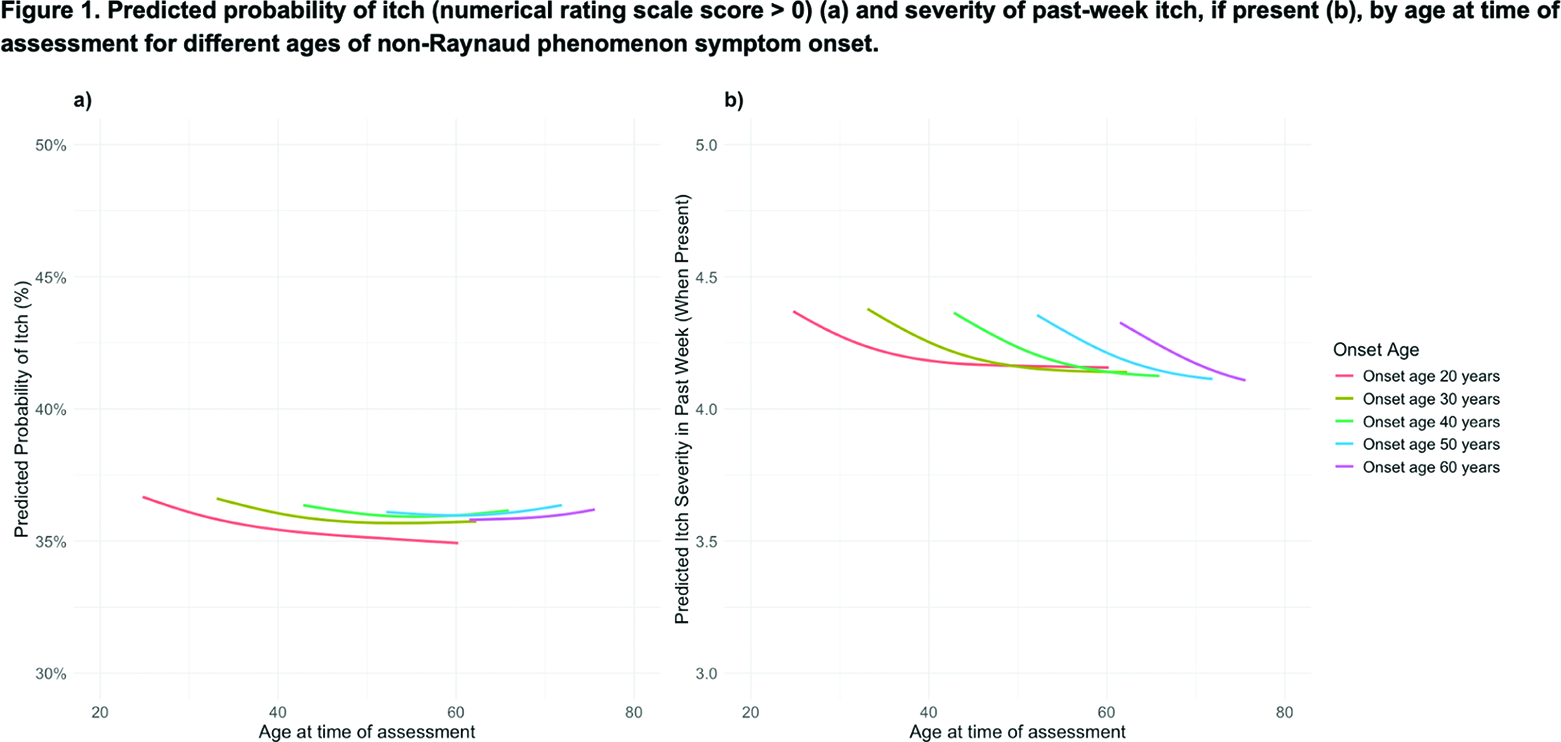
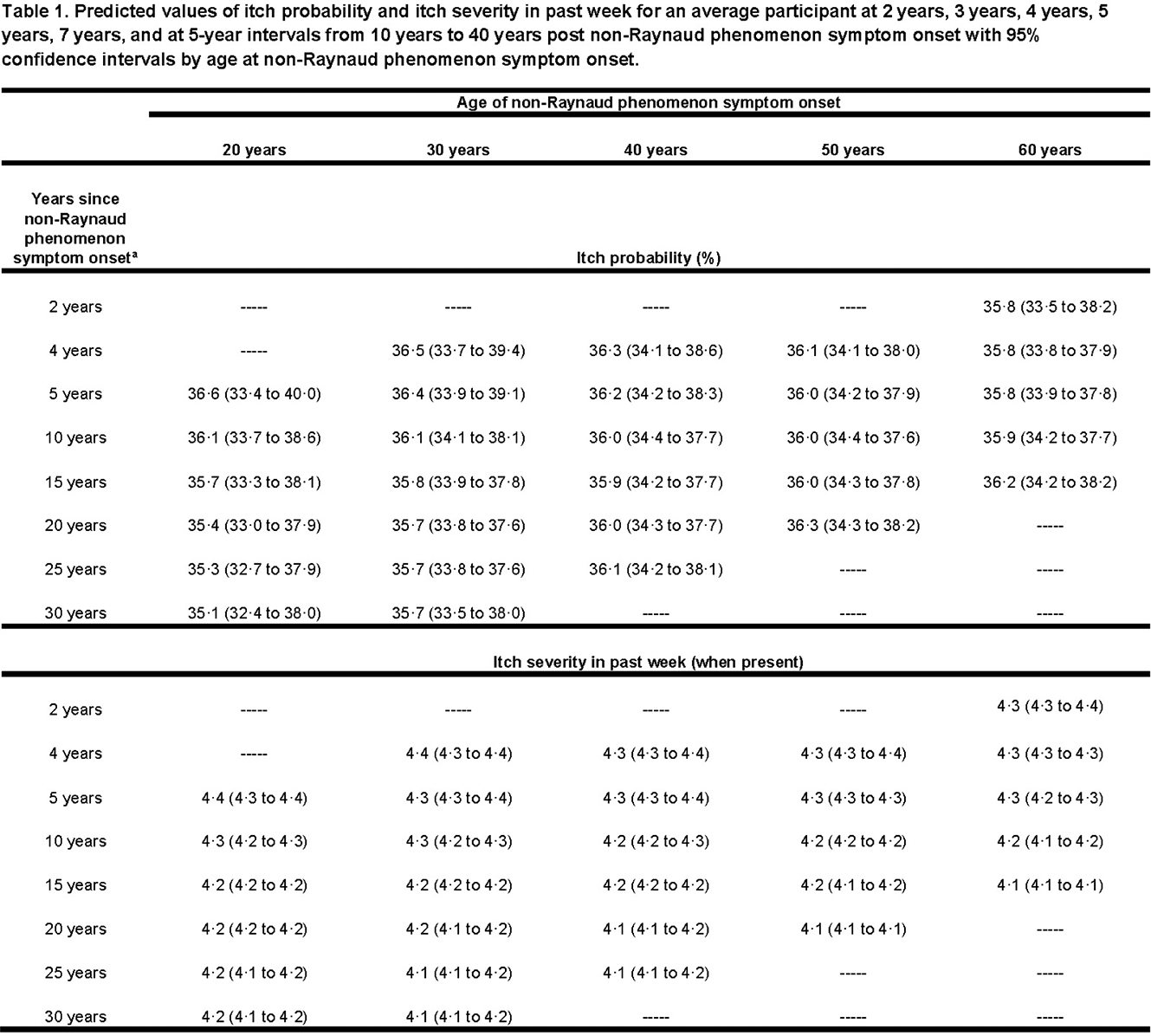
Results: We included 2173 participants with 19733 itch assessments. 87% were female, and 80% were White. Participants were from the United States (36%); France (27%); Canada (23%); the United Kingdom (9%); and Australia, Mexico, or Spain (5%); 40% had diffuse SSc. Participants completed between 1 and 26 past-week itch severity assessments. Mean (standard deviation) number of assessments was 9·1 (6·9). Figure 1a shows trajectories of predicted probability of the presence of any itch (numerical rating scale score > 0) across time by age of onset, and Figure 1b the predicted severity for participants who reported any itch. Predicted values of probability of the presence of any itch and severity among those who reported any itch are in Table 1. All predicted probabilities were between 35% (95% confidence interva[[CI] 31% to 39%; age of non-RP symptom onset 20 years, 40 years since onset) and 37% (95% CI 33% to 40%; age of non-RP symptom onset 20 years, 5 years since onset). All predicted severity levels among participants who reported any itch were between 4·1 (95% CI 4·1 to 4·1; age of non-RP symptom onset 50 years, 20 years post-onset) and 4·4 (95% CI 4·3 to 4·4; age of non-RP symptom onset 20 years, 5 years since onset). Predicted itch severity decreased < 0·2 points for all 10-year differences (e.g., 5 years to 15 years, 20 years to 30 years) in years since non-RP symptom onset for all onset ages.
Conclusions: We modelled the probability of having any itch and, if present, itch severity. We accounted for both normal aging and SSc disease duration by including age of onset of non-RP symptoms and time since onset in our models. For all non-RP symptom onset ages and times since onset, predicted past week itch probability was between 35% and 37%. For participants with itch, predicted severity on a 0-10 scale was between 4.1 and 4.4 points for all onset ages and times since onset. Our findings suggest that itch may not be as closely related to disease duration in SSc as previously thought. It is possible, despite attempting to account for both chronological age and disease duration, that normal aging and disease processes may have countered each other to some extent. However, the stability of estimated prevalence and severity across onset ages and over time within onset ages suggest that any such effects would be minimal. Research is needed to elucidate the pathophysiology of itch in SSc and identify effective management strategies.
REFERENCES: [1] doi:10.1093/rheumatology/ket275.
[2] doi:10.1002/acr.20257.
[3] doi:10.1093/bjd/ljae260.
[4]
[5] doi:10.1093/rheumatology/key139.
[6] doi:10.1136/annrheumdis-2013-204424.
[7] doi:10.1111/bjd.17744.
Acknowledgments: NIL.
Disclosure of Interests: Meira Golberg: None declared, Cassidy Dal Santo: None declared, Marie-Eve Carrier: None declared, Linda Kwakkenbos: None declared, Tracy Frech: None declared, Sabrina Hoa: None declared, Elena Netchiporouk: None declared, Laurent Misery: None declared, Jo-Ann Lapointe McKenzie: None declared,: None declared, Sandra Rideout: None declared, Maureen Sauvé: None declared, Anie Philip: None declared, Janet Pope: None declared, Gil Yosipovitch Consulting fees from Abbvie, Arcutis, Almiral, Amgen, Attovia, Boehringer Ingelheim, Celldex, Escient Health, Eli Lilly, Galderma, LEO Pharma, Merck, Novartis, Pfizer, Regeneron Pharmaceuticals, Inc., Sanofi, Vifor, GSK, Celldex, unrelated to SPIN, Research support from Eli Lilly, LEO Pharma, Novartis, Pfizer, Galderma, Escient, Clexio, Regeneron, Sanofi, Celldex,Kiniksa, Pfizer, Abbvie, unrelated to SPIN, Susan J. Bartlett Speaker fees from Fresenius Kabi, Janssen, Merck, Novartis, Organon, Sandoz, unrelated to SPIN., Consulting fees from Sandoz, Nordic, unrelated to SPIN., Benjamin Chaigne Consulting fees from Boehringer Ingelheim and Novartis, unrelated to SPIN., Catherine Fortune: None declared, Amy Gietzen: None declared, Karen Gottesman: None declared, Genevieve Guillot: None declared, Laura Hummers Consulting or advisory boards with Biotest, Boehringer Ingelheim, and Abbvie, unrelated to SPIN., Grant funding from Astra Zeneca, Cumberland Pharmaceuticals, Mitsubishi Tanabe, Boehringer Ingelheim, and Glaxo Smith Kline, unrelated to SPIN., Amanda Lawrie-Jones: None declared, Vanessa Malcarne: None declared, Maureen D. Mayes Consulting fees from Cabaletta Pharma, an honorarium from GSK Pharma; and data safety monitoring board or advisory boards with Mitsubishi Tanabe, Boehringer Ingelheim, and EICOS, unrelated to SPIN., Research grants or contracts from Prometheus Biosciences, Mitsubishi Tanabe, Boehringer Ingelheim, EICOS, Corbus, and Horizon Pharma, unrelated to SPIN., Michelle Richard: None declared, James Stempel: None declared, Robyn Wojeck Shares in Amgen, unrelated to SPIN., Employed by Amgen, unrelated to SPIN., Luc Mouthon: None declared, Andrea Benedetti: None declared, Brett Thombs: None declared.