fetching data ... 
Background: In systemic lupus erythematosus (SLE), platelets are activated as defined by P-selectin expression, and their activation follows the disease activity [1]. We have shown that platelets interact with T regulatory cells through a P-selectin/PSGL-1 axis and promote dysregulated inflammation in SLE [2]. Neutrophils express high levels of PSGL-1 which predicts a physical interaction between neutrophils and activated platelets in SLE patients.
Objectives: To investigate the role of relationships between platelets and neutrophils in the pathogenesis of SLE and explore the therapeutic potential of inhibiting this interaction.
Methods: We prospectively included SLE patients satisfying the 2019 ACR-EULAR criteria. Clinical data including disease activity (SLEDAI-2K; active SLE if SLEDAI ≥6) and immunological parameters were retrieved. Spectral cytometry (Cytek Aurora) was performed on fresh whole blood using a 38-color panel covering platelet and immune cell markers to explore neutrophils and platelet-neutrophil aggregates (PNA). Both supervised and unsupervised analyses were applied to assess neutrophil heterogeneity in relation to platelet interaction. Spatial transcriptomic profiling (10X, Visium HD) was performed on renal biopsy specimens from patients with lupus nephritis (LN), and the data were integrated with same-day matched peripheral blood single-cell RNA sequencing (scRNAseq) data to investigate the roles of PNA in the pathogenesis of LN. In vitro experiments were conducted to investigate the signaling induced by P-selectin engagement on human neutrophils and the impact on their phenotype. Finally, To explore the therapeutic potential of PNA disruption, we treated12-week-old TLR7 Y264H (kika) homozygous female mice with an anti–P-selectin antibody administered biweekly for 8 weeks.
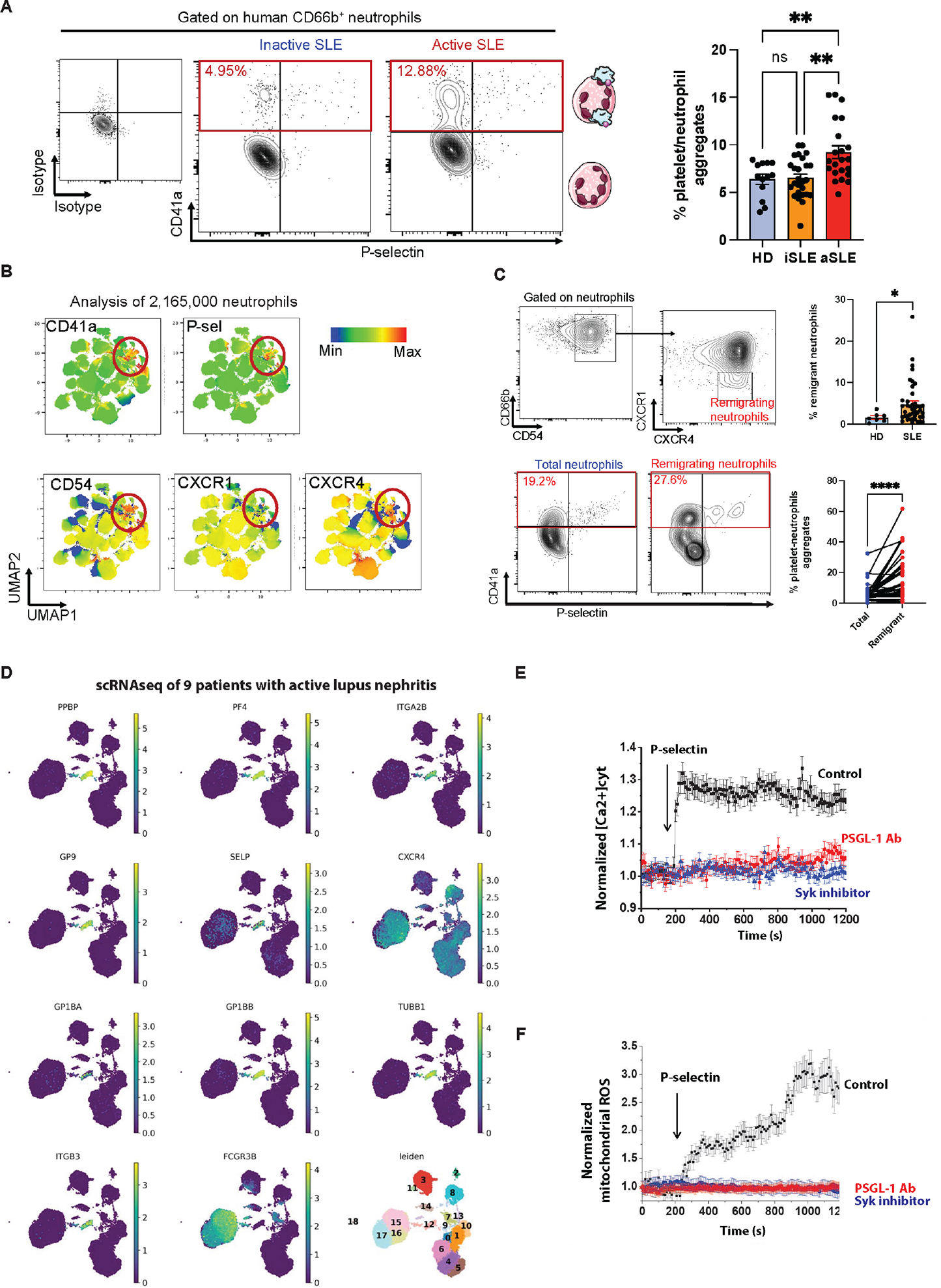
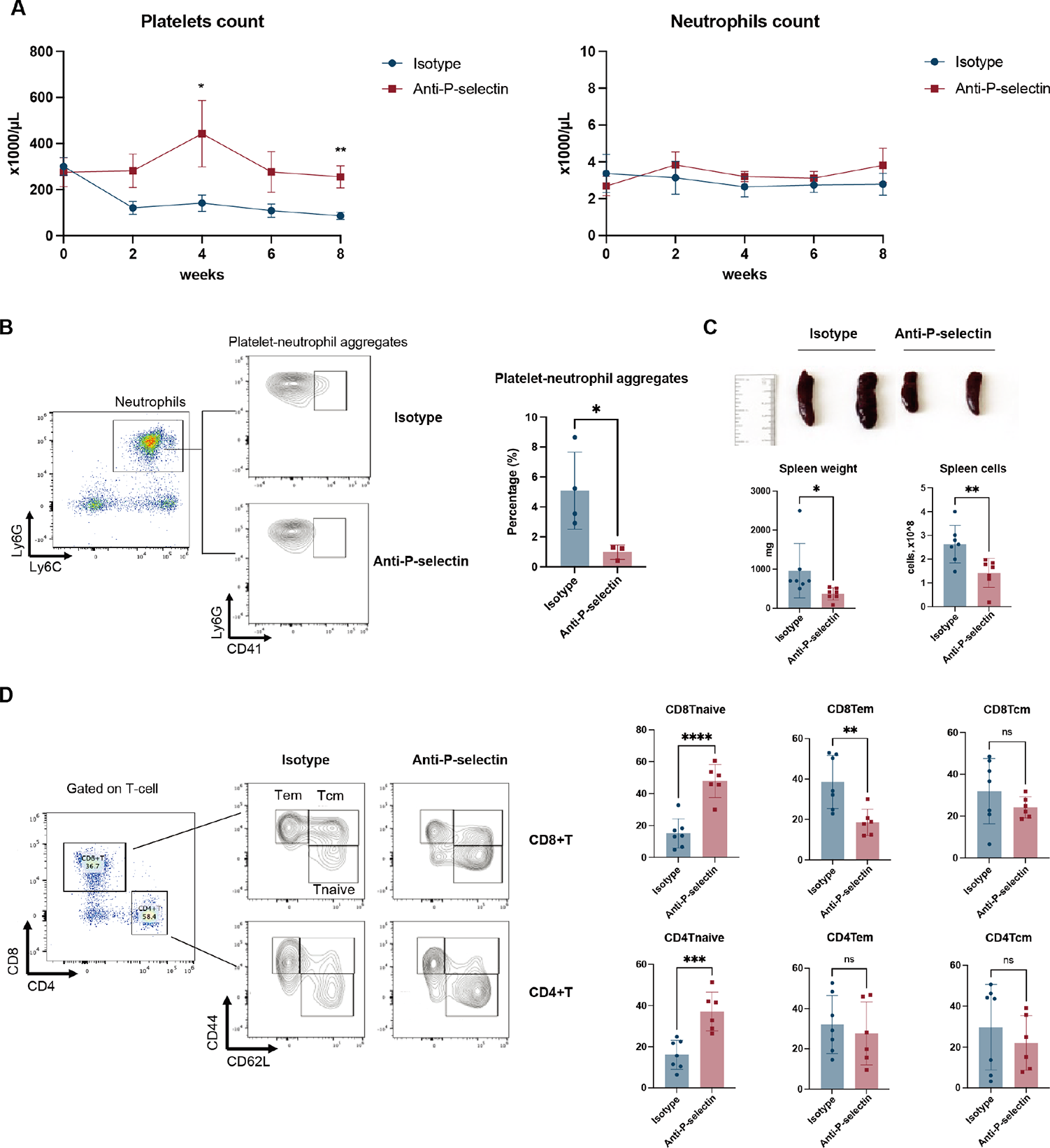
Results: We recruited 48 SLE patients with longitudinal samples for 10. Platelet-neutrophil aggregates were increased in patients with active SLE compared to inactive SLE and healthy donors (p = 0.001 and p = 0.005, respectively; Figure 1A). PNA positively correlated with the SLEDAI (Spearman’s r = 0,45; p = 0.001) and followed disease activity in longitudinal analyses. Unsupervised analysis identified that PNA have an atypical phenotype (ICAM1 high , CXCR4 + , CXCR1 low ; Figure 1B), previously described as activated neutrophils that remigrates from a peripheral tissue (ie, skin) to the kidney to sustain tissue inflammation [3]. We confirmed that these atypical neutrophils are increased in SLE patients (p < 0.05) and that these remigrant neutrophils preferentially aggregate with platelets (p < 0.0001; Figure 1C). Blood scRNAseq identified PNA with enriched NETosis transcripts, CXCR4 signaling, and a migration phenotype (Figure 1D). In vitro , P-selectin engagement on human neutrophils induced a syk-dependent calcium flux and mitochondrial ROS production (Figure 1E-F), resulting in significantly increased SLE serum-induced NETosis. In the lupus murine model, anti–P-selectin treatment resulted in a reduction in circulating PNAs and improved thrombocytopenia (Figure 2A-B). Consequently, the mice demonstrated improved clinical phenotype with decreased splenic size, cell numbers and normalized splenic CD4 + and CD8 + T cells subpopulations (Figure 2C-D). Treated mice also showed decreased anti-dsDNA levels, and kidney pathology evaluation is underway.
Conclusions: Platelet-neutrophil aggregates are increased in SLE especially on CXCR4 + remigrating neutrophils. Platelet-selectin prime such neutrophils for NETosis and promote their migration to tissues where they promote inflammation. Anti–P-selectin antibody treatment effectively ameliorated cardinal features of SLE in mouse suggesting its potential interest for human SLE.
REFERENCES: [1] Scherlinger et al. Nat Rev Immunol 2023 Aug;23(8):495-510
[2] Scherlinger et al. Sci Transl Med. 2021 Jun 30;13(600):eabi4994.
[3] Skopelja-Gardner et al. Proc. Natl. Acad. Sci. 2021 Jan 19;118(3):e2019097118.
Acknowledgments: NIL.
Disclosure of Interests: None declared.