fetching data ... 
Background: Despite major advances in the treatment of rheumatoid arthritis (RA), approximately 5–20% of patients continue to experience persistent symptoms, particularly pain, and are classified as difficult-to-treat (D2T) RA. The D2T population is clinically heterogeneous, and several contributing factors have been identified; however, the underlying mechanisms remain unclear. Altered pain processing, central sensitization, neuroinflammatory processes, and psychological factors have been identified as contributors to persistent symptoms.
Objectives: To investigate factors underlying the D2T state, with a primary focus on psychological alterations and central nervous system (CNS) involvement using a multimodal approach, and to investigate the relationship between pain and inflammation in D2T RA.
Methods: 31 D2T RA (defined by the 2020 EULAR definition), 18 non-D2T RA patients, and 32 healthy controls (HCs) were included. All participants underwent a clinical assessment, psychological analysis (including in-depth interviews, the Rorschach test, and questionnaires), two resting-state functional MRI (fMRI) scans with standardized heat pain stimulation in between, as well as peripheral blood mononuclear cell (PBMC) transcriptomic analysis. Group differences were tested across the three groups, and cross-modal associations were assessed by relating psychological measures and transcriptomic results to fMRI connectivity metrics.
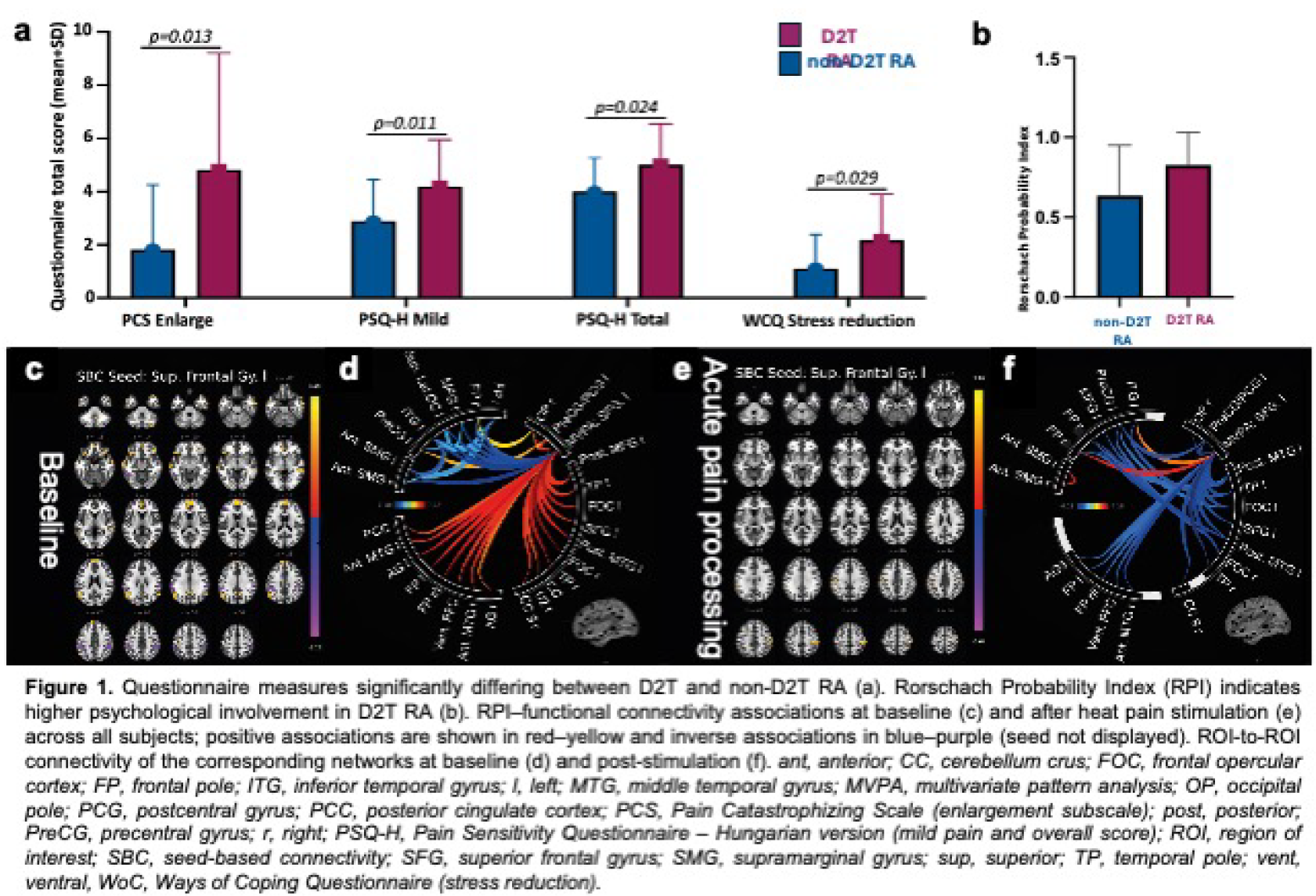
Results: Overall, 91% of D2T RA patients showed clinically relevant psychological involvement. The most frequent features were cognitive disturbances (rigid thinking and limited coping flexibility; 32%), negative future outlook (78%), and depressive symptoms (38%). In the questionnaire-based comparison, the D2T group exhibited a greater tendency toward pain catastrophizing and a greater focus on somatic complaints (Pain Catastrophizing Scale, p=0.013). D2T RA patients also showed higher sensitivity to pain (Pain Sensitivity Questionnaire, p=0.024), suggesting a lower pain threshold and heightened sensitivity to painful stimuli. D2T patients tended to prefer emotion-focused strategies that provide quick relief when facing difficulties over problem-focused coping (Ways of Coping Questionnaire, p=0.029). Rorschach patterns were quantified using the Rorschach Probability Index (RPI), a composite score that estimates the probability of a chronic pain-like personality profile; RPI discriminated RA from HCs with 82% accuracy and was higher in D2T vs non-D2T RA (82.7% vs 63.6%). D2T RA patients showed altered baseline and pain-evoked resting-state connectivity in the posterior cingulate cortex (PCC), an important hub of the default mode network (DMN), and the postcentral gyrus, a key part of the somatosensory network. To test whether these network alterations relate to psychological involvement, we examined the RPI in relation to the fMRI alteration. We found that higher RPI was associated with lower baseline left superior frontal gyrus connectivity to bilateral PCG and higher connectivity to the PCC, and these associations changed dynamically after pain stimulation, linking higher psychological involvement to specific connectivity patterns at baseline and after pain.
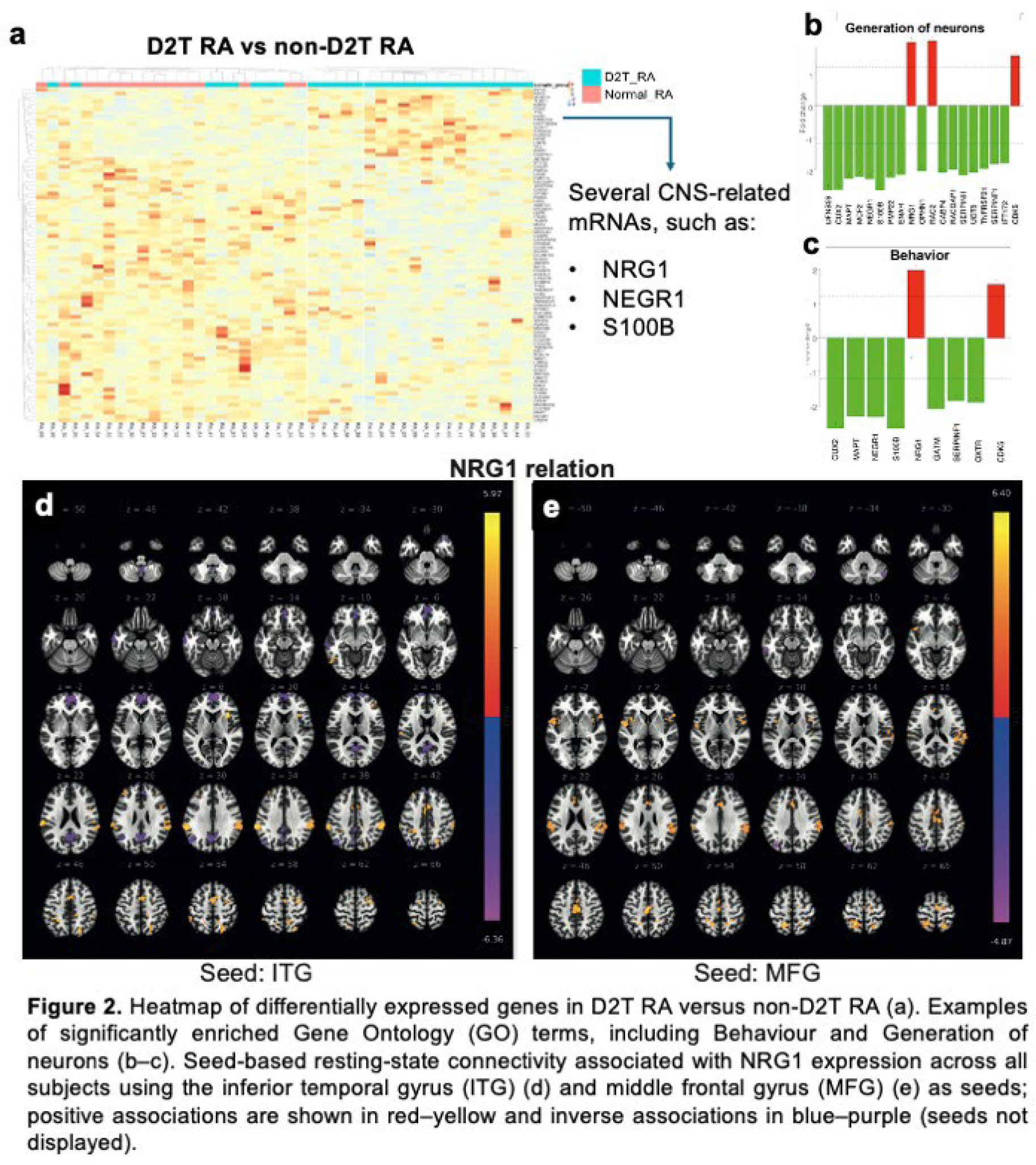
PBMC transcriptomics revealed 87 differentially expressed mRNAs in D2T versus non-D2T RA (17 upregulated, 70 downregulated). Enrichment analysis identified several CNS-related candidates (e.g., NRG1, NEGR1, S100B) and included cognitive/behavior-related Gene Ontology terms (e.g., Cognition, Behaviour, Learning/memory ; p < 0.001) as well as neurodevelopmental terms (e.g., Generation of neurons ; p < 0.001), consistent with the psychological findings in D2T RA. NRG1 showed an association with baseline connectivity patterns from right middle frontal gyrus (MFG) and inferior temporal gyrus seeds (ITG): higher NRG1 was linked to stronger connectivity with the PCG and cingulate regions (both anterior cingulate cortex (ACC), and PCC) and to inverse associations in medial prefrontal/posterior midline regions. This association is consistent with the previously observed network alterations mainly affecting the DMN and somatosensory network.
Conclusions: These findings reveal a novel neuroimmune signature of D2T RA, characterized by altered brain connectivity patterns, psychological features, and distinct transcriptomic profiles. Associations among these measures (RPI, NRG1 expression, and fMRI connectivity) indicate that both psychological involvement and peripheral gene expression can be linked to CNS connectivity features. Overall, these findings may present new opportunities for patient stratification, biomarker development, and more personalized approaches to management by targeting central mechanisms.
Funding: HUN-REN–PTE Chronic Pain Research Group (14017), OTKA K138046 and K131479, TKP2021-EGA-29, National Brain Research Program, Richter Gedeon PhD Scholarship for LGT.
REFERENCES: NIL.
Acknowledgments: NIL.
Disclosure of Interests: None declared.