fetching data ... 
Background: Sjögren’s disease (SjD) is characterized by marked clinical heterogeneity. Previous stratification attempts have relied on clinical, serological, or transcriptomic parameters, largely overlooking tissue histology, which is currently limited to Focus Score (FS) assessment and germinal center (GC) detection.
Objectives: (1) To evaluate, in a national multicenter cohort, the association between minor salivary gland histology and clinical and laboratory features in patients with SjD; (2) to implement histological analysis by integrating classical parameters with novel quantitative histological parameters assessed by digital image analysis; (3) to identify histological pathotypes associated with distinct clinical-immunological phenotypes.
Methods: Minor salivary gland biopsies from a large national multicenter Italian cohort were analysed (n=424 SjD, n=56 sicca controls). Classical histological parameters (FS, GC, and lymphoepithelial lesions [LEL]) were correlated with clinical and laboratory features. Digital image analysis was applied to quantify CD3 + and CD20 + immunopositive areas, T/B-cell area ratio, lymphocytic aggregation (small, medium, and large foci for both CD3 + and CD20 + cells), and fibrosis. Fibrosis was assessed by Sirius Red staining, measuring fibrotic area fraction in bright-field microscopy and collagen quality and maturity (Collagen Maturity Index, CMI) under polarized light. Unsupervised clustering based exclusively on histological variables (classical and quantitative) was performed, and the most informative features were identified using random forest analysis. Clinical and laboratory characteristics were compared between the resulting clusters.
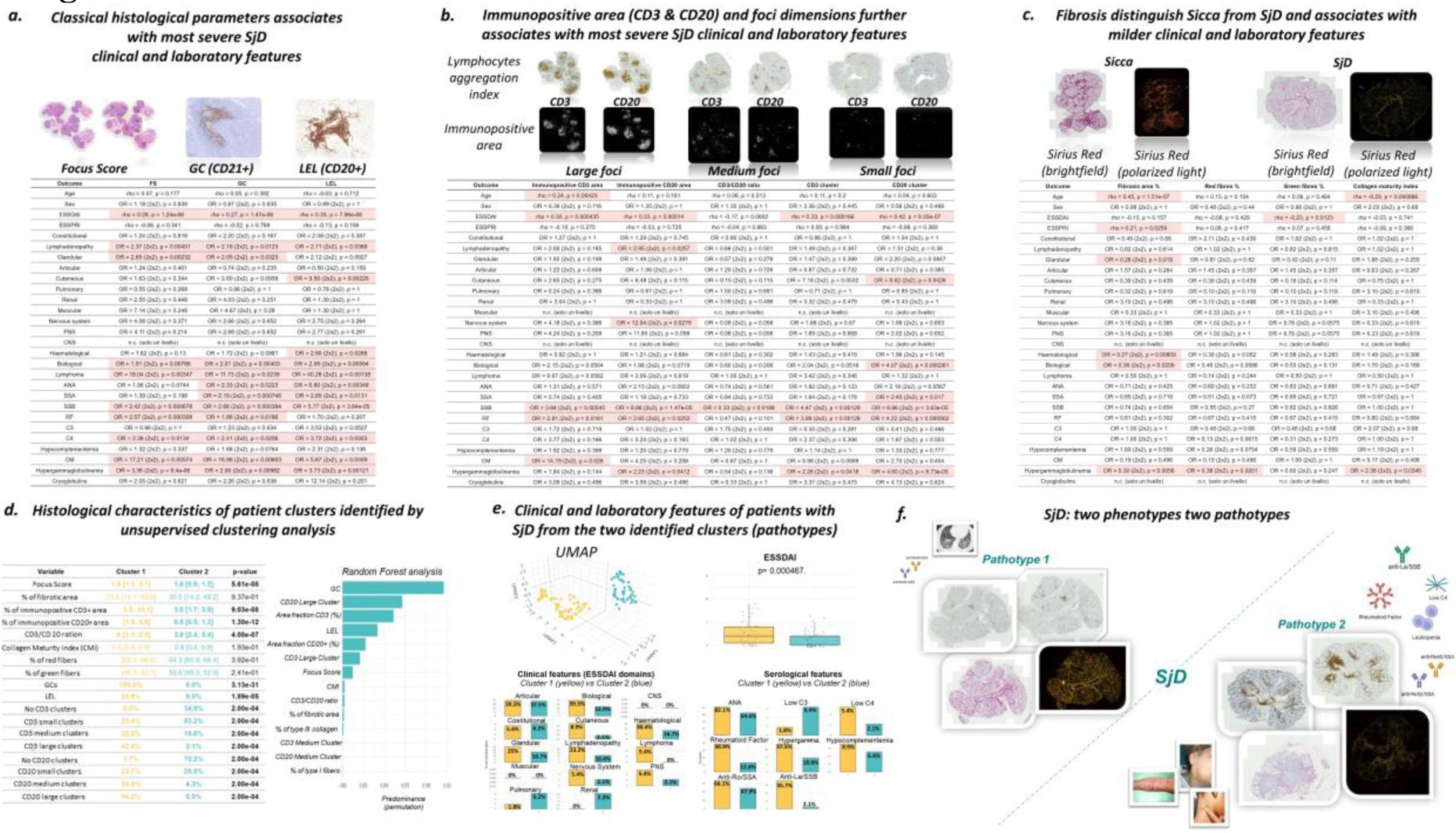
Results: Classical histological parameters (FS, GC, and LEL) showed significant associations with markers of disease severity, including systemic involvement and serological activity (Figure 1a). Quantitative digital pathology features further strengthened these associations: increased CD3 + and CD20 + immunopositive areas, larger lymphocytic aggregates, and a B-cell-enriched profile correlated with more severe clinical and laboratory phenotypes (Figure 1b). Fibrosis analysis revealed a higher fibrotic area fraction in sicca controls compared with SjD (p<0.0001), while within SjD fibrosis was inversely associated with severity, identifying a SjD phenotype linked to milder disease features (lower prevalence of glandular, haematological and biological domains) (Figure 1c). Unsupervised clustering based solely on histological variables successfully identified two distinct patient clusters, a result that could not be achieved using classical histological parameters alone. Random forest analysis highlighted the most the most discriminative variables in GC, presence of CD20+ large cluster and percentage of immunopositive CD3+ area (Figure 1d). These clusters corresponded to two distinct clinical-immunological pathotypes: a B-cell–enriched pathotype, marked by dense, highly aggregated infiltrates, B-cell predominance, autoantibody positivity, and higher systemic disease activity (Cluster 1); a pauci-immune pathotype, characterized by limited lymphocytic infiltration, higher fibrosis, and milder disease (Cluster 2) (Figure 1e,f).
Conclusions: This study demonstrates that quantitative salivary gland histology, enabled by digital image analysis, provides critical information beyond traditional FS and GC assessment. By integrating immune infiltrate composition, spatial organization, and fibrosis features, we identify for the first time two distinct histology-driven pathotypes in SjD: “pauci-immune” and “B-cell-enriched” associated with divergent clinical and immunological phenotypes respectively. These findings establish salivary gland histology as a powerful stratification tool and support its role in advancing precision medicine approaches in SjD.
REFERENCES: NIL.
Acknowledgments: NIL.
Disclosure of Interests: Serena Colafrancesco Novartis, Sobi, Novartis, Sobi, Eli Lilly, Edoardo Simoncelli: None declared, Elena Pontarini: None declared, Nicolò Foroni: None declared, Mohamed Hamed Abdelaziz Hegazi: None declared, Giulia Cavallaro: None declared, Elena Sciacca: None declared, martina villa: None declared, Ilaria Pace: None declared, Bruna Cerbelli: None declared, Maria Gemma Pignataro: None declared, Chiara Baldini: None declared, Valentina Donati: None declared, Onorina Berardicurti: None declared, Annalisa Marino: None declared, Fabio Pasqualini: None declared, Carlo Francesco Selmi: None declared, Elisa Gremese: None declared, Fabio Grizzi: None declared, Roberto Giacomelli: None declared, Fabrizio Conti: None declared, Costantino Pitzalis: None declared, Michele Bombardieri: None declared, Roberta Priori: None declared.