fetching data ... 
Background: Sjögren’s disease (SjD) is a systemic, heterogeneous, autoimmune disease with substantial disease burden, high unmet need and no approved systemic treatments. B cell hyperactivity and dysregulated B cell-activating factor/receptor (BAFF/BAFF-R) signalling are hallmarks of SjD pathogenesis. SjD is characterised by the infiltration of immune cells in exocrine glands, notably in the salivary glands (SG), as focal dense aggregates of B and T cells around ducts known as foci. Ianalumab, an investigational fully human immunoglobulin G1 monoclonal antibody with a novel dual mechanism of action, depletes B cells through enhanced antibody-dependent cellular cytotoxicity and also inhibits their function and survival via BAFF-R blockade. Ianalumab 300 mg delivered subcutaneously (s.c.) monthly resulted in a clinically meaningful benefit in the global NEPTUNUS-1 and NEPTUNUS-2 Phase 3 trials, showing both improvement in disease activity and reduction in patient burden.
Objectives: The purpose of this mechanistic biopsy-based study is to better understand the mechanism of action of ianalumab on B cells in blood and labial SG tissue of patients with SjD.
Methods: This is an open-label, single-centre, non-randomised, Phase 2 mechanistic study (NCT05124925) with a 5-week screening period, a 6-month treatment period and a follow-up period of up to 2 years after the last dose. Eligible participants fulfilled the 2016 American College of Rheumatology/European Alliance of Associations for Rheumatology (EULAR) classification criteria for SjD with anti-Ro/Sjögren’s syndrome antigen A (SSA) autoantibodies, EULAR Sjögren’s Syndrome Patient Reported Index (ESSPRI) score of ≥5, labial SG focus score (FS) of ≥0.3/4 mm 2 , and B/B+T cell ratio of ≥0.2 at screening. This analysis reports the results of participants who completed the 24-week treatment period (ianalumab 300 mg s.c. monthly). The primary outcome was change in labial SG B/B+T cell ratio from baseline (BL) to Week 25. Other outcomes included the number and phenotype of circulating B cells and B cells in labial SG tissue by mass cytometry (MC) and single-cell RNA sequencing (scRNA-seq) of circulating immune cells, labial SG histologic parameters, imaging MC as well as clinical evaluations, safety and tolerability. Boxplot and spaghetti plots were used for visualizing B cell counts by MC parameters, B cell density by immunohistochemistry and proportions of CXCR5+ CD20+ B cells, and also descriptive statistics such as median, minimum and maximum, geometric mean, percent coefficient of variation and the percent of B cells below the lower limit of quantification were calculated. ScRNA-seq data was pre-processed using the scanpy and scVI packages, among others. Pseudobulk differential gene expression analysis in naïve B cells was conducted using the limma trend method. Correlation analyses were performed using the Spearman method.
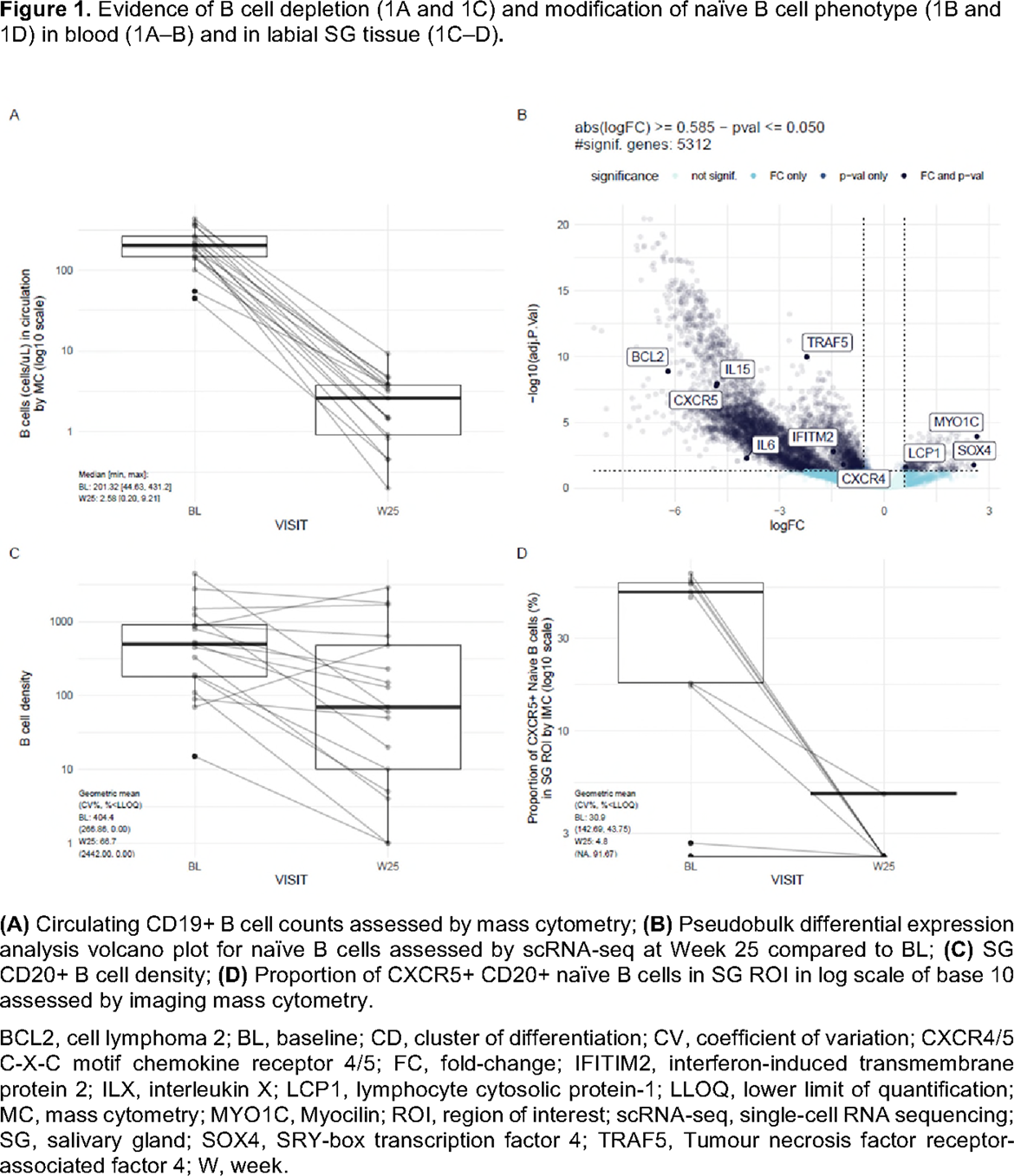
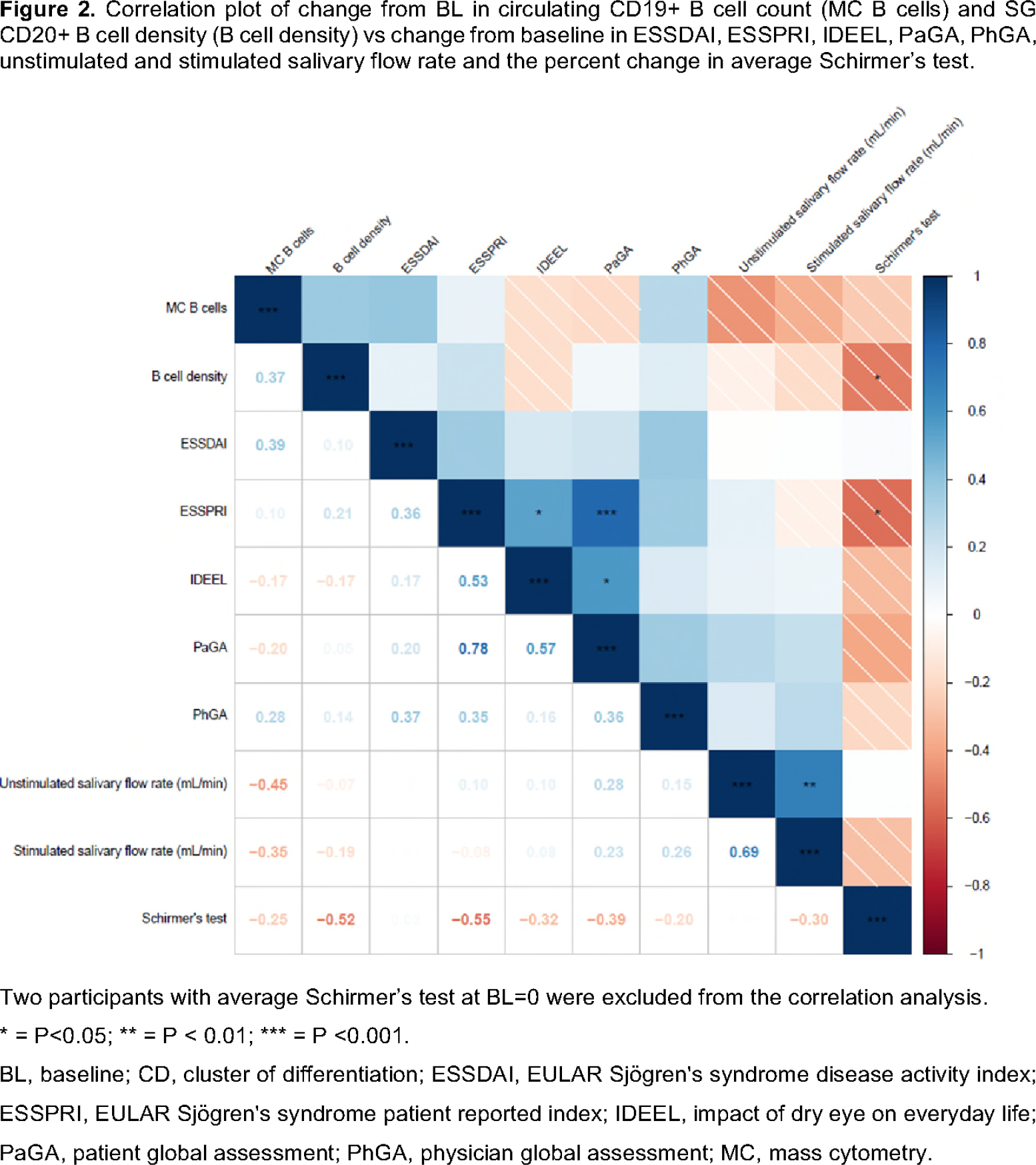
Results: This primary interim analysis was performed after all participants had received all six doses and underwent post-treatment biopsy at Week 25 or discontinued treatment earlier. Seventeen participants, out of 21 treated with ianalumab, completed 24-week open-label treatment, underwent paired screening and Week 25 labial SG biopsies were analysed. The baseline disease characteristics were as follows: mean (SD) EULAR Sjögren’s syndrome disease activity index (ESSDAI) 8.05 (4.43); ESSPRI 7.02 (1.35); FS 2.72/4 mm 2 (4.08); B/B+T cell ratio 0.52 (0.11). After 24 weeks of treatment with ianalumab 300 mg s.c. monthly, the total CD19+ B cell counts in blood decreased by 99% versus BL (Figure 1A). Depletion was observed across all B cell subsets, and was almost complete in most of them, namely transitional, naïve, unswitched and switched memory B cells, and to a lower extent in double negative effector memory B cells 3 (89.5%) and plasmablasts (69.5%) [1]. Gene expression analysis revealed downregulation of B cell proliferation, activation, chemotaxis/cell migration and NF-kB-related genes, and upregulation of genes with roles in B cell development and cytoskeleton arrangement in the remaining circulating naïve B cells present at Week 25 versus BL (Figure 1B ). Similarly, in the labial SG biopsy, the extent of inflammatory infiltrate composed of B and T cells diminished at Week 25 versus BL, with a statistically significant reduction of the B/B+T cell ratio by 41% (80% confidence interval [CI]: 22, 55) [1] and a reduction of the B cell density by 84% (80% CI: 68, 91) at Week 25 versus BL (Figure 1C ). In the region of interest (ROI) centred on a focus, the density of CD20+ B cells decreased at Week 25 compared to BL (not shown). In addition, the proportion of CXCR5 CD20+ naïve B cells, known to be drawn to tertiary lymphoid structures in SG, decreased at Week 25 compared to BL ( Figure 1D ). Physician- and patient-reported outcomes improved numerically at Week 25 compared to BL [1]. Post-hoc analyses showed correlations between the reduction in circulating CD19+ B cells and increases in unstimulated salivary flow rate at Week 25 (r=–0.45; p=not significant) (Figure 2 ). Correlations were observed between the reduction in CD20+ B cell density in SG and the increase in the average Schirmer’s test at W25 (r=–0.52; p<0.05). In the safety analysis set (N=21), ianalumab was well tolerated with no drug-related serious adverse events and one adverse event leading to discontinuation (data cut-off: 26 June 2024).
Conclusions: Treatment with ianalumab 300 mg s.c. monthly reduced B cells in circulation and labial SG tissue and modified the phenotype of the remaining B cells. Notably, reduction in B cell density in tissue correlated with an improvement in the Schirmer’s test. These results shed new light on the relevance of the dual mechanism of action of ianalumab and the interaction of BAFF-R-blockade and CXCR5+ B cells in the pathogenesis of SjD.
REFERENCES: [1] Cornec D, et al. Arthritis Rheumatol. 2025; 77 (supp 9); abstract:2296. DOI:10.1002/art.43421.
Acknowledgments: NIL.
Disclosure of Interests: Divi Cornec GSK, Servier, BMS, Roche-Chugai, CSL Behring, Astra-Zeneca, Sanofi, Rainer Hillenbrand Novartis, Novartis, Patrice Hémon: None declared, Marion Le Rochais: None declared, Diego Saldana Miranda Novartis, Novartis, Aida Santos da Costa Novartis, Novartis, Marie Frutoso: None declared, CRISTIAN IPERI: None declared, Céline CAO: None declared, Christelle Le Dantec: None declared, Ulrike Sommer Novartis, Novartis, Tala Shekarian Novartis, Arnaud Uguen: None declared, Christophe Jamin: None declared, Patricia Baley: None declared, Caroline Denis: None declared, Dewi Guellec: None declared, Alice Tison Bristol-Myers Squibb, Sandoz, Galapagos, Daniel Strasser Novartis, Novartis, Sandrine Jousse-Joulin: None declared, Shuqi Chen Novartis, Novartis, Noemi Giglioli Novartis, Novartis, Carole Sips Novartis, Novartis, Isabelle Isnardi Novartis, Novartis, Sumanta Barman Novartis, Enrico Ferrero Novartis, GSK, Novartis, GSK, Nils Eling Novartis, Novartis, Grazyna Wieczorek Novartis, Sandoz, Novartis Pharma AG, Alain Saraux Abbvie, BMS, Galapagos, Lilly, Novartis, Pfizer, Roche Chugai, UCB, Abbvie, BMS, Lilly, Fresenius Kabi, Richard Siegel Novartis, Sandoz, Novartis, Wolfgang Hueber Novartis, Novartis, Sophie Hillion: None declared, Valerie Devauchelle-Pensec Novartis, Abbvie, alphasigma, Novartis, abbvie, Claire Bonal Novartis Pharma AG, Novartis Pharma AG.