fetching data ... 
Background: In rheumatoid arthritis (RA), T cells develop insulin resistance which protects them from senescence and elimination. Oncoprotein survivin modulates glucose metabolism through chromatin binding, which propagates proliferation and IFNγ effects in CD4 + cells.
Objectives: In this study, we investigated how insulin addition influenced epigenetic and metabolic activity in CD4 + T cells of RA patients and explored how anti-rheumatic drugs affect insulin responsiveness.
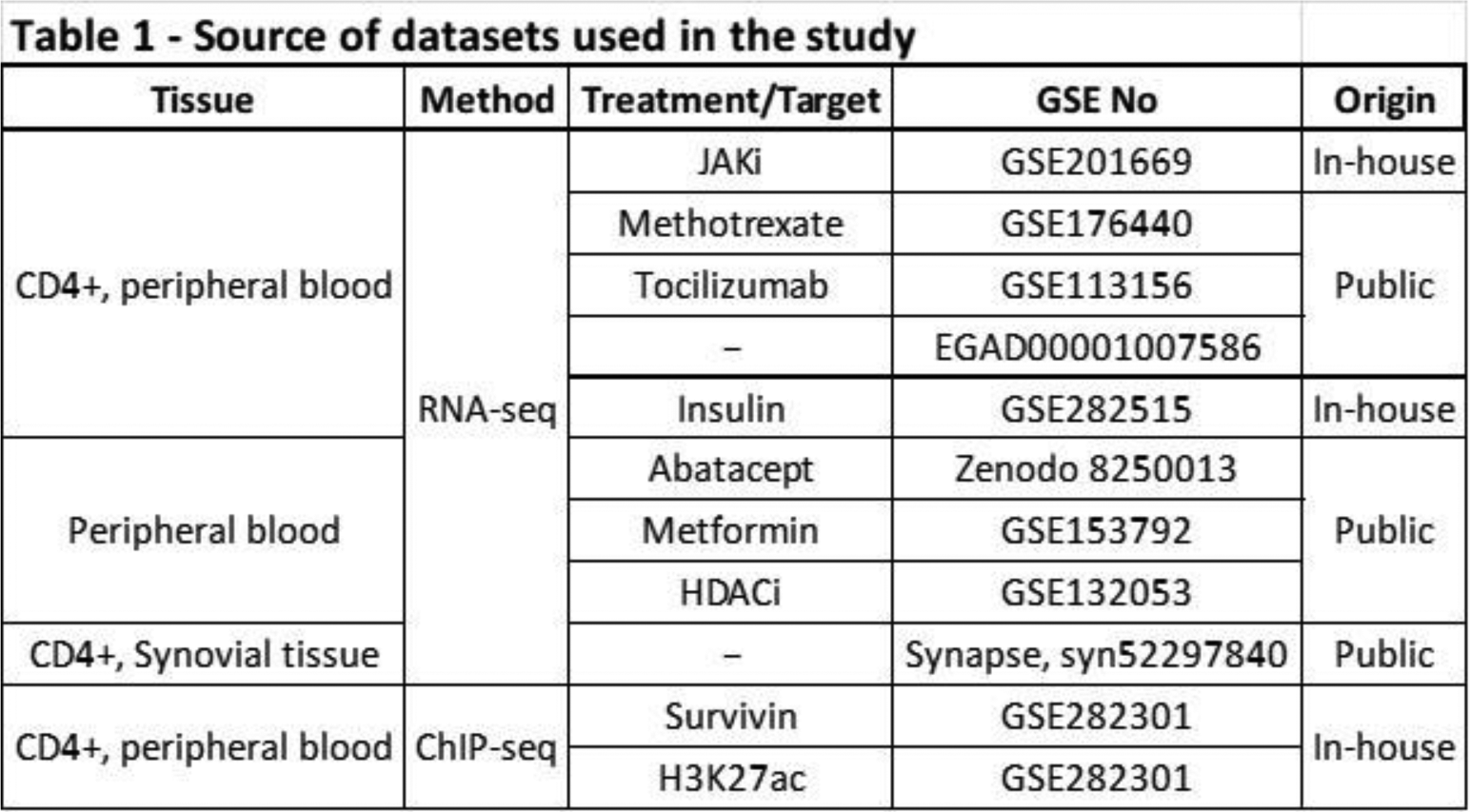
Methods: We treated CD4 + cell cultures with insulin and histone deacetylase inhibitors (HDACi) and investigated functional effects on the phenotype of CD4 + cells using flow cytometry and gene transcription. Through chromatin immunoprecipitation and sequencing, we identified the genes controlled by deposition of survivin and acetylated lysine 27 on histone H3 (H3K27ac) in CD4 + cells and retrieved the insulin-dependent subset of genes obtained either by direct insulin stimulation or through linear regression analysis of CD4 + cell transcriptome to serum insulin levels. Using genes characterizing the metabolic pathways of glycolysis (GO:0006096), pentose phosphate pathway (GO:0006098), tricarboxylic acid cycle (TCA, GO:0006099), oxidative phosphorylation (GO:0022900 and GO:0006119), we profiled the metabolic activity of CD4 + T cell clusters found through single-cell transcriptomic analysis in blood, synovial fluid and synovial tissue (ST) of RA patients. Changes in metabolic activity were investigated using transcriptome of CD4 + cells of RA patients treated (n=34) and not-treated (n=24) with JAK-inhibitors, and paired CD4 + cells of RA patients before and after treatment with methotrexate (MTX, n=28, 3m), tocilizumab (TOCI, n=6, 6m), abatacept (ABA, n=22, 3m). Source of the data sets is indicated in Table 1.
Results: Leukocytes treated with insulin and HDACi significantly increased H3K27 acetylation in the nuclei of CD4 + T cells. Insulin/HDACi treatment inhibited IFNγ production and surface expression of PDCD1, and significantly increased subset of CD27 + CD45RO + memory T cells. Further, insulin stimulation increased protein production of IL7, and gene expression of IL7 , IL7R , CD27 , and BCL2 by CD4 + cells. Chromatin immunoprecipitation analysis revealed the co-accumulation of H3K27ac and survivin in 2452 genomic sites in the CD4 + T cells. Majority (68%) of these regions were present within cis-regulatory elements (cis-RE), potentially regulating transcription of 4452 genes connected to these elements. Among those, 585 genes were responsive to insulin. These insulin-responsive genes showed enrichment in the pathways of chromatin remodelling (p=1.56e -8 ; GO:0006338), regulation of cell cycle (p=1.17e -3 ; GO:0051726), and positive regulation of cytokine production (p=2.5e -4 ; GO:0001819). Notably, survivin-H3K27ac deposition transcriptionally controlled major HAT complex genes (GO:0000123; 35/95 genes) including EP300 , CREBBP (EP300 complex), BRPF3 , JADE2 (MOZ-MORF complex) and were significantly differentially regulated by both increasing serum insulin levels and treatment with HDACi. In contrast, genes of HDAC complexes (GO:0000118) were affected only by HDACi. Transcription of genes involved in glucose metabolism displayed a tight correlation to HDAC activity, which was partly reversible by treatment with HDACi. Among the genes regulating metabolic pathways, survivin-H3K27ac deposition in cis-RE controlled more than 15% of the genes, with the highest observed in glycolysis (34/97), followed by TCA cycle (7/34), pentose phosphate pathway (4/20) and oxidative phosphorylation (34/176) pathways. High expression of the insulin signaling mediators INSR , IRS1 , IRS2 demarcated the metabolically active CD4 + cells in blood and synovial tissue of RA patients. These cells had high expression of survivin ( BIRC5 ) and showed enrichment in the PDCD1 + CXCL13 + Tph, PTTG1 + TUBA1B + proliferating, CD4 + GNLY + GZMB + CD45RO neg , CD4 + GZMK + , and Vdelta1 and Vdelta2 T cell clusters. Both MTX and JAKi upregulated the genes of insulin signaling contributing to activation of metabolic pathways and HAT/HDAC enzymes, which was not found in ABA and TOCI treated patients. MTX and JAKi enabled insulin responsiveness by inhibiting histone methylation genes EZH2 , KMT2A and PRKDC in RA patients. Anti-rheumatic drugs had only a limited effect on the metabolism genes, in contrast to metformin which significantly suppressed the metabolic genes. MTX and JAKi increased, while ABA inhibited, the genes of oxidative phosphorylation, required for memory T cell development. JAKi activated glycolysis, pentose phosphate pathway and HDAC genes. TOCI suppressed transcription of glycolysis genes. Anti-rheumatic drugs had diverse effect on the specific markers of metabolically active clusters. MTX suppressed Tph markers PDCD1 , CXCL13 , ZNRF1 , and had no significant effect on other clusters. ABA and TOCI activated transcription of Vdelta 1 + 2 and GLNY + CD4 + clusters by increasing transcription of GNLY , GZMB , NKG7 , KLRD1 . ABA suppressed proliferating cell cluster, while promoting the memory IL7R + signaling genes CD27 , IL7R , FOXO1 , CD27 , and BCL2 . MTX and JAKi mirrored insulin-dependent immune modulation by suppressing check-point receptors PDCD1 , TIGIT , and HAVCR2 , and activating transcription of the memory genes CD27 , CCR7 , and IL23A .
Conclusions: Insulin and inhibition of HDAC facilitate a transition of the PD1 + peripheral T helper cells to the IL7R + memory T phenotype thereby minimizing inflammation. Genome co-deposition of survivin-H3K27ac controls chromatin remodeling and glucose metabolism in CD4 + T cells. Anti-rheumatic drugs guide insulin responsiveness and change transcriptome of the metabolically active BIRC5 hi CD4 + T cell clusters. The improved insulin responsiveness could stop trafficking of these pathogenic cells to synovia preventing development of arthritis.
REFERENCES: NIL.
Acknowledgments: NIL.
Disclosure of Interests: None declared.